The AI agent industry is rapidly evolving, but the real impact of these agents (and how much we can trust them) depends on a thorough evaluation. Let’s start by exploring an AI agent definition: software systems that use artificial intelligence to autonomously perform tasks and interact with other agents to accomplish complex, compound objectives.
AI agent evaluation involves assessing an AI agent’s effectiveness, reliability, safety, and performance in real-world situations. Unlike conventional software, AI agents present unique challenges. These include new and unexpected behaviors, outputs that we can’t predict, and security issues. Therefore, agent evaluation is crucial for reducing risks. Our guide offers a concise overview of key AI agent evaluation metrics and practical methods for accurately assessing agent performance.
Why AI Agent Evaluation Matters
Untested or poorly evaluated AI agents can cause significant problems for any business. Think of financial losses from wrong answers, a damaged reputation from unfair actions, or even data leaks in automated systems.
As companies move beyond simple chat-based implementations into more advanced frameworks that emphasize multi-agent collaboration and more autonomous capabilities, the need for reliable AI agent evaluation methods is only increasing. Businesses must recognize the crucial aspects worth their consideration:
- Performance Assurance: Ensures agents accomplish their tasks efficiently and correctly. According to LangChain’ Survey, 41% of technology leaders view performance quality as a top concern.
- Safety and Reliability: Detects harmful or unintended behaviors. Data privacy indeed presents a challenge, with related concerns expressed by 53% of respondents in another study.
- User Trust: Establishes confidence through transparency and explainability.
- Ethical Alignment: Verifies adherence to ethical guidelines and privacy.
- Regulatory Compliance: Ensures agents meet relevant legal and regulatory requirements.
- Continuous Improvement: Identifies areas for iterative enhancements.
By regularly evaluating AI agents and checking your agent performance, you get clear proof that your AI solutions are reliable, effective, and ready for real-world use.
Key Metrics for AI Agent Evaluation
Measuring agent performance involves looking at many different aspects. There isn’t just one score that tells the whole story. Instead, we use several important AI agent evaluation metrics to get a full picture of how well an AI agent is performing.
Performance & Efficiency Metrics
These metrics focus on how quickly and efficiently an AI agent completes its tasks, as well as the resources it utilizes.
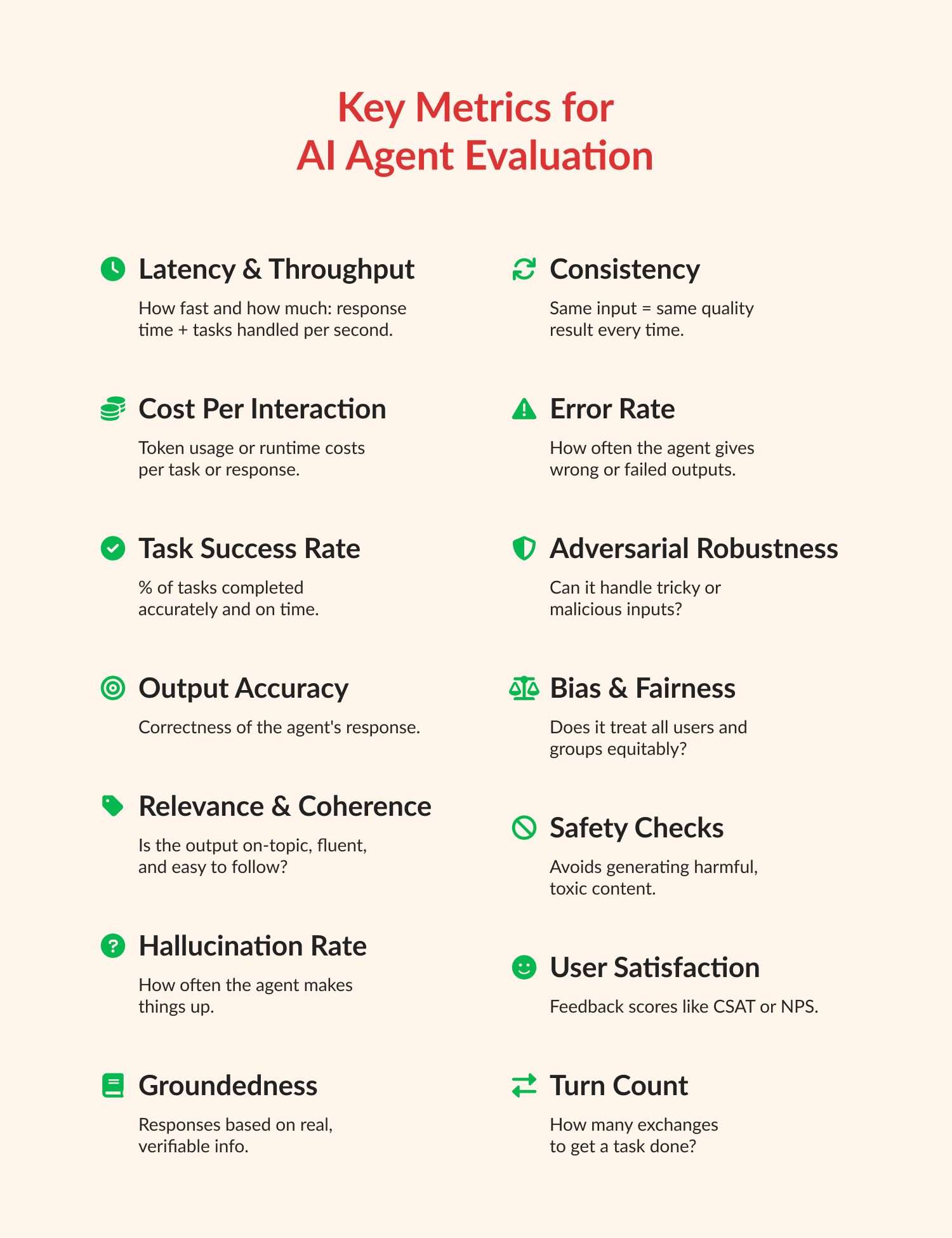
- Latency/Response Time: This refers to the speed at which the agent responds to a request or completes a task. Lower times mean a more responsive agent, which is vital for a good user experience.
- Throughput: This measures the number of tasks or requests an agent can handle within a specified time frame. Higher throughput means the agent can manage more work.
- Cost-per-Interaction/Token Usage: This examines the operational cost associated with each task or interaction. For LLM-powered agents, this often includes the number of “tokens” (parts of words) processed, as this affects billing and resource consumption.
- Success Rate/Task Completion: This refers to the percentage of tasks that the agent completes within the expected timeframe. It directly shows if the agent is achieving its goals.
Output Quality & Accuracy Metrics
These metrics assess the quality, accuracy, and clarity of the agent’s generated content or actions.
- Accuracy: This measures how closely the agent’s output aligns with the correct answer or the desired outcome. It’s about getting things right.
- Relevance: This checks if the agent’s response is truly related and useful to the user’s question or task.
- Coherence & Fluency: For agents that generate text, this assesses how natural, logical, and grammatically correct their responses sound.
- Hallucination Rate: This is a crucial metric for LLMs. It measures how often the agent creates information that is factually incorrect or fabricated. You can find more about combatting AI hallucinations at Capitol Technology University.
- Groundedness: This checks whether the agent’s responses are based on real, verifiable information, primarily when they draw from specific knowledge sources (common in RAG systems).
Robustness & Reliability Metrics
These metrics help us understand how stable and consistent an AI agent is, even when faced with challenging or unexpected situations.
- Consistency: This means the agent provides similar, correct answers when given the same or very similar questions multiple times.
- Error Rate: This metric indicates the frequency at which the agent makes mistakes or fails to respond correctly. A lower error rate is better.
- Resilience to Adversarial Attacks: This measurement tests how well the agent can handle inputs designed to trick it or cause it to fail intentionally. It’s about security and stability.
Safety & Ethical Metrics
These metrics are vital for ensuring AI agents are used responsibly and do not cause harm.
- Bias Detection: It identifies if the agent’s outputs show unfair treatment towards different groups of people (based on gender, race, or age).
- Harmful Content Generation: This measures the frequency with which the agent generates toxic, offensive, or inappropriate content.
- Fairness Metrics: These are measurable methods for evaluating whether the agent treats everyone equally and ethically.
User Experience Metrics
While sometimes harder to measure, user experience is crucial to how people feel about and interact with the AI agent.
- User Satisfaction Scores (e.g., CSAT, NPS): These scores are derived from direct user feedback regarding their satisfaction with the agent’s performance.
- Turn Count: This metric measures the number of messages or turns it takes for the agent to complete a user’s request. Fewer turns usually mean a smoother experience.
AI Agent Evaluation Checklist
How to Evaluate AI Agents: Methods & Frameworks
To effectively evaluate AI agents, a clear and structured approach is necessary. This approach isn’t just about running tests; it’s about building a robust AI agent evaluation framework that helps you understand and improve your AI’s capabilities. It requires going through key software testing phases.
Defining Objectives & Criteria
First, clearly define what you want your AI agent to achieve. What are its primary tasks? How will you know if it’s successful? Setting clear AI agent evaluation criteria at the start helps guide the entire evaluation process. These initial definitions are crucial because they dictate which AI agent evaluation metrics are most relevant and how success will be measured, ensuring your efforts are focused and meaningful.
For instance, if your AI agent is a customer service bot, a core objective might be to “resolve 85% of common user queries without human intervention.” This objective immediately highlights key metrics such as “success rate” and “conversational efficiency.” Without such precise goals, evaluating the agent becomes a vague exercise, making it difficult to pinpoint areas for improvement or confidently claim its value to the business.
Curating Diverse Test Data & Cases
Next, gather a wide range of test data. It should include scenarios that are common in the real world, as well as tricky “edge cases” or inputs designed to challenge the agent (adversarial examples). Creating specific prompts or interactions tailored to these diverse conditions helps stress-test the agent’s capabilities beyond typical use, revealing how robust and reliable it truly is under varied circumstances.
Insufficient data diversity can lead to glaring failures in deployment. For example, an AI agent trained solely on perfectly phrased, formal text may struggle to comprehend real user queries that include slang, misspellings, or ambiguous language. Similarly, suppose a visual AI agent is trained solely on images taken under perfect lighting conditions. In that case, it may fail in low-light conditions, leading to unexpected behaviors and poor agent performance in the real world.
Choosing Evaluation Strategies
There are different ways to run your evaluations, and often, a mix works best:
- Automated Benchmarks & Testing: This approach is fast and consistent. You run the agent through many tasks, and computers automatically record metrics. This is great for checking things like accuracy or how fast it responds (e.g., using rule-based checks or other models to score outputs).
- Human-in-the-Loop Assessments: For things that computers can’t easily judge—like tone, creativity, or how natural a conversation feels—you’ll need human reviewers. Methods include having people rank different responses or rate them on a scale. “Red teaming,” where security experts attempt to compromise the agent’s security, is also part of this process.
- Hybrid Approaches: Don’t think of your options as just manual vs. automated testing for AI agents: the most effective strategy often combines both automated tests for speed and scale, with targeted human review for deeper insights and nuanced judgments.
Ensuring Reproducibility
It’s vital that your evaluations can be repeated while still producing the same results. This means controlling variables, like using fixed “random seeds,” and carefully documenting how your agent and tests are set up. Reproducible evaluations help you compare different versions of your agent fairly, allowing you to confidently attribute performance changes to specific improvements or regressions in your AI model.
The non-deterministic nature of many generative AI systems, particularly those utilizing LLMs, poses a significant challenge to reproducibility. However, by meticulously logging all parameters, inputs, and environment configurations, you can create a reliable baseline. This baseline will ensure that when you observe a shift in agent performance, you can confidently identify whether it’s due to a code change, a model update, or an external factor. You’ll end up worrying less about whether performance shifts are due to random variations, making the AI agent evaluation process transparent and trustworthy.
Iterating Process
Evaluation is not a one-time thing. It’s a continuous cycle:
- Run your tests.
- Collect and quantify the results using your chosen metrics.
- Look closely at what the results tell you about your agent’s strengths and weaknesses.
- Use these insights to make improvements to your agent’s model, its prompts, or its overall design.
This constant loop is crucial to improving your AI agent over time.
Best Practices for Effective AI Agent Evaluation
To get the most out of your AI agent evaluation efforts, follow these practical guidelines. They will help ensure your assessments are informative and actionable, leading to real improvements in agent performance.
- Define Clear Success Criteria: Before you start testing, be very clear about what “success” looks like for your AI agent. What specific goals should it achieve? Setting these targets helps you design focused evaluations.
- Track Multiple Metrics and Balance Them: Avoid focusing solely on a single performance metric. Instead, measure various AI agent evaluation metrics (such as speed, accuracy, and user satisfaction) simultaneously. This provides a balanced view and helps you make more informed decisions.
- Use Baselines and Comparisons: Always compare your agent’s current performance against a starting point (baseline) or previous versions. It helps you determine if your changes are improving or worsening the agent’s performance.
- Automate Evaluation in the Development Workflow: Integrate your evaluations into your regular development process, especially within your CI/CD (Continuous Integration/Continuous Deployment) pipelines. This way, tests run automatically with every new change, catching issues early.
- Log Detailed Data for Debugging: When your agent doesn’t perform as expected, having detailed logs of the evaluation process—including inputs, outputs, and intermediate steps—is crucial. This data helps you quickly find and fix problems.
- Include Human Feedback Where Appropriate: For aspects like tone, creativity, or user experience, human judgment is invaluable. Build mechanisms to gather feedback from real users or expert reviewers to get a nuanced understanding of your agent’s performance.
- Consider Robustness/Stress Tests: Intentionally challenge your agent with complex, unexpected, or even malicious inputs. These “stress tests” help ensure your agent remains stable and reliable even under the most challenging conditions.
- Document and Version Everything: Keep clear records of your evaluation setups, test scenarios, and all changes. Just like with code, versioning your evaluations ensures transparency and reproducibility.
- Iterate and Refine Continuously: Evaluation is an ongoing cycle. Use the results to guide improvements, then re-evaluate. This continuous loop ensures that your AI agent continually improves and adapts to new challenges.
By following these best practices, you can build a system for evaluating AI agents that consistently drives their improvement and ensures reliable deployment.
Real-World Examples
Understanding AI agent evaluation is easier when you see it in action across different types of AI. Here are some real-world examples showing how these principles are applied:
Customer Service Agents (Chatbots, Virtual Assistants)
- What they do: These agents handle customer inquiries, provide support, and automate routine tasks.
- How they’re evaluated: We check their speed of response, the accuracy of their answers, and overall user satisfaction (e.g., did the customer’s problem get solved quickly and correctly?). This includes examining aspects such as conversational efficiency (the number of turns required to resolve an issue).
Content Creation Agents
- What they do: These AI agents help generate text, articles, or other creative content, often tailored to specific needs or trends.
- How they’re evaluated: Key metrics include the accuracy of the generated information, its coherence (does it make sense and flow well?), and its engagement (does it hold the reader’s attention or achieve its purpose?). We also check for hallucinations and groundedness to determine if they are drawing from reliable sources.
Gaming AI/Strategy Agents
- What they do: AI in games, like advanced opponents (e.g., AlphaGo), learn strategies and make decisions to compete against players.
- How they’re evaluated: We assess their adaptability (how well they learn new strategies), their strategic thinking (can they plan complex moves?), and their ability to learn over time to improve their performance against human players or other AI.
Online Purchase/Workflow Automation Agents
- What they do: These agents automate steps in processes like online shopping, data entry, or other business workflows, often interacting with various tools.
- How they’re evaluated: Crucial checks include tool call accuracy (does the agent pick and use the right external tools?), path efficiency (does it take the shortest, most logical steps to complete a task?), and parameter handling (does it correctly pass information between steps or to tools?).
These examples highlight that effective AI agent evaluation is always tailored to the specific function and context of the AI, ensuring it delivers value where it matters most.
Summing Up
AI agent evaluation is a complex yet essential step in building reliable, efficient, and ethical AI. Combining diverse AI agent evaluation metrics with robust AI agent evaluation methods is key to truly understanding and optimizing your AI agent’s capabilities. This continuous process of evaluation and refinement ensures agents remain effective, coherent, and trustworthy as they adapt to real-world challenges.
At QAwerk, our specialized QA team delivers comprehensive AI agent testing services. We ensure your AI agents are reliable, perform optimally, and adhere to ethical guidelines. We provide the expertise needed to confidently harness AI, driving business growth and effectively reducing associated risks. To ensure your AI agents are of high quality and used responsibly, contact our experts today for a consultation.
FAQ
What is AI Agent Evaluation?
AI agent evaluation is the systematic process of assessing an AI agent’s performance, reliability, safety, and adherence to desired behaviors. It ensures that the agent functions effectively and ethically in real-world scenarios.
How to evaluate AI agents?
To evaluate AI agents, you define clear objectives, prepare diverse test data, and use various evaluation strategies. These include automated benchmarks, human-in-the-loop assessments, and hybrid approaches. The process involves continuously measuring metrics, analyzing results, and refining the agent.
How do you measure the performance of an agent in AI?
You measure the performance of an agent in AI by using a range of AI agent evaluation metrics. These cover aspects such as task completion rate, accuracy, response time, resource utilization, output quality, robustness, and user satisfaction.
What are the metrics of evaluation of AI agents?
Key metrics for evaluating AI agents include Latency, Throughput, Cost-per-Interaction, Success Rate, Accuracy, Hallucination Rate, Consistency, Error Rate, Bias Detection, and User Satisfaction Scores.
What are some common challenges in AI agent evaluation?
Some common challenges in AI agent evaluation include defining a clear “ground truth” for subjective outputs, managing the agent’s new or unexpected behaviors, the cost and scalability of comprehensive human evaluation, and addressing potential biases within the evaluation data itself.
Learn about how we tested an AI digital growth solution, increasing regression-testing speed by 50%