The gaming market keeps getting larger and harder to launch into. Newzoo’s 2026 PC & Console Gaming Report puts PC and console software at $88.3B in 2025 and $103.7B by 2028, with development costs climbing and franchises no longer guaranteed to land. Mobile adds another $107B on top. More platforms, more device fragmentation, more scrutiny per release.
That’s the pressure that pushes studios toward external QA. Build cadence tightens, testers get pulled into design, and one certification miss can slip a release by a quarter. This piece is a decision guide covering when to hand off QA, how to scope the engagement, which engagement model to pick, and what to look for in a partner. Studios already at the shortlist stage often work from a curated view of the top game testing companies before running pilots. If your priority right now is validating that mechanics, menus, and progression actually work under player load, our functional game testing services page walks through the full scope.
Should You Outsource Game Testing?
Hand off QA when internal capacity can’t match the scope, cadence, or platform mix your release plan demands. Keep it in-house when the game is small-scope, single-platform, and testers need daily elbow-time with designers during rapid prototyping.
Five signals that outsourcing is the right call:
- Build cadence outpaces regression coverage, and testers are logging bugs from two releases ago.
- The game is launching on three or more platforms, and you don’t have real-device lab access.
- Live ops or patch cycles need continuous coverage that no full-timer can sustain without burnout.
- A soft launch or console certification deadline is under 90 days, and QA headcount is short.
- You need a specialist (load, security, localization, compliance) for one project, not a permanent hire.
The counter-case matters too. Two-person indie teams shipping a narrative game to Steam rarely benefit from external QA until the scope grows. Prototypes where features change daily are also better served in-house. Everywhere else, the math starts favoring external help fast.
In-House vs Outsourced Game QA: What Each Is Actually Good at
Framing this as a pros-and-cons list misses the point. Each model wins at different things, and mature studios use both.
In-house wins at early prototyping, design-tight feedback loops where a tester can walk over to a level designer, and IP-sensitive projects where fewer parties reduce leak risk. It also wins when a small team already collaborates closely, and adding an outside vendor introduces more coordination cost than benefit.
Outsourced wins at scale-up before launch, platform coverage across device labs internal teams can’t afford, fresh-eye bug detection (internal blind spots are real after months on the same build), specialist skills on demand, and the shift from fixed to variable cost. External QA also brings pattern recognition. A tester who has seen fifty F2P mobile game spots can fix monetization flow bugs faster than a tester who has seen one.
Hybrid is what most mid-sized studios actually run. An internal QA lead owns strategy and the test plan; the external team executes coverage, regression, certification, and load testing. Most guides skip this framing. It’s the practical default and matches how our dedicated QA team model plugs into studios that already have some internal capacity.

Where Game Testing Outsourcing Fits Across the Development Lifecycle
The stage the game is in decides how much QA to hand off and what shape it should take.
Pre-alpha / prototype
Low
Nothing. Keep it internal.
Alpha
Medium
Exploratory passes, platform smoke tests, bug crawls
Beta / pre-launch
High
Regression, compatibility, load, certification prep
Launch week
High
Dedicated team for follow-the-sun coverage
Live ops
High
Retainer for patch validation, LiveOps events, and monetization checks
The pattern is straightforward. Early stages reward proximity; late stages reward scale. Load testing at the pre-launch stage is where outsourcing pays back fastest, because internal testers on laptops can’t simulate the traffic spikes a real launch brings. That’s the same window where console certification prep runs, which almost always needs specialists who’ve been through the process on Xbox, PlayStation, and Switch multiple times.
How to Scope a Game QA Outsourcing Engagement
Scoping is where most engagements succeed or fail. A vague scope produces a vague quote, and a vague quote produces a drifting project. Six components make a scope defensible.
1. Test objectives tied to release risk. Not “test the game.” Something closer to: “Verify no P0 or P1 crashes on iOS 17 across the top 20 devices before soft launch on June 10.” Measurable, dated, tied to a release decision.
2. Platforms and device matrix. Which OS versions, which device tiers, which regions? This drives roughly 40% of the cost. Lock it in before you ask for a quote; otherwise, every vendor will quote something different, and you can’t compare.
3. Test types in scope. Functional, compatibility, performance, localization, compliance, security. A single-player mobile puzzle needs the first two. A multiplayer online RPG needs all six, plus penetration testing. Our breakdown of game QA team roles covers what each role owns across dev stages.
4. Deliverables and cadence. Daily bug reports, weekly summaries, video repros for every P1, Jira or Linear integration. If it isn’t in the SOW, it won’t happen.
5. Entry and exit criteria. When does testing start (build stability threshold, smoke test pass)? When does it end (test case pass rate, no open P0 or P1 defects)? Without these, engagements never conclude cleanly, and invoices pile up.
6. Communication contract. Response SLAs, escalation paths, standups, time zone overlap. Most partner failures stem from communication gaps rather than technical ones.
One more note. Even a minimal test plan and known-issues list halve onboarding time. Vendors that ask for both before quoting are the ones worth talking to. Vendors that quote a flat rate without asking are the ones to avoid.
Engagement Models: Pick the Shape Before the Vendor
Four engagement models cover almost every real game QA arrangement. Picking the right shape matters more than picking the right vendor, because the wrong shape breaks even a strong partnership.
Bug crawl or paid pilot. A one- to two-week exploratory pass with a written report. Best for evaluating a partner before committing to anything longer. Low risk, high signal. It surfaces how the vendor writes bugs, communicates, and reads a build.
Fixed-scope milestone. Best for a pre-launch push with a hard deadline and a clear feature list. Cost is predictable. Scope creep hurts you fast, so scope has to be tight going in.
Time and materials. Best when scope is uncertain: early beta, unstable builds, or projects where feature velocity is still high. You pay for what you use, and the vendor absorbs less risk, so hourly rates are honest.
Dedicated QA team. Best for long-term partnerships, live ops, or studios running multiple projects. Predictable capacity, deep product knowledge over time, and the tester roster stays consistent enough that context doesn’t reset every sprint.
Rate reality check: offshore game QA hourly rates typically run $20–$50 depending on region and seniority. Nearshore lands are higher; the US and the UK are higher again. The real cost driver is scope, not headline rate. According to Research and Markets’ report, the outsourced testing market reached $61.13B in 2025 and is on track to reach $107.72B by 2029, at a 15.2% CAGR. Studios are moving toward external QA fast, which means partner quality varies widely.
What to Look For in a Game Testing Partner
Signals, in order of predictive power:
- Genre and platform track record. A team that has tested F2P mobile puzzles is not the same team you want for a console multiplayer shooter. Ask for cases in your genre and on your platforms. Vague answers here mean vague results later.
- Real-device labs. Emulators miss battery drain, thermal throttling, and network-edge bugs that cause ship-stopping crashes. A vendor without a device lab is testing half the game.
- Written test artifacts. Test plans, test cases, bug reports. Ask for samples. Vendors who won’t share redacted samples either don’t have them or don’t want you to see them.
- Communication cadence and tools. How often they report, what channels they use, and who your named point of contact is. If the answer is “our PM will figure it out with your PM,” push harder.
- Security posture. NDA is table stakes. Ask about access controls, secure build handling, and whether they hold ISO 27001 or an equivalent standard. A gaming IP leak before launch is unrecoverable.
- Senior testers on your project. Not a rotating pool of juniors managed by a lead you never speak to. Ask who specifically will work on the build and what their game QA experience is.
Red flags to walk away from: no genre-specific cases, no written samples, opaque team composition, and any vendor promising to start Monday without asking a single question about your build.
Ship the Game, Not the Risk
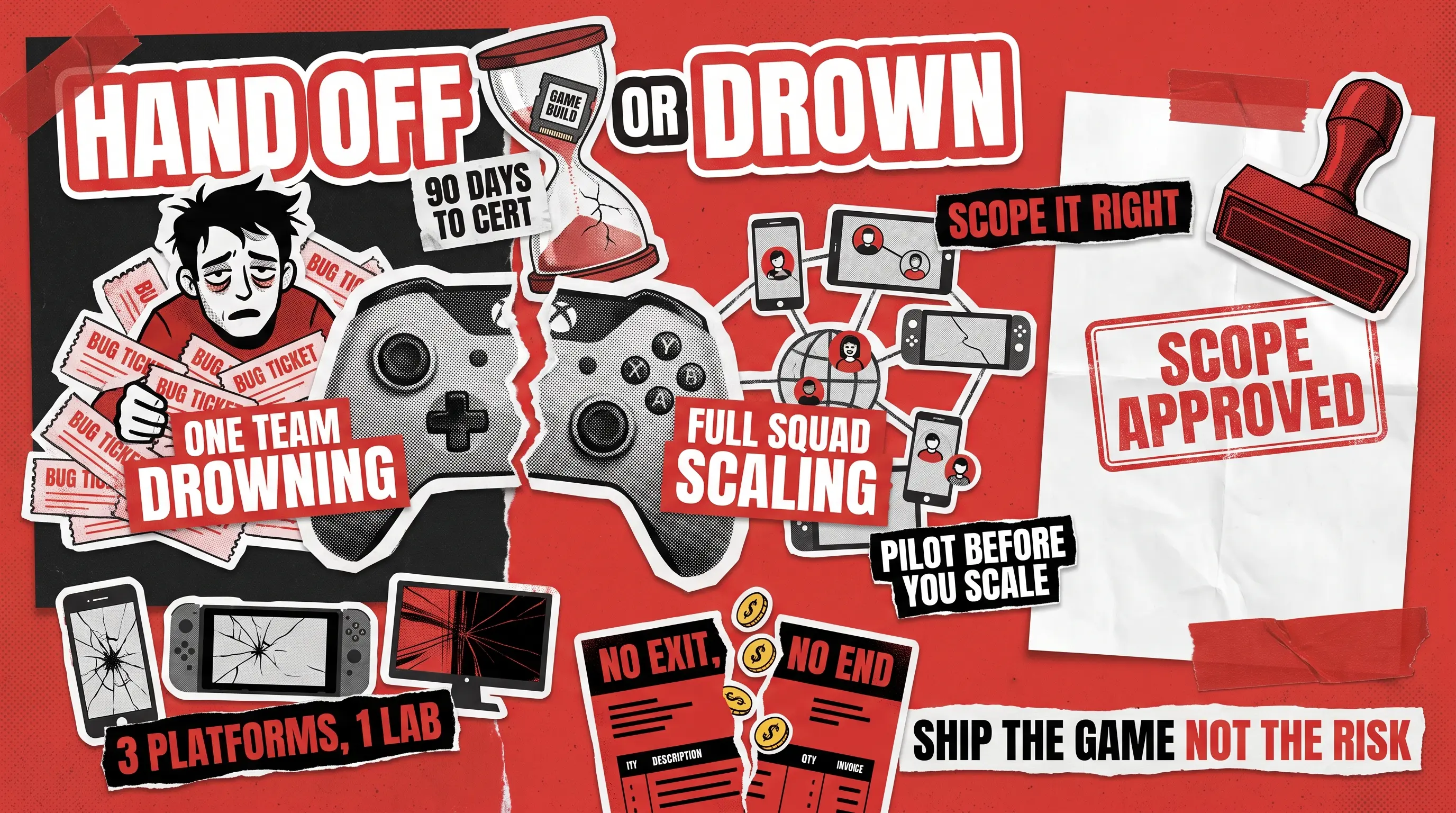
Outsourcing works when the model matches the moment. Scope tight before you shop. Pilot before you scale. Match the engagement shape to how certain you are about the scope. Pick a partner whose track record matches your genre and platforms, not one who promises the fastest start.
Studios that get this right treat QA as a strategic layer of the release plan, not a last-mile checkbox. If that’s the position you’re building toward, contact us to talk through builds, deadlines, and scope.
FAQ
How do you outsource game testing?
Define the scope first: objectives, platforms, test types, deliverables, entry and exit criteria. Pick the engagement model that aligns with your certainty about the scope. Run a paid pilot with a shortlisted vendor before signing a longer contract. Onboard with a test plan and known-issues list to shorten ramp-up. Scale from pilot to full engagement once the vendor has proven they can read your build and report cleanly.
Is outsourced game testing better than in-house?
Neither is universally better. In-house wins on prototype-stage feedback loops and IP-sensitive early work. Outsourced wins on scale, platform coverage, specialist skills, and cost flexibility. Most mid-sized studios run both: internal QA leads own strategy; external teams execute the coverage-heavy work. The right question is which mix fits your current stage, not which model is superior.
How long does game QA outsourcing take?
A bug crawl or paid pilot runs for one to two weeks. A pre-launch regression cycle for a mid-scope mobile game typically runs four to eight weeks. Console certification prep runs six to twelve weeks, depending on the platform and how clean the build is at handoff. Live ops engagements are ongoing, sized by release cadence. Onboarding takes three to five days with a test plan, closer to two weeks without one.
What types of game testing can be outsourced?
Functional, compatibility, performance, load, localization, compliance, security, and penetration testing all outsource cleanly. Exploratory and usability testing are outsourced well when the vendor understands your genre. Design-tight testing during rapid prototyping usually stays internal because feedback loops need to be immediate. In practice, everything except the earliest prototype phase can be handed off in some form.
See how we helped an indie game studio scale to large-scale gaming through outsourced load testing and server audits