
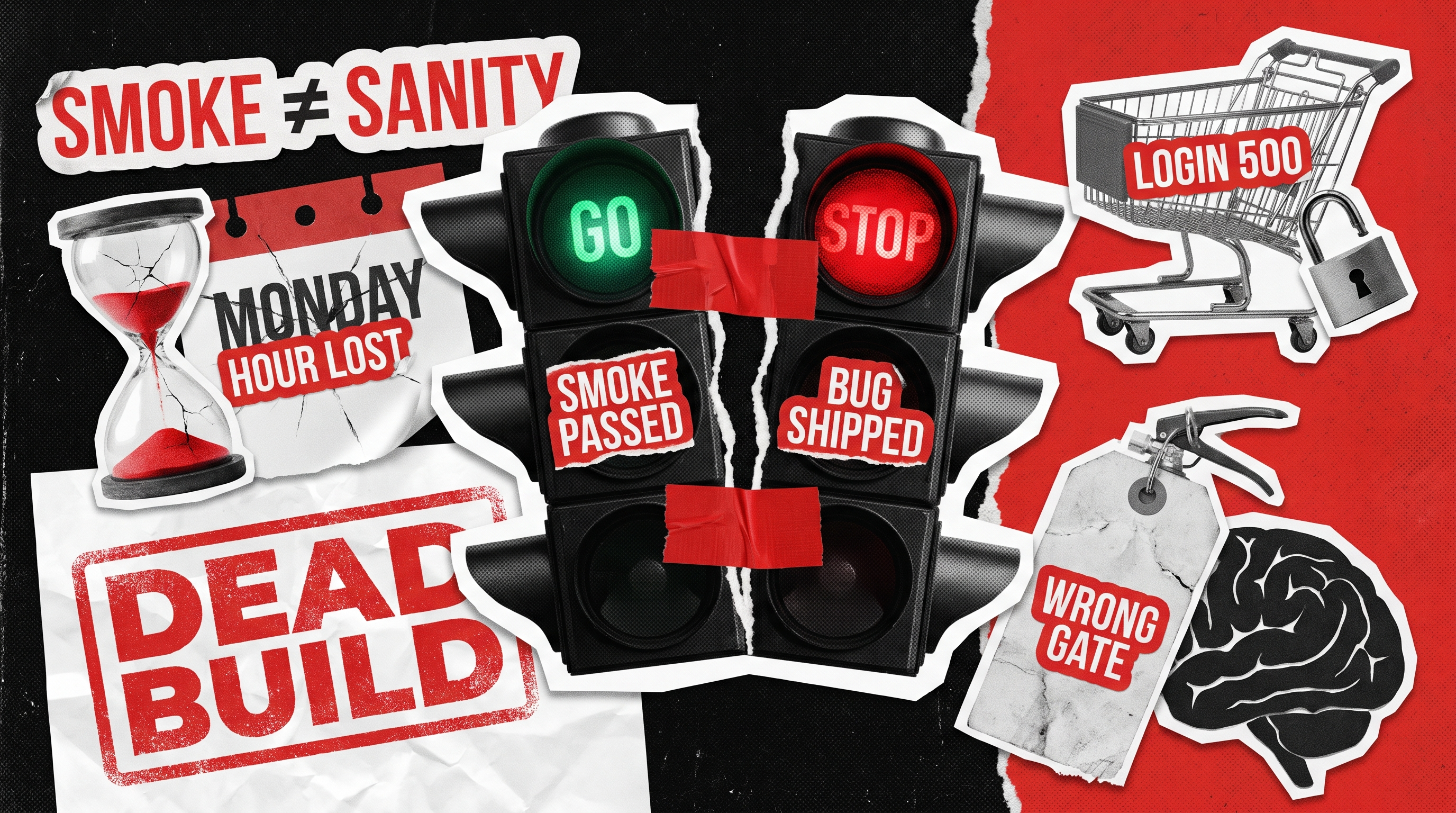
Half of QA teams use “smoke” and “sanity” interchangeably. The other half argue about it in standups. Both groups lose hours per sprint to misrouted tests, and most of them have no idea it’s happening.
The confusion is more than terminology. Pick the wrong test type and your QA engineers spend an hour debugging a discount code fix while login has been broken since the morning build. Pick it the other way and a smoke pass quietly green-lights a release that ships a bug straight to Monday-morning customers. The 2025 DORA Report found that teams accelerating delivery with AI are seeing increased delivery instability when their underlying testing discipline is weak. The teams that avoid that trap usually pair these gates with regression testing services that tie everything together.
This article gives you the short version up front: smoke testing checks if the build runs, sanity testing checks if a specific change works. Then it walks through how to use each one without burning sprint capacity, and what it actually costs when teams get the call wrong.
What Smoke Testing Actually Does
A smoke test is the gate, not the test suite. It answers one question: is this build alive enough to test? If login is broken, the homepage throws a 500, or the database connection is dead, smoke testing surfaces it inside ten minutes, the build gets rejected, and nobody downstream wastes time on it.
The discipline matters more than the definition. The moment a smoke suite grows past ten minutes, engineers stop trusting it and start working around it. So you keep it small: five to seven critical paths, no edge cases, no fancy validations. For an e-commerce build that usually means the homepage loads, login works, search returns results, a product page renders, items add to the cart, and checkout initiates. That’s the whole suite. If any of those fails, the build is dead on arrival.
This is also where automation earns its keep. Smoke runs on every merge to main, every deployment to a new environment, every nightly build, and every release candidate handoff. Manual smoke testing on that cadence is a recipe for skipped runs. Scripted smoke testing in CI/CD gives the team a binary signal in under ten minutes and frees up QA capacity for deeper work.
One trap to flag: passing smoke does not mean the build is good. It means the build is testable.
What Sanity Testing Actually Does
Sanity testing is the opposite shape. Where smoke tests broadly across the application, sanity tests narrowly into one specific area where something just changed. A developer fixed a discount code bug? Sanity covers the discount flow, the cart total recalculation, and the checkout step that depends on it. Nothing else.
The trigger is always a targeted change: a bug fix, a config tweak, a small enhancement, a third-party integration update, or a hotfix where there’s no time for a full regression cycle. Sanity assumes the build is already stable (smoke already passed), so it skips the foundational checks and goes straight to “did this change behave, and did it break anything next to it.”
Sanity testing is usually manual. The reason is practical: what gets tested changes from build to build, so scripted sanity suites get stale within weeks. A QA engineer who understands the change being verified will outperform a scripted suite that was written for last sprint’s fix. The exception is recurring high-risk areas like payments or authentication, where the same kinds of patches land month after month. Those are worth automating once.
If sanity fails, the fix is rejected, but the rest of the build usually stays in play. That’s the structural difference between smoke and sanity testing, and it’s why the sanity testing vs smoke testing framing matters in practice: smoke failures kill the whole build, sanity failures kill one slice of it.
Smoke Testing vs Sanity Testing at a Glance
When the two sit side by side, the smoke vs sanity testing distinction becomes obvious. The table below is the same comparison every QA lead ends up sketching on a whiteboard at some point. Use it as a reference.
Trigger
New build, fresh deployment
Targeted change to a stable build
Scope
Broad, full application
Narrow, one or two modules
Depth
Shallow, critical paths only
Deep, within the changed area
When in cycle
First, before any other test runs
After smoke, before full regression
Automation fit
Highly automated, runs in CI/CD
Mostly manual, selective automation
Who runs it
Automated pipeline, sometimes developers
QA engineer familiar with the change
Documentation
Scripted, version-controlled suite
Often unscripted, checklist-driven
What failure means
Build is rejected entirely
Specific fix is rejected
The pattern is simple once you see it: smoke is breadth, sanity is depth. Mix them up and you waste hours.
The 30-Second Decision Rule
The whole smoke testing vs sanity testing debate collapses into one rule: use smoke testing when you have a new build and don’t know if it works at all. Use sanity testing when you have a stable build and need to verify one specific change.
Four quick examples of the rule in practice:
- New build dropped from development → smoke
- Single bug fix pushed against a build that already passed smoke this morning → sanity
- Friday afternoon hotfix on a build that’s already in production → sanity, scoped tight
- Major refactor merged that touched 14 files → smoke first, then sanity on each touched module
That’s the entire decision tree. The trigger is what changed, not how long ago it changed and not how confident the developer feels about the fix.

Where Regression Testing Fits in
Smoke and sanity are gates. Regression is the full sweep that confirms the rest of the application still works after everything else has passed. Smoke runs on every build, sanity runs after every targeted change, regression runs nightly or before a release.
The relationship is hierarchical. Sanity is technically a subset of regression: it reuses regression test cases but limits them to the changed area. The trouble starts when teams treat the two as the same suite. A “sanity test” that runs for six hours on a hotfix is no longer a sanity test, it’s a regression cycle wearing a sanity label, and the team has lost the speed advantage that made sanity worth doing in the first place.
The three layers work together: smoke gates the build, sanity gates the change, regression gates the release. Skip any layer and the cost shows up somewhere else.
When to Use Each, with Real Triggers
Theory is easy. The hard part is making the right call when a developer drops a PR in Slack at 4:30pm. Here are the patterns we see most often and the right call for each.
A developer merged a refactor that touched 14 files. The build is new and the blast radius is wide. Run smoke first, because anything could be broken. If it passes, run sanity on each module the refactor touched. Skip the full regression unless the release is imminent.
A bug fix landed for a single login error. The build itself is the one that passed smoke that morning. Smoke is not needed again, because the foundation hasn’t moved. Run sanity on the login flow and the two flows that depend on it (password reset, account lockout). Ten minutes, not an hour.
A Friday afternoon hotfix needs to ship for a checkout bug. The build is the same one running in production with one targeted change. Sanity is the right call, scoped tight to the checkout path. Smoke would burn time you don’t have on flows that haven’t changed since last week.
A nightly build came off main with ten merged PRs. Automated smoke testing runs first, then full regression overnight. This is the cadence where automation pays for itself.
A third-party payment API got upgraded. This is a foundational integration, so smoke testing covers it (does the app still start, does checkout still load), then sanity covers the payment flows in depth.
A designer pushed a CSS change. Tempting to skip testing entirely. Don’t. Run sanity on the affected screens and verify auth still works, because CSS specificity bugs really do break login flows.
What It Costs When You Get This Wrong
Most teams don’t measure the cost of the wrong testing call because the loss hides inside normal sprint capacity. It shows up as “QA is slow” or “we keep missing release dates” when the real problem is hours spent testing the wrong layer. The pattern compounds when teams add AI-generated code on top of weak testing discipline: the 2025 Stack Overflow Developer Survey found that 45% of developers say debugging AI-generated code takes more time than expected, and 66% cite “almost right but not quite” solutions as their top frustration. Confusing smoke and sanity testing produces the same kind of hidden tax: hours that look like work but are actually rework.
Running Sanity on an Unstable Build
The scenario: a developer pushes a fix for a discount code bug at 9am. QA picks it up, jumps straight to sanity testing on the discount flow, spends an hour validating edge cases, then discovers around 10:15 that the login service is throwing 500s on the same build and has been since the morning merge.
That hour is gone, and so is the context-switch tax of debugging the wrong layer. The QA engineer now has to wait for a new build, reset their environment, and start over. Multiply by the number of times this pattern repeats in a sprint and you’re losing the better part of a day per cycle. The fix is mechanical: smoke gates every new build before sanity touches it. No exceptions.
Running Smoke When You Need Sanity
The reverse scenario is more dangerous because it ships. A developer fixes a discount code bug. QA runs the smoke suite, which checks that login works, the homepage loads, and checkout initiates. Everything passes. The fix ships.
The actual discount code bug was never in the smoke suite’s path, because smoke doesn’t go deep into the discount flow. Customers hit it Monday morning. Now it’s a production incident, not a test cycle, and the cost just jumped from QA hours to engineering hours plus support tickets plus the trust hit. This is exactly the failure mode that turns a clean DORA Change Failure Rate into a bad one. Sanity exists to catch this category of bug. Skipping it because “smoke passed” is the most common version of the sanity vs smoke testing confusion, and the most expensive.
The QA Team Checklist
The takeaway is operational, not theoretical. Run this checklist against your current QA process and most of the misrouted-test cost disappears.
Before every build:
- The smoke suite runs automatically in CI/CD, stays under ten minutes, and covers five to seven critical paths
- If smoke fails, the build is rejected, no further testing happens on it
- Smoke suites get reviewed quarterly and updated when critical features change
After every targeted change:
- Identify what changed and what flows are adjacent to it
- Run sanity on that scope only, not the whole application
- Document the sanity scope in the pull request so the next person knows what was and wasn’t covered
- Automate sanity only when the same area gets patched repeatedly
Before every release:
- Full regression runs against a build that already cleared smoke and sanity gates
- Sanity never substitutes for regression on a release candidate
- Release confidence comes from all three layers passing, not one of them passing well
The rule one more time: smoke gates the build, sanity gates the change, regression gates the release. Most QA delays come from running the wrong one. The fix is not a new tool, it’s discipline on which test answers which question. If you want a second set of eyes on your QA process from a team that runs this playbook across hundreds of shipped projects, contact us.
See how QAwerk helped Sitch establish QA gates that stabilized onboarding, chat, and payments before nationwide expansion, with 50+ critical production bugs prevented and 99.8% crash-free sessions.