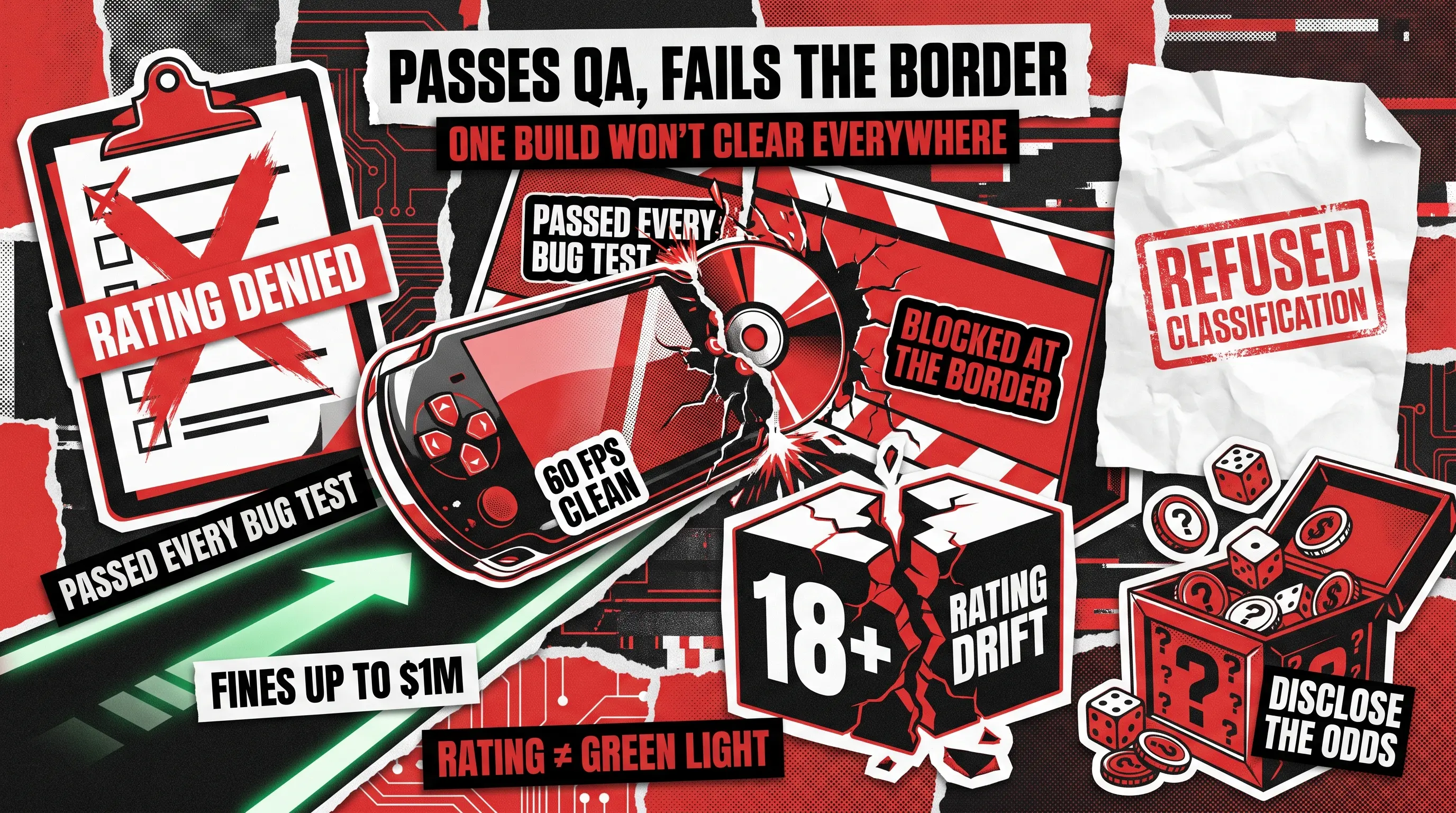
A game can pass every single bug test you throw at it, run at a flawless 60 FPS, and still get brutally stopped at the digital border. No one tells you during those late-night coding sessions that your biggest launch-day threat isn’t a game-breaking glitch but it’s a regional regulator with a clipboard.
An app store refuses to list you, a platform holder blocks certification, or a national agency locks your store page before you can earn a single cent. It all comes down to content ratings and the regional rules behind them. Get either one wrong, and you’re not just looking at an awkward email from your publisher. You’re looking at a blocked launch, a massive fine, or a title pulled from an entire country while your marketing team wonders why the countdown hit zero and nothing happened.
Whether you are targeting a smooth console release or need a hand navigating mobile requirements, leaning on a trusted partner like QAwerk’s game testing services ensures your game actually makes it to the players. Our video game compliance testing catches these regional roadblocks before launch day. In this guide, we’re breaking down how the major rating systems work, how QA verifies them, and which sneaky regional rules trip up studios that assumed one global build would clear everywhere.
What Is Video Game Compliance Testing?
Video game compliance testing verifies two things. First, it confirms that a game’s actual content matches the rating it claims. Second, it confirms that the game meets the content rules of every region where it will sell. It is separate from passing a platform holder’s technical requirements and separate from verifying a player’s age at checkout.
The first part of it keeps the rating honest, meaning it ensures the game contains no undisclosed violence, missing loot box descriptors, or content that slipped in during a late patch and was left unrated. The second part has to do with regional regulation compliance. Plenty of countries do not care about your Entertainment Software Rating Board (ESRB) rating at all. They have their own rules about what appears on screen, how randomized purchases are disclosed, and whether your game can sell there in the first place.
How Do Games Get An ESRB Or PEGI Rating?
When releasing a game, you must have a clear map in mind because many countries have highly specific regulations. Therefore, the best you can do is make a list of exact locations and check each individually. This way, you’ll be able to avoid a costly flop that might affect your brand reputation. Below, we offer some guidelines on how to handle the most prevalent regulations.
How The IARC Questionnaire Assigns Age Ratings
Most digital releases go through the International Age Rating Coalition (IARC), built by the major rating boards, so publishers stop filling out a separate form per region. You answer one questionnaire about your game’s content, and IARC generates the age rating, content descriptors, and interactive elements for every participating region at once. Light content takes a few minutes. Mature or complex content takes closer to fifteen.
However, there is one catch, as IARC covers digital distribution only. A physical retail release needs a traditional rating from the board directly, and you retake the questionnaire whenever your content changes enough to alter your original answers. The good news is that this might not be an issue for long, as major gaming companies are dropping physical releases entirely.
How ESRB Ratings Work In North America
In the US, Canada, and Mexico, ESRB rates games across five categories. These range from ‘Everyone’ to ‘Adults Only’ and include descriptors flagging violence, language, and in-game purchases. However, studios often underestimate the level of enforcement for this regulation. The ESRB runs post-release verification and can impose fines of up to one million dollars on publishers who misrepresent their content.
Mobile game developers in the US also need to be aware of Google Play age verification regulations that come into force in 2026. This is one of the examples of how both the geographic location and the platform you release the game on impact your compliance planning.
How PEGI Ratings Work In Europe
Pan European Game Information (PEGI) covers more than thirty European countries and has been aggressive about randomized purchases. Its Code of Conduct contractually requires publishers to disclose the odds of each item in a loot box before a player buys, and to keep those probabilities transparent and equal for everyone. A missing or buried disclosure is not going to help your game slip through onto the EU market.
How USK Rates Games In Germany
Germany’s Unterhaltungssoftware Selbstkontrolle (USK) uses IARC for digital releases, so most of the process feels familiar. However, there is an important difference that involves content tied to Germany’s legal history. It is a clean example of how a rating earned elsewhere does not clear every hurdle.
Why CERO Rates Games Separately In Japan
Japan stands out as a game publishing destination with quite specific rules because its Computer Entertainment Rating Organization (CERO) is not part of IARC. If you release a fully digital product, major Japanese storefronts accept an IARC rating fine. However, if you ship a physical console copy, you will need a traditional CERO submission. To get it you’ll have to send a gameplay video that includes your most intense content for review by trained raters. Change the content afterward, or disclose it incompletely, and you are back in review.
How Compliance Testing Verifies A Game's Content Rating
This is where compliance testing earns its keep, and it rarely gets discussed outside a QA team’s own docs. A rating is only as good as the build behind it. Games change constantly between the day you fill out the questionnaire and the day you ship, and every change is a chance for the rating to drift from reality.
Good compliance testing will map the descriptors a game claims against what actually ships. This must happen even if you must document it scene by scene. For example, adding a new weapon after the rating was submitted or shipping a chat feature that was never disclosed affects the compliance requirements set by different regulators. Therefore, if a content update adds something that should trigger a fresh rating, you must catch this before launch, not after a regulator does it for you. The alternative is a resubmission cycle that eats your launch window while the countdown clock refuses to move.

What Content Rules Apply To Games In Different Regions?
A rating tells you how to label a game. It does not tell you whether the game is allowed to exist in a market, or whether your monetization needs a rework before you can take a single payment. That is where regional rules take over, and this is the part most likely to blindside a studio that has only shipped at home.
Loot Box Disclosure Rules By Country
Randomized purchases, or loot boxes, are the most scrutinized area in game compliance due to the feature’s gambling nature. The rules differ by country, for example:
- South Korea mandates full odds disclosure under its Game Industry Promotion Act. This requirement covers even indirect purchases, where a player buys a key or ticket instead of the item itself. To grasp the impact, consider that when Korean regulators pressed this point in 2026, Roblox rewrote its disclosure policy worldwide rather than run two versions of the same feature.
- The United States has no federal loot box law, which is not the same as no exposure. In January 2025, the Federal Trade Commission (FTC) reached a twenty million dollar settlement with the developer of Genshin Impact over misleading players about the odds and cost of rare prizes and collecting children’s data without consent. The order also barred selling loot boxes to players under sixteen without parental consent and forced a direct cash purchase option instead of a maze of virtual currencies. With this, regulators do not need a gambling statute to treat a confusing purchase flow as a consumer protection problem.
- Europe adds PEGI’s Code of Conduct on top, and European lawmakers keep debating tighter rules for gambling-like mechanics aimed at younger players.
China's Game Approval And ISBN Requirements
China runs a system with no connection to IARC, PEGI, or the ESRB. Before a game can take a payment in mainland China through a purchase price, subscription, or in-app purchase, it needs an approval number, commonly called a game publishing International Standard Book Number (ISBN), from China’s National Press and Publication Administration. Only Chinese entities can hold the license to apply, so foreign studios cannot submit directly and must work through a licensed local publisher who becomes accountable for the game’s ongoing compliance.
It’s interesting to note that the Chinese review digs into details other boards ignore. Randomized mechanics need clear probability disclosure and usually a guaranteed reward after a set number of attempts. In-game maps must match Chinese territorial boundaries exactly. And the build under review needs real name verification and anti-addiction systems already built in, not promised for a later patch. None of this appears in an ESRB or PEGI rating, and none of it bolts on after the fact without another review.
Local Content Restrictions That Can Block A Release
What you must understand is that sometimes a rating does not travel because the destination market has its own red lines, regardless of the age category you secured elsewhere. Examples of such cases include:
- Germany prohibited the depiction of any Nazi symbols, like the swastika, forcing publishers to censor or replace them even in titles using the imagery to depict history rather than glorify it. That changed in 2018, when the USK began allowing such symbols case by case, as long as the use serves a genuine artistic, historical, or educational purpose.
- Australia goes further as under its classification system, a game can be Refused Classification, meaning it cannot legally sell in the country at all, regardless of the rating it holds elsewhere. This has hit well over a thousand titles that went through IARC, often surprising smaller studios because the refusal can land after a successful launch elsewhere.
- Brazil passed a law banning loot box sales to players under eighteen starting in 2026 as part of a wider trend of countries fencing off randomized monetization for minors.
Let’s also not forget that aside from geographic location, the platform you publish on will also have its own set of highly specific regulations. For instance, there are over a dozen reasons why apps get rejected on the App Store, and some of those are quite vague.
Game Rating Systems Compared By Region
No two markets treat your game exactly alike, so the same title can breeze through a questionnaire in one region but get stuck in a months-long review in another. Sometimes, you even need a local partner just to be considered for the market. The table below lines up the major boards so you can see potential friction points at a glance.
North America
ESRB
IARC questionnaire
Traditional submission with post-release play testing
Fines up to one million dollars for misrepresented content
Europe
PEGI
IARC questionnaire
Traditional content assessment
Must disclose loot box odds before purchase
Germany
USK
IARC questionnaire
Traditional USK submission
Certain historical symbols assessed case by case since 2018
Japan
CERO
Accepts IARC on many digital storefronts
Mandatory traditional submission with gameplay video review
Sits entirely outside the IARC coalition
China
National Press and Publication Administration
Approval number required before any monetization
Same approval process, no digital shortcut
Only a licensed local publisher can submit
What Non-Compliance Costs Game Studios
The numbers can vary greatly, depending mostly on your geographic location and the ‘strength’ of your infraction. As such, a misrepresented ESRB rating stemming from a loot box disclosure gap just cost one publisher $20 million in the United States alone. Belgium and the Netherlands have treated certain paid loot boxes as gambling outright, which is a far bigger problem than a rating correction. China’s approval can take most of a year, and a rejection over compliance restarts that clock.
Under the fines and delays sits a quieter cost: the resubmission cycle itself. It’s a silent killer for many releases today, as the competition in this sector is extreme. Every repeated review takes time, so your carefully planned launch window is slipping.
How To Build Game Compliance Testing Into Your Release Process
The studios that handle this well do not treat compliance as a box to tick the week before launch. Instead, they build it in through the entire development process, alongside functional and performance testing. The alternative is finding out about a content mismatch or a missing regional disclosure only after a regulator, platform holder, or store review team finds it first.
That is what our game testing services are built around: confirming your declared rating matches your shipped build, and clearing the regional rules between your game and its next market before they become a launch-day surprise. Therefore, let’s ensure you spend the time on game development, while the QAwerk team worries about whether your loot box odds read correctly in three countries. Contact us today, and we’ll make it happen.
See how we helped Highrise City identify the cause of freezes and optimize performance before the release