You’re deciding whether AI belongs in next year’s QA budget. But every comparison of AI in testing vs traditional methods you find was written by someone selling an AI testing platform. Unsurprisingly, they all have the same conclusion: use our tool, it’s the best.
The situation isn’t as clear-cut as that content would lead you to believe. QAwerk has been testing software for 11+ years. We don’t license a platform you must keep paying for, so we have no reason to oversell one. This article is our honest breakdown, based on that experience. We’ll explain in detail how AI-powered QA can save your budget, and when it just adds an expense that leads nowhere. Our AI-based software testing services exist for the first case, not the second.
One boundary matters before the numbers. This guide covers using AI inside your testing process. If the product you ship is itself intelligent, our AI testing services answer a separate question.
Is AI Testing Cheaper Than Traditional Testing?
AI-assisted testing costs less only when the recurring work it removes outweighs the licensing, integration, review, and governance it adds. Teams carrying heavy upkeep on a large regression suite usually clear that bar. Stable products, thin test volume, and early-stage builds often don’t.
No honest percentage exists for this. The figures circulating on vendor pages, typically a 35% to 45% drop in maintenance effort, are self-reported and describe somebody else’s suite. Your result turns on regression volume, release cadence, and how often your interface changes. It also reflects how mature your automation already is, and what an engineer hour costs you.
Therefore, the useful comparison isn’t tool price against salary. It’s your total QA spend before the change, compared with the total after it. That figure includes work most budgets never itemize. One example is the hours lost investigating failures that turn out to be test defects. Another is the review time a generated artifact demands before anyone trusts it.
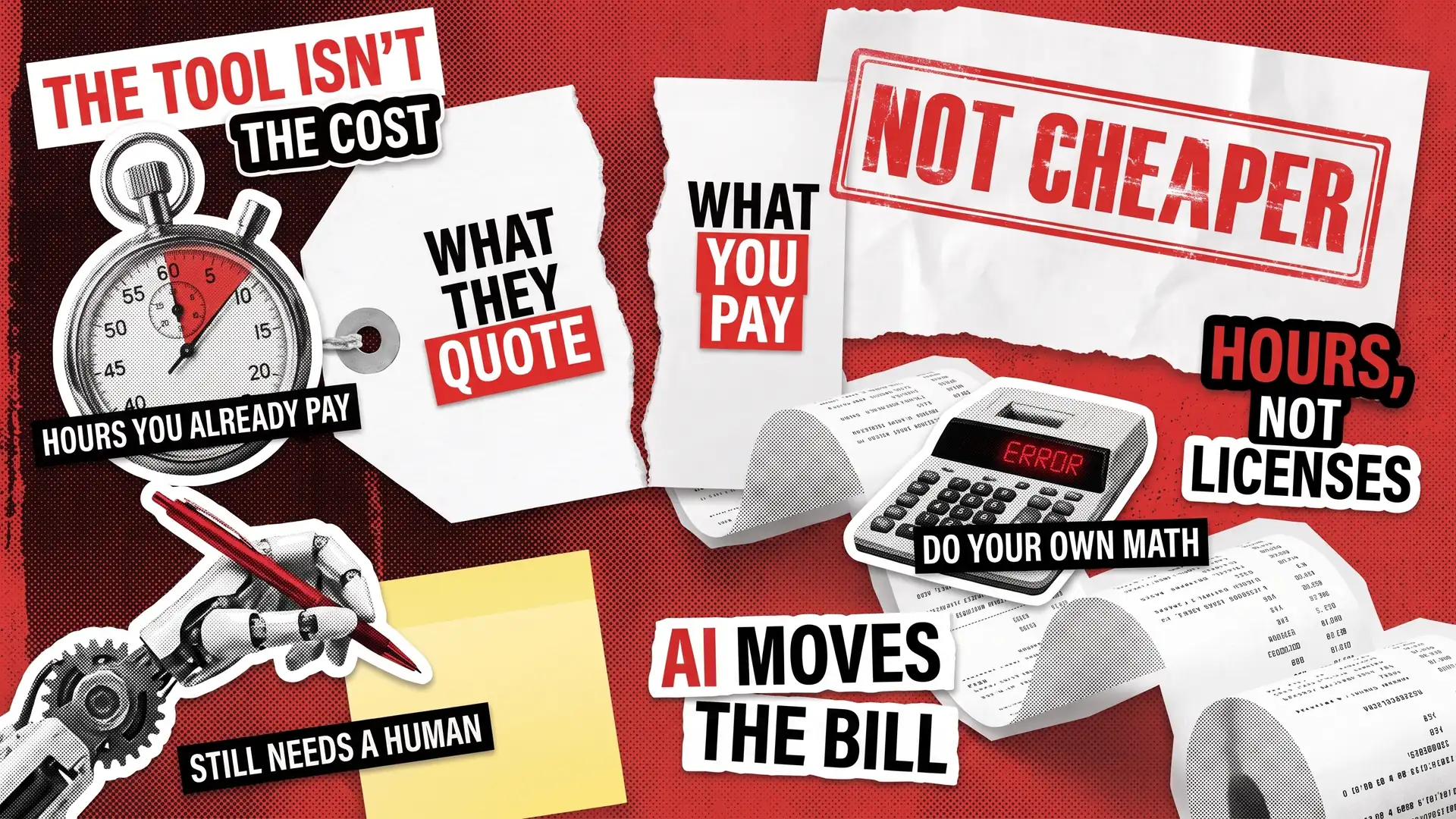
No vendor demo shows you that total. The number on the slide is a license fee, usually the smallest item in your QA budget. Your biggest cost is the time your existing team already spends. A pitch that sets a monthly fee against a tester’s salary compares the wrong two things.
AI in Testing vs Traditional Methods, Side by Side
Most comparisons on this topic run two columns, and that hides the problem. Traditional testing conceals two different cost structures, manual QA and coded automation. They spend money in nearly opposite ways, so collapsing them produces an average that describes nobody.
Manual work pays per execution, and every regression cycle costs roughly what the last one did. Coded automation front-loads the spend into building a suite, then charges rent in upkeep. AI assistance sits on top of either one, shifting effort away from producing artifacts and toward checking them.
Upfront investment
Low
High, the suite has to be built
Varies with how much integration your stack needs
Cost per repeat run
High, and it never falls
Low
Low, plus usage fees
Where the effort goes
Executing tests
Writing and repairing them
Reviewing what the model produced
Maintenance burden
Nothing to speak of
Substantial and continuous
Lighter on locators, unchanged on logic
Human oversight
Constant
Moderate
Moderate to high, and easy to underestimate
Predictability
Varies with the tester
High
Lower, since output shifts between runs
Best economic fit
Exploratory and usability work
Stable, high-volume regression
Large suites that change often
Main hidden cost
Repetition
Flaky failures
Review time and governance
What it cannot do
Scale to nightly runs
Judge whether a requirement was right
Decide what deserves checking
Read that as a map of where money moves rather than a ranking of AI testing against traditional methods. As an example, conventional automated testing turned Evolv‘s regression cycle of 3 or 4 days into one that finishes in 2. Gains of that kind are often credited to AI later, when a stable suite and parallel execution did the work.
Where the Cost Actually Moves
AI doesn’t remove testing work so much as relocate it. That is the real difference between AI in testing vs traditional methods. Five areas carry most of a QA budget, and each responds differently.
- Authoring is where generation helps most, and where the saving is easiest to overstate. A model drafts a case in seconds. An engineer then spends real minutes deciding whether it asserts the right behavior. Our guide to generative AI use cases in software testing works through which drafts survive that review.
- Upkeep is the target vendors aim at hardest. Self-healing repairs a broken locator without a human, which genuinely removes hours from a volatile interface. However, it does nothing when a workflow changes. A test that heals into the wrong assertion still reports green. Much of what teams file under maintenance is really flaky tests, where the answer is environmental rather than clever.
- Execution is the area AI touches least, though vendors rarely volunteer that. Running 400 browser sessions at once is a question of infrastructure. Cloud test platforms have done it for years with no model involved. Yet parallel speed often ends up on the same slide as the AI budget request.
- Triage responds well to summarization. Clustering failures and drafting a probable cause saves somebody the first pass through the logs. Still, a person has to rule on whether the break is a product defect, a broken environment, or a bad test.
- Review and governance are the two areas AI-assisted testing adds rather than removes. Big companies feel this most. Someone has to approve the model, agree what data it sees, control access, and set how long records are kept.
Sometimes the case for AI isn’t savings at all. Testing Granola, an AI notepad, we hit output that exact-match assertions can’t validate, since the summaries differ on every run. So we put a model inside our own automation scripts to judge whether each summary captured the meeting. That let us automate 76% of the core regression suite across macOS and Windows. Traditional assertions wouldn’t have covered it at any price.
The example cuts against the usual pitch. AI earned its place there by making automation possible, not by making it cheaper.
When AI Assistance Does Not Pay for Itself
Adoption figures make the question look settled, but it isn’t. The World Quality Report 2025-26 found 89% of organizations piloting or deploying generative AI inside their testing function. However, only 15% had reached enterprise scale. Most of the distance between those two numbers is cost nobody forecast.
Five situations where AI-assisted testing loses to traditional methods on cost:
- Your regression suite is small enough that upkeep never appears as a line item.
- The product still changes shape weekly, so no coverage survives long enough to maintain.
- Existing automation runs stably and rarely flakes, which leaves no recurring expense to remove.
- Review becomes the new queue, and validating generated tests costs more than authoring them did.
- Purchase approval, a security review, and questions about your data turn a subscription into months of internal work.
That last point matters more than it looks. The fee might be a few hundred dollars, but your security team can take 6 months to approve the tool. That delay costs you money before anyone has saved a single hour.
Research on generated tests points the same way. A 2026 study in the Journal of Systems and Software reached 96.3% branch coverage under careful prompting. The same work found models skipping robustness cases such as None, infinity, and NaN, blind spots that human developers share. Coverage and correctness aren’t the same measurement.
How to Prove AI Will Save You Money Before You Buy
Measure the cost first, then buy the tool that promises to shrink it.
Spend 4 to 8 weeks recording what QA costs you now. Count time spent authoring tests, repairing them, running regression, and investigating failures, plus the infrastructure bill. Then pilot against your single most expensive workflow rather than across the whole function. Choose it by cost instead of curiosity. The one your team complains about every sprint is a recurring expense with a name.
Here’s the shape of the calculation, with illustrative figures only. Suppose suite upkeep takes your team 12 hours a week, at a loaded cost of C per hour. That’s 624 hours a year. An AI-assisted workflow removing 30% of it frees 187 hours. Against that, count the subscription, the integration effort, the time spent checking generated output, and the security review. If those exceed 187C, your pilot has told you not to scale. Substitute your own figures, because the ones above only show the method. That is the only way to settle AI in testing vs traditional methods for your team.

Perceived speed isn’t evidence either. A 2025 randomized trial by METR found experienced developers ran 19% slower with AI tools while believing they’d gone faster. That study covered general development rather than QA, so read it as a caution about self-reported gains.
Start shopping only after the numbers behind your bottlenecks are clear. For platform choices, our AI testing tools guide weighs each option against a specific job instead of a feature count. If nobody on staff has time to establish the baseline, a dedicated QA team can measure it alongside the testing itself.
The Verdict
AI in testing vs traditional methods isn’t a contest with one winner. Manual QA buys judgment. Coded automation buys repeatability. AI buys leverage over repetitive engineering work, and only where enough of it exists to matter.
Therefore, the cheapest strategy uses each where its economics hold. For most established teams, that means adding AI to an automation suite rather than swapping one out. Only pay for AI if you can point to a specific cost it will remove. If you can’t name that saving today, measure where the money goes before buying anything.
To see what your testing actually costs, book a call with our QA team.
FAQ
Is AI testing cheaper than traditional testing?
Comparing AI in testing vs traditional methods on cost depends on what your QA budget already funds. AI assistance is cheaper when it removes more recurring authoring, upkeep, and triage work than it adds in licensing, integration, review, and governance. Teams with large, volatile regression suites usually clear that bar, while small or stable ones often don’t.
Can AI replace software testers?
AI can’t replace testers. It takes over specific tasks such as drafting tests, repairing locators, prioritizing runs, and summarizing failures. Deciding what deserves checking, judging business risk, exploring an unfamiliar build, and signing off a release stay with people. A generated suite can look thorough while asserting the wrong behavior, so somebody must own that judgment.
When is AI testing not worth it?
AI rarely pays off when repetition is low, or when existing automation is stable and cheap to maintain. It also disappoints when the product changes faster than coverage accumulates. Approval and data rules matter too, since a security review can hold up a small subscription for months. Unclear return is itself a reason to wait.
How do you calculate ROI on AI testing?
Measure your baseline over 4 to 8 weeks: hours spent authoring tests, repairing them, running regression, and investigating failures, plus infrastructure spend. Then pilot on your most expensive workflow. Subtract subscription, integration, review, and governance costs from the hours saved multiplied by your loaded hourly rate. Scale only if the result is clearly positive.