
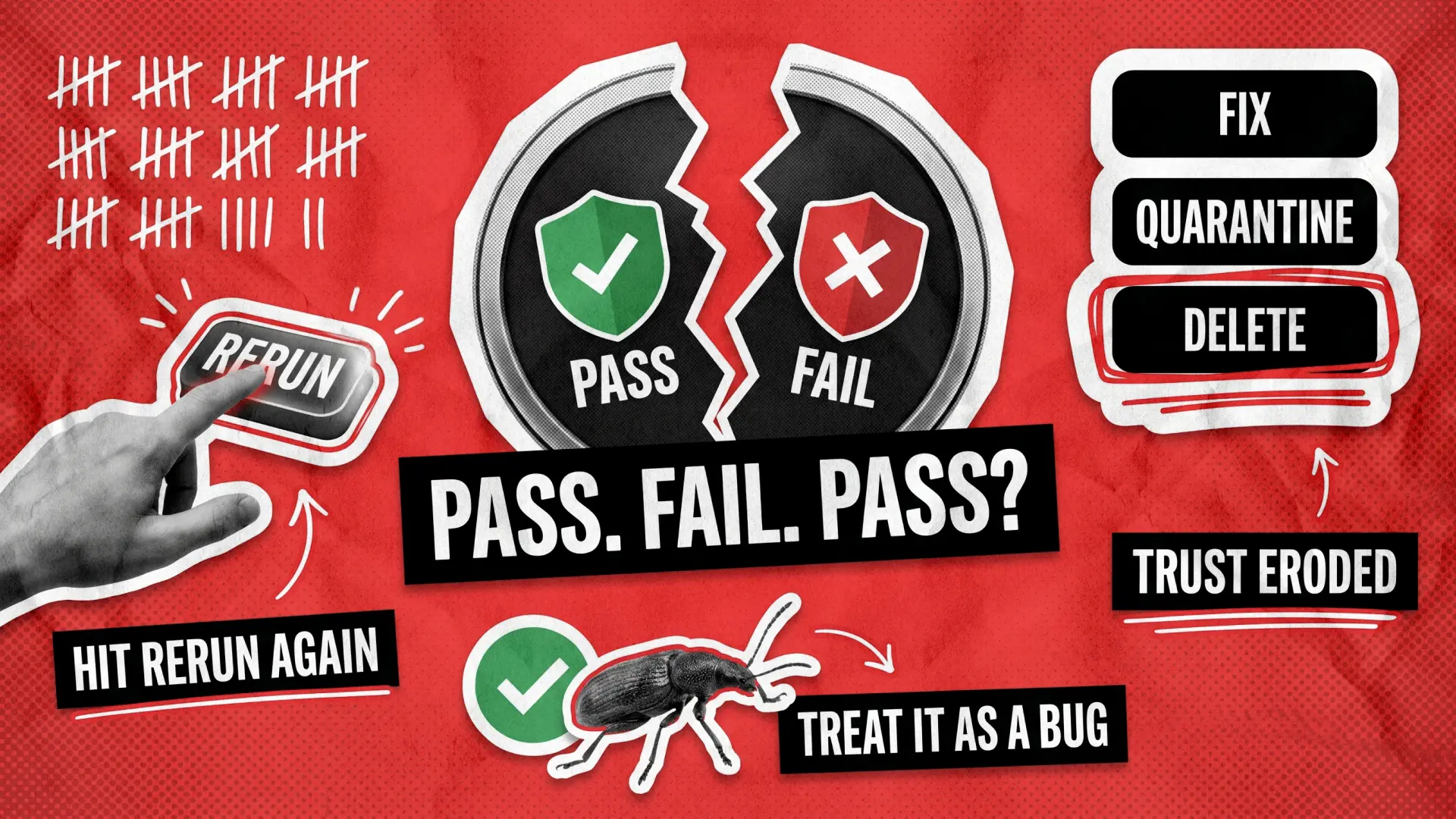
Your CI pipeline turns red, someone clicks rerun, and the build comes back green on the second try. The PR ships, and nobody asks why the test failed the first time, because the team already has the answer ready: “it was flaky.” If this happens once a week, you have a problem worth naming.
Flaky tests are automated checks that pass and fail without anyone touching the code. They look harmless because each individual rerun ends in green, but they are the moment your QA stops being a quality signal and starts being noise your team learns to ignore. They show up in the same way as the inconsistent outputs that erode user trust in AI systems, and the underlying problem is the same: when results are not predictable, people stop trusting them.
In this article, we will walk you through what flaky tests actually cost your team, why they happen, how to fix them properly, and how to keep them out of your suite from the start.
How Test Flakiness Damages Your Team
The damage from test flakiness is rarely a single dramatic failure. It builds slowly, and most teams notice only after months of decay. According to the Capgemini World Quality Report 2025-26, 60% of organizations now struggle with secure, scalable test data, which is one of the foundations flakiness builds on.
Here is what flakiness actually does to a team over time:
- Real bugs hide behind dismissed failures. When the team’s first instinct on a red build is “probably flaky, hit rerun,” they are training themselves to ignore failures, and real regressions slip through with the same shrug.
- The rerun reflex replaces investigation. Engineers click rerun until the build is green and merge, so the test suite stops working as a quality gate and starts working as a coin flip with extra steps.
- Releases lose their confidence. You either delay a release while someone untangles whether a failure is real, or you ship and hope, and neither approach scales as your product grows. A reliable test suite is what makes pre-release confidence possible at all.
- One bad test infects the rest. Once your team stops trusting one test, they start questioning the entire suite, and reliable tests get the same shrug as flaky ones.
- Onboarding suffers. New engineers cannot tell which failures matter, so they keep asking, and worse, they pick up the rerun reflex on day one and carry it forward.
A test suite is only as valuable as the trust your team places in it, and that trust is the asset flakiness erodes most. This is the slow-burning quality problem we untangle for fast-moving teams through our regression testing services, where stability of the suite is the whole point.
Why Flaky Tests Happen: Five Real Causes
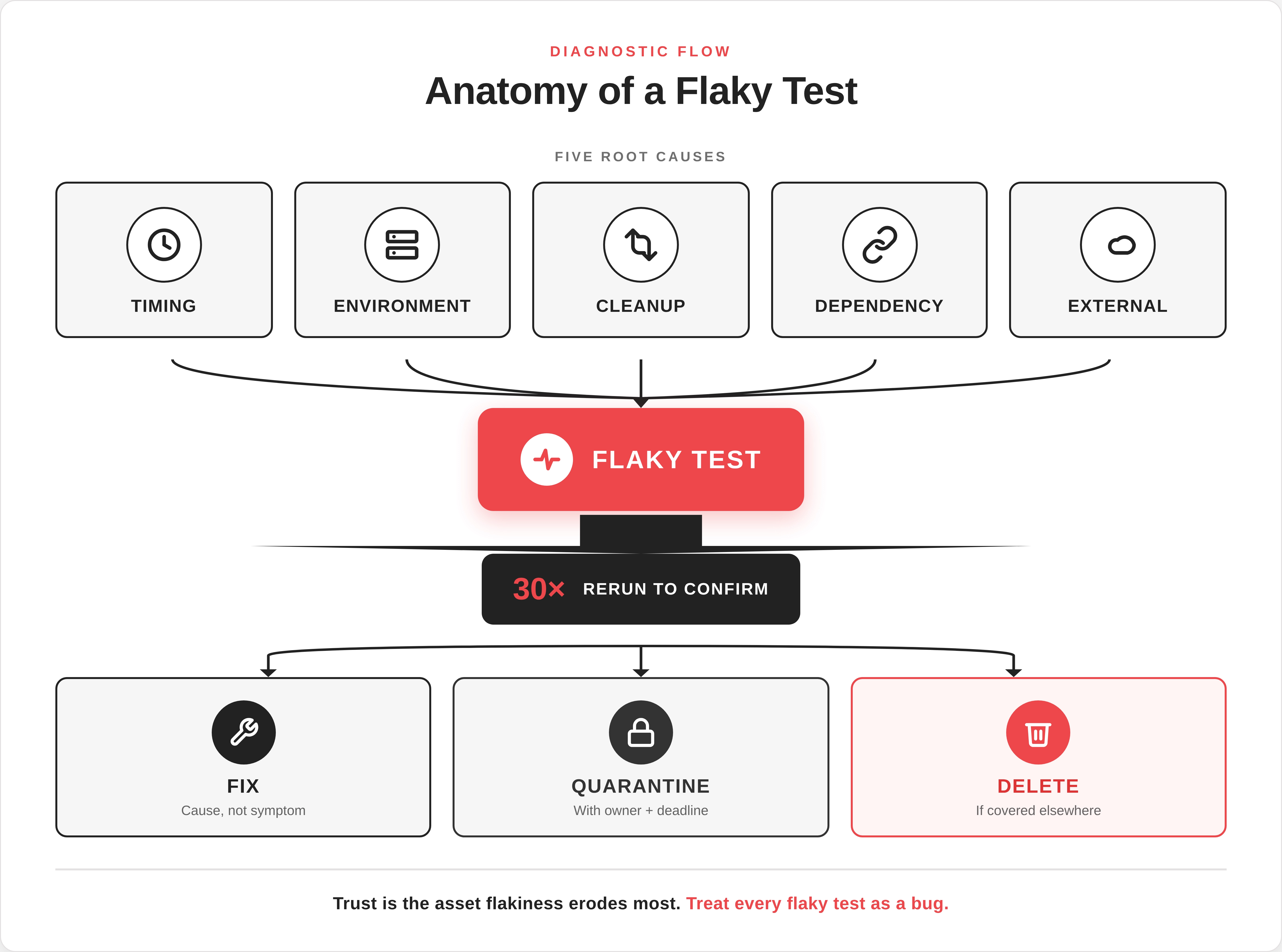
Most flakiness traces back to one of five causes. Knowing which one you are dealing with is already half the fix. The other half is resisting the urge to hit rerun and hope it goes green. Teams that skip the diagnosis end up with a suite nobody trusts and a red build everyone learns to ignore.
Timing and Synchronization
The test moves faster than the app. It clicks a button and immediately checks for the result, but the app is still loading, and a confirmation message that takes 200 milliseconds to render will not be there if your test checks at 50. The conversation analogy works well here: it is like asking “did you hear me?” before the other person has finished speaking. Timing issues are the most common cause of flakiness across every framework and language.
Test Environment Differences
Your developer’s laptop has more RAM, faster disk, and a stable network connection. Your CI runner is shared, slower, and constrained on resources, so a test that runs in 2 seconds on a premium laptop can take 5 seconds in a small CI container. The code is fine, the environment is not, and that is why the joke “works on my machine” never seems to die.
Tests That Do Not Clean up After Themselves
A well-behaved test sets up its own data, runs its check, and leaves the system the way it found it. When a test creates a record in the database and forgets to delete it, the next test runs against a polluted state. Sometimes nothing happens, but sometimes the next test breaks in subtle ways that look like flakiness and are actually a hygiene problem. This category usually shows up only when tests run in a different order or in parallel.
Tests That Depend on Each Other
This one is closely related and just as common. Test B silently depends on something Test A did, but nobody documented the dependency, so running them in a different order makes Test B fail. Modern CI systems often randomize test order or run tests in parallel, which is exactly when these invisible dependencies surface. The team thinks Test B is flaky, but it is not. It just had a roommate it never declared.
External Services the Test Relies on
Tests that hit real APIs, third-party services, or live databases inherit every problem those services have. A network blip, a rate limit, or a slow response from a partner means your test fails through no fault of yours. The test was not really testing your software, it was testing the internet on a Tuesday morning. The official Microsoft Learn documentation on Azure Pipelines makes the same point: tests can be flaky for reasons ranging from simple timing issues to complex dependencies on external environments.
If your team relies heavily on automation, choosing what to automate and how stable to keep it is a strategic call, not a technical one. We cover the principles in our automated testing practice.
How To Fix Flaky Tests (Without Making It Worse)
When you finally tackle a real flaky test, the order of operations matters more than the technical depth. Here is how to fix flaky tests without accidentally making the problem worse, in five steps we would recommend you hold your team to.
- Confirm it is actually flaky. Run the test 20 to 30 times in the same conditions. If it fails once in 30 runs, it is flaky, but if it fails consistently, it is broken, which is a different and faster problem to solve.
- Do not fix it by adding more time. The most common amateur fix is increasing a timeout or adding a fixed wait. This usually masks the problem rather than solving it, and the test will still fail eventually, just less often, which is the worst possible outcome because it pushes the next investigation further into the future.
- Find the actual root cause. Map the failure to one of the five categories above. Is it a timing issue, an environment difference, or test pollution? Each cause has a different fix, and applying the wrong fix wastes everyone’s afternoon.
- Fix the cause, not the symptom. A flaky timing test does not need a longer timeout, it needs to wait for a specific condition. A polluted test does not need better cleanup logic in that test, it needs the previous test to clean up after itself.
- Verify the fix. Run the test 50 to 100 times after the fix. If it never fails, the fix is real, and if it still fails occasionally, you found a symptom and not a cause, so back to step 3.
The whole sequence sounds simple, and it is. The reason most teams skip it is that flakiness investigations are tedious, while the immediate pressure to merge the PR is right there in everyone’s face.
How to Avoid Flaky Tests in the First Place
Prevention is unglamorous work. It is also the reason some teams have stable suites and others spend Monday mornings triaging. Here is how to avoid flaky tests before they get into your codebase, framed as policies a manager can hold a team to rather than tips a developer can ignore.
- Treat flakiness as a bug from day one. The day a test goes flaky is the day someone investigates it, not the next sprint, and not “when we have time.” Once you let one slide, you have signaled to the team that flakiness is acceptable.
- Make every test self-contained. Each test should set up its own data, run its check, and clean up after itself, with no shared accounts, no shared records, and no quiet dependencies on what ran before. This single principle removes two of the five causes outright.
- Match your test environment to your CI environment. If your team writes tests on premium laptops and runs them in constrained CI runners, environmental flakiness is guaranteed, and no amount of clever code will fix it. Bringing this discipline in early matters even more if you follow shift-left testing, where catching issues at the right phase saves the most time.
- Use smart waits, not fixed waits. Tests should wait for the right thing to happen, not for a fixed amount of time, and a wait of 5 seconds is not a fix. It is a delayed failure with a friendly face. This is the single highest-impact prevention principle, and the one most teams get wrong.
- Do not let tests touch the real internet. Tests that call live APIs or third-party services will be flaky eventually, because services go down, rate-limit, or change behavior on their own schedule. Replace those calls with controlled stand-ins so the test only depends on things your team can control.
- Make stability a code review concern. A new test that is already flaky should not be allowed to merge, because stability is not an afterthought. It is part of the definition of “done.”
Should You Quarantine, Fix, or Delete?
Pulling a flaky test out of the main suite so it stops blocking releases is what most teams call quarantine. It is useful as a temporary measure, and it is not a fix. Quarantined tests with no owner and no deadline turn into a graveyard nobody reads and nobody fixes.
Before you decide, ask three honest questions:
- Does this test cover real business risk? If not, lower the priority and stop pretending it is urgent.
- Is the same scenario covered by another, more reliable test? If yes, you may not need this one at all.
- Will fixing it cost more than rewriting it at a different layer? Sometimes the right answer is delete and start over.
Whatever process you choose, the worst outcome is the silent middle ground, where a test was quarantined six months ago and everyone ignores it while nobody owns it. That is not a fix. It is a postponed decision wearing a fix’s clothes, and your test suite carries the weight of every one of them.
Tests Behaving Badly?
A test suite is only as useful as the trust your team places in it, and test flakiness is how that trust quietly disappears. Catching flaky tests early, and keeping them out of your suite from the start, is what separates a useful QA function from a noisy one.
We have spent over two decades building and rescuing test suites for SaaS, fintech, e-commerce, AI, and games across 300+ projects. We have taken over messy, unstable suites and turned them back into something teams actually trust. If your team is spending more time triaging tests than writing them, contact us or learn how a dedicated QA team can take it off your plate.
See how a fintech card-issuing API stabilized its regression suite, automated 90% of endpoints, and kept critical bugs out of production while scaling globally.