Company leadership has decided that QA should be using AI. Now it’s your job to determine where to implement it, and how. Sadly, a landscape of dozens of competing tools is not helping you choose. Neither are the vague promises that using generative AI in software testing is a miracle fix for everything.
QAwerk sits in the middle of this. We test AI products for clients, and run generation in our own QA workflow. Our AI testing services cover the first, and this guide comes out of the second.
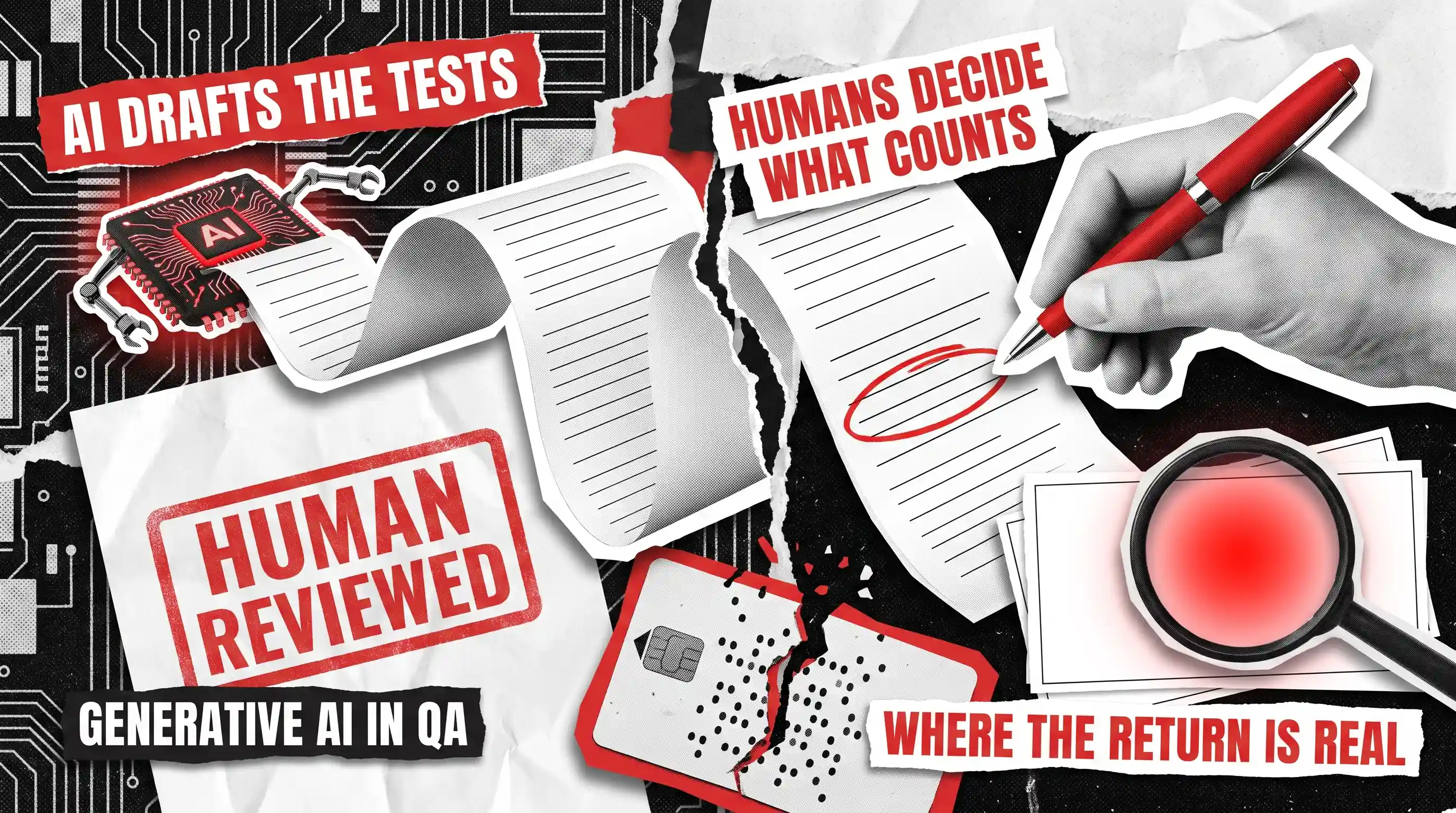
Let’s be clear about what the generative AI use cases in software testing really are. The model drafts the written work that QA teams produce by hand. That includes test cases from requirements, synthetic data, automation scripts, defect reports, and release documentation. So, generative AI builds artifacts from information you already hold. Then, a QA engineer decides which survive review.
We ranked those seven use cases by the payback we see in real engagements, fastest first. Each one answers the same four questions: what the AI does, and where your business saves time or money. The other two are what has to exist first, and where a person still has to step in. That last question is the one tool vendors avoid, and it decides whether the investment survives its first quarter.
What Generative AI in Software Testing Actually Does
AI adoption is already close to universal. Google’s DORA team reports that 90% of software professionals now work with AI. Yet 30% place little or no trust in the code it writes, per the 2025 State of AI-assisted Software Development report. That gap describes most QA functions we meet. Generative AI in testing is already in the workflow, and nobody can say what it returns.
Feed a model a user story, a database schema, a screen, or a stack trace, and back comes something new. What the model will not do is decide what deserves checking, or tell you whether the requirement it read was correct. That boundary decides where the money is.
So you save time wherever your team is simply writing down what it already knows. However, using generative AI for software testing barely helps in the parts of QA work that call for judgment. A model can draft 40 scenarios in a minute, but it cannot tell you which of them are worth running.
Not Everything Sold as AI Testing Is Generative
This is where budgets go wrong. Vendor pages fold four separate technologies into one word, and only one of them creates anything.
- Self-healing automation repairs broken locators by matching against earlier versions of the page.
- Predictive defect analytics scores which modules are likely to break, using your historical bug data.
- Risk-based prioritization reorders an existing suite so the important checks run first.
- Visual AI compares screenshots against a baseline and flags differences.
All four are genuinely useful. What none of them does is write something new, because they only classify, rank, repair, and compare what already exists. So if you win budget for generative AI in testing and buy a maintenance tool, the hours you promised never appear. Your bottleneck was somewhere else all along.
Tooling questions belong in our hands-on review of AI testing tools, which compares specialized platforms and says where each falls short. If your product is the AI itself, start from our LLM testing checklist instead.
Generative AI Use Cases in Software Testing, Mapped to the Bottleneck
Every row starts from a business problem, not a technology.
Test design lags behind development
Test cases drafted from requirements
Coverage keeps pace with releases
Written acceptance criteria
Which cases matter
Real customer data cannot be used
Synthetic test data
Realistic checks without privacy exposure
A documented schema
Cross-service integrity
A manual suite nobody has time to automate
Scripts generated from written cases
A faster first draft of automation
Stable selectors and working CI
Whether green means correct
Triage burns senior engineering hours
Defect reports written from failed runs
Shorter path from failure to fix
Logs, traces, and recordings
Root cause and severity
Regression scope is guesswork
Coverage gap analysis
Defensible retest decisions
A queryable test repository
Which gaps carry risk
Testers keep finding the same bugs
Exploratory charters and edge case ideas
Fresh angles on a familiar product
Testers who run timeboxed sessions
The noticing itself
Reporting eats the last day of the sprint
Documentation and release notes
Hours back, at low risk
Accurate tracker data
Anything an auditor reads
1. Turning Requirements Into Test Cases
This is the most valuable of the generative AI use cases in software testing, and the easiest to start. Give a generative tool a user story with clear acceptance criteria, and it drafts scenarios for the happy path and the failure paths. It will also propose the awkward combinations a tired engineer skips at 5pm. The better tools write directly into Jira or Azure DevOps, so every generated case links back to the story that produced it. That linkage matters as much as the cases themselves, because it turns traceability into a byproduct rather than a separate documentation project.
The saving appears in the gap between “the requirement is ready” and “the tests exist”, which shrinks from days to an afternoon. Coverage widens without new headcount, and the release stops waiting on whoever writes test cases fastest. However, none of this works without requirements written down, with acceptance criteria specific enough to fail against. You also need one test management system of record, and a reviewer with real authority to reject what comes back.
Ranking is where generative AI in testing hands the work back, and DrAnsay shows why. That German e-prescription platform serves 700,000 patients, and we use an AI test case generator to surface scenarios across its prescription order flow. What no tool of that kind knows is which of those carries legal weight. A mandatory field on a controlled-substance order is a regulatory fact, and it never appears in the story text. Thin requirements also produce confident nonsense, so a weak backlog stays weak after generation.
2. Generating Test Data You Are Allowed to Use
A generative model can produce synthetic records that match your schema and its real distributions, without copying a single production customer. For regulated teams that is the whole game. Legal review, the data protection officer’s conditions, and the anonymization script nobody maintains all fall away. As such, staging environments stop being a compliance liability and start being somewhere you can test properly.
Generative AI for software testing needs three things here: a documented schema, understood constraints, and an environment where loading records is routine. With those in place, the cost of realistic test data drops close to nothing.
Two problems still need a human. Referential integrity across services rarely survives a generated dataset, so somebody has to confirm that the records agree with each other. The more subtle issue is that synthetic data is average by construction, and averages do not break software. Consider the payment that failed one second before midnight on the last day of a leap year. It sits outside that distribution, so a person has to write it.
3. Converting Manual Test Cases Into Automation Scripts
Generation turns written test cases into runnable code for Playwright, Cypress, or Selenium, translating plain-English steps into selectors and assertions. The payoff is first-draft automation time, which matters most to a team holding a large manual suite and no spare engineer. Such a team can start automating without waiting on a hiring cycle.
Be precise about what generative AI in software testing actually compresses here. The 40+ Playwright and TypeScript checks we run daily for the e-prescription platform above began life as hand-written cases. Generation shortens the initial pass, never the design thinking behind it. For any of this to hold you need stable selectors, a chosen framework, and a pipeline that runs on every commit. Our automated testing process sets out that groundwork.
Then the engineer earns their keep. Generated scripts pass on a laptop and flake in continuous integration, so waits, fixtures, and teardown all need a human hand. Worse, a passing check only proves the code matches what the model assumed, not what the requirement said.
4. Writing Defect Reports Engineers Can Act On
Hand a model a failed run with its logs, its trace, and a screen recording, and it returns a structured report. It carries reproduction steps, expected against actual behavior, environment details, and a proposed severity, in the same shape every time.
The saving from generative AI in testing is triage. A vague ticket sends a developer hunting for reproduction steps before the real work starts, and consistency removes that detour. Reports written to one shape also shorten the messaging loop between QA and engineering, an improvement clients tell us they notice first. All of it depends on genuine artifacts from the run. Without logs, traces, or video, the model invents a plausible account that does more damage than a thin one.
Root cause and severity stay with the tester. Forty failures caused by one broken login screen should arrive as a single bug. Recognizing that pattern takes somebody who understands the system underneath.
5. Finding the Gaps in a Regression Suite
Point a model at your existing suite alongside current requirements and the recent changelog, and it will draft the cases nobody wrote. It also summarizes where you have no coverage at all, which is the more useful half of the output.
Of all the generative AI use cases in software testing, this one informs the expensive judgment call in every release. Our guide to software regression testing works through the events that force one. Generation makes the gap list concrete, so the argument runs on evidence rather than instinct. It does need a suite that lives somewhere queryable, plus a changelog or commit history the model can read. If yours is a spreadsheet, fix that before anything else.
What a model cannot supply is risk. It counts coverage accurately, but it cannot know that a checkout failure ends your quarter. A broken settings toggle, by contrast, annoys nine people. Our notes on automated regression testing cover which of those gaps deserve a script at all. For Evolv, we cut the regression cycle from 3 or 4 days to 2. Scope discipline did that, not volume, and generation only helps once such groundwork exists.
6. Drafting Exploratory Testing Charters
Here generative AI in software testing writes session charters, user personas, and adversarial inputs for a tester to work through. That includes combinations long familiarity trains you to stop seeing. The preparation saving is real but modest, and the genuine gain is broken tunnel vision on a product your team knows too well. That said, you need enough context to prompt with, and testers who actually run timeboxed sessions.
Everything after the prompt stays human. Exploratory value lives in noticing, and noticing cannot be generated, so treat the output as a starting list and never as a script.
7. Producing Test Documentation and Release Reports
The safest use of generative AI for software testing is also the least valuable. A model will assemble test plans, release notes, and status summaries out of tracker data your team already keeps. That returns hours at almost no risk. It sits last because that time is cheap, and because the whole exercise collapses when the underlying records are wrong.
The exception is anything an auditor will read. Compliance evidence needs traceable authorship, and a generated summary of a test cycle is not a record of that cycle. On regulated products we write those documents by hand and keep the provenance clear.
What Generative AI for Software Testing Needs, and Where It Does Not Pay Yet
Every entry above rests on the same foundation. The generative AI use cases in software testing that disappoint almost always break here rather than inside the model.
- Requirements exist in writing, with acceptance criteria specific enough to fail against.
- Test cases live in one system of record, not across three spreadsheets and a wiki.
- Your pipeline produces a signal the team actually trusts.
- One named person holds authority to reject generated output, and the time to exercise it.
- You measured the baseline you now claim to be improving.
Miss two of those and generation hands you volume rather than coverage. The distinction is expensive, because 900 shallow generated cases cost more to maintain than 200 somebody thought about. QAwerk plugs into projects at whatever stage they have reached, so none of this groundwork has to be finished before QA starts. It does have to be honest.
In four situations, though, we tell clients to wait before trying generative AI for software testing.
- Undocumented legacy products. With no requirements to read, the model guesses at intended behavior, and the output sounds authoritative anyway.
- Regulated evidence trails. Auditors ask who wrote a test and why, and “the model proposed it” is a poor answer.
- Teams without a QA process. Generation accelerates a workflow, so there has to be one first.
- Anywhere green is treated as proof. A passing generated case confirms the code behaves as the generator expected. Whether that matches the requirement is a separate question, and only a person answers it.
Is generative AI worth it for QA? Yes, in the places where your team turns existing information into written artifacts and a named reviewer checks the result. It is worth little as a substitute for test design judgment, or on a product with no documented requirements. For the full cost breakdown across setup, upkeep, review, and governance, see AI in testing vs traditional methods.
How We Run Generation Inside a QA Workflow
Our position on the generative AI use cases in software testing is unglamorous. Generation belongs inside a reviewed workflow owned by an engineer who can throw the output away. QAwerk’s 30+ senior QA specialists average 9 years of experience, and that judgment is what clients pay for. Across 300+ projects we have documented more than 50,000 critical bugs, none of them found by accepting a draft unread.
Two commitments matter here. We work on Time and Material, with realistic and pessimistic ranges per subtask. When generation cuts the hours on a task, the reduction lands on your invoice instead of our margin. We also onboard quickly, which our clients mention more consistently than anything else.
Of the seven generative AI use cases in software testing above, four pay back soonest. Those are drafting test cases, generating synthetic data, turning manual suites into scripts, and writing defect reports. Tell us which bottleneck costs you the most, and we will map a QA plan against it. Book a call with our team.
FAQ
What is generative AI used for in software testing?
The seven jobs, ranked by payback, are test case drafting, synthetic data, script conversion, defect reports, coverage analysis, session charters, and release documentation. Most of the return sits in the first four. The generative AI use cases in software testing all share one limit. A model produces a draft, and it cannot tell you which risks in your product matter enough to test.
Can AI write test cases?
Yes, and it writes them quickly from a user story carrying clear acceptance criteria. What it cannot do is rank them by business risk or catch a regulatory rule the ticket never mentions. Expect a usable first draft covering both happy and failure paths. A review pass follows, where an engineer cuts, merges, and adds what matters.
Is generative AI worth it for QA?
Generative AI in testing depends on what you already have in place. You need written requirements, a single home for your test cases, a pipeline the team trusts, and somebody empowered to reject output. With those, it pays off, starting with test case drafting. Without them, generation adds volume to a process that was already your bottleneck.
Does generative AI replace QA engineers?
No, because generation removes typing rather than judgment. Deciding what to test, ranking risk, and tracing 40 failures back to one broken screen all stay human. So does spotting the edge case with legal weight. Instead, the QA role shifts toward review, risk calls, and maintaining what the tools produce. It rarely reduces how many people you need.
Generative AI or self-healing automation: which should we fund first?
They solve different problems. Generation produces artifacts you do not have yet, including test cases, data, and scripts. Self-healing automation keeps an existing suite running when the interface shifts underneath it. Choose the first when coverage is your gap, and the second when maintenance eats your engineers’ week.