When tests fail because the data shifted underneath them, or a release waits days for a refreshed database, the team is paying for weak test data management. In the Perforce Delphix 2026 test data management report, 99% of enterprises wait longer than one business day for a fresh full production copy of their test data, and 42% wait weeks or months.
AI products raise the stakes further, because an agent or LLM is only as testable as the data you feed it. That is why our AI agent testing services include generating synthetic data and simulating real-world edge cases for every agent update. Below are the patterns that make test data realistic, safe, and repeatable, where each one fits and where it fails, and how to choose between tools and outside help.
What Is Test Data Management
Test data management is the practice of creating, provisioning, protecting, and maintaining the data that tests run on. Done well, it gives every test data that looks like production, carries no exposed personal information, and stays identical from one run to the next, so a failing test points to a real defect.
Those three properties, realistic, safe, and repeatable, are the yardstick this article applies to every pattern. They line up with the test data management capability defined by DevOps Research and Assessment (DORA), Google Cloud’s delivery research program. Its successful teams have enough data to run full automated suites, can get that data on demand, and never let data limit which tests they run.
Most organizations miss all three because nobody owns the problem. K2view’s 2025 State of Test Data Management survey found that half of developers and testers provision and manage test data themselves.
Patterns for Realistic Test Data
Realistic test data reproduces the shapes, relationships, volumes, and edge cases of production without being a copy of production. It matters because data that is too clean hides the bugs real users trigger: the customer with three billing addresses, the order placed across a currency change, the null field a legacy import left behind.
In the same Perforce Delphix report, 39% of enterprises said they face data quality or validity issues in their test data. The quickest route to realism, copying production in full, fails the safety test outright. Each pattern below starts from a smaller or generated dataset instead.
Production Subsetting
Subsetting extracts a small, referentially intact slice of production: a few thousand customers with all their orders and invoices, instead of the whole database. It loads fast and keeps real-world combinations generators miss. Avoid it when the slice still holds raw personal data, because a 2% subset of a healthcare database is still protected health information.
Rule-Based Synthetic Generation
Rule-based generation builds data from the schema and business rules, so you can create the cases production rarely contains, such as a leap-day renewal or a 255-character surname. The same K2view survey found that edge case testing is the top use case for synthetic tabular data, cited by 53% of organizations overall and 70% in financial services. The cost is effort, since someone has to keep the rules in step with the product.
AI-Generated Synthetic Data
Generative models produce plausible records fast, including free text such as support tickets that rules handle badly. Many teams already use them, but few have made them a routine part of testing: the World Quality Report 2025-26 found that 95% of organizations use generative AI to generate test data. Only 10% have fully embedded it in their development lifecycle. AI-generated records can look convincing one by one yet be off as a whole, for example with too few empty fields or too many customers from one country. Before relying on them, compare them with production on a few basic measures: typical value ranges, how often fields are left empty, and how often each category appears.
Patterns for Safe Test Data
Safe test data contains no real personal or regulated data, or protects it so thoroughly that no record can be traced back to a person. It is the property most teams believe they have and the fewest achieve, because non-production environments get less scrutiny than production while holding much of the same data.
K2view’s 2026 State of Enterprise Data Compliance survey found that 88% of organizations report full compliance in production, but only 4% say their development and test environments are fully compliant. The IBM Cost of a Data Breach Report 2026 puts the global average breach at $4.99 million, a record high.
Static Masking and Tokenization
Static masking replaces sensitive values with fictitious ones before data reaches a test environment, while tokenization swaps them for tokens that only a secured vault can map back. Both must stay consistent across systems. If customer 4471 becomes “Jane Doe” in the CRM and “Mark Lee” in billing, every join breaks. Masking also has a ceiling, since a real birth date, ZIP code, and rare diagnosis can still identify one person after the name is gone.
Synthetic-First for Regulated Domains
For healthcare, fintech, and any product under the General Data Protection Regulation (GDPR) or the Health Insurance Portability and Accountability Act (HIPAA), the safest default is synthetic data first, with masked data only where synthetic data cannot reproduce a behavior. Data that was never real cannot leak a real patient or account holder. Regulators look at test environments too, so the approach should hold up in your compliance testing before an auditor checks it.
Fewer Copies, Shorter Lives
Every copy of a dataset widens exposure, and copies tend to outlive the projects that created them. Ephemeral environments, destroyed after each test run, remove most of that risk when paired with role-based access and a cleanup step. QAwerk’s penetration testing engagements include a cleanup step, and test environments need the same habit.
Patterns for Repeatable Test Data
Repeatable test data puts every test in the same known state on every run, regardless of which tests ran before it or what another team changed in a shared environment. Without it, failures stop meaning anything: the same commit passes on Tuesday and fails on Wednesday, and engineers learn to rerun builds instead of investigating them.
Shared, mutable data is one of the main sources of flaky tests. The mechanism is order dependency: a test passes or fails depending on what an earlier test left in the database, a cache, or a file. In a study of 7,571 flaky tests across 22,352 Python projects, order dependency caused 59% of them.
Timing issues cause flaky tests too. An earlier analysis of 201 flaky-test fixes ranked order dependency third, behind asynchronous waits and concurrency. When a red build might be noise, teams ship past real failures or block on fake ones. Stable data is what lets regression testing give a trustworthy answer on every build.

Test-Owned Data
Each test creates the records it needs during setup, through the application’s own APIs, and asserts only against those records. DORA’s guidance recommends this approach because it removes dependence on a shared dataset and allows tests to run in parallel. The cost is slower setup and more test code, which factories and data builders keep manageable.
Reset and Isolation
When tests need a larger baseline, isolate it and reset it between runs: roll back a database transaction after each test, restore a snapshot between suites, or start a fresh containerized database for every CI run. Rollback is fastest but fails for code that commits its own transactions, while containers cost startup time and give the strongest isolation for parallel pipelines. Our back-end testing checklist covers the database checks worth running against each setup.
Versioned Datasets and Fixed Seeds
Store seed scripts and generator configurations in the same repository as the code, and pin the random seed for any generated data. A failure reported in March can then be reproduced in June with the exact dataset that triggered it.
Test Data Management Patterns Compared
No single test data management pattern is realistic, safe, and repeatable at once. Production copies are realistic but unsafe, synthetic data is safe but takes work to stay realistic, and test-owned data is repeatable but narrow. The table scores each pattern so you can pick the combination that covers your gaps.
Full production copy
High
Low
Low
Low at first, high to maintain
Rarely justified
Production subsetting
High
Low unless masked
Medium
Medium
Integration and end-to-end tests
Static masking
High
Medium
Medium
Medium to high
Shared QA and staging environments
Tokenization
High
Medium to high
Medium
High
Payment and identifier fields
Rule-based synthetic
Medium
High
High
Medium to high
Edge cases, regulated domains, load tests
AI-generated synthetic
Medium, after validation
High
Medium
Low to medium
Free-text fields, large volumes
Test-owned data
Low to medium
High
High
Medium
Unit, API, and functional tests
Snapshot and reset
Same as baseline
Same as baseline
High
Medium
Regression and end-to-end suites
Most teams combine two or three of these, typically test-owned data for API tests, a masked subset with snapshot resets for end-to-end runs, and rule-based synthetic data for edge cases, because no single pattern scores high on all three.
Test Data for AI and LLM Testing
AI systems need test data of a different kind: curated evaluation datasets, adversarial and edge-case inputs, and versioned golden answers, so results can be compared across model, prompt, and retrieval updates. Without a fixed evaluation set, there is no way to tell whether a new model version made answers better or only different.
Large language model (LLM) outputs vary between runs, so evaluation sets are scored against criteria such as accuracy against a reference answer, refusal of out-of-scope requests, or the correct tool call for an agent. Edge cases need deliberate design here too: prompt injections, ambiguous questions, multilingual inputs, and questions the knowledge base cannot answer.
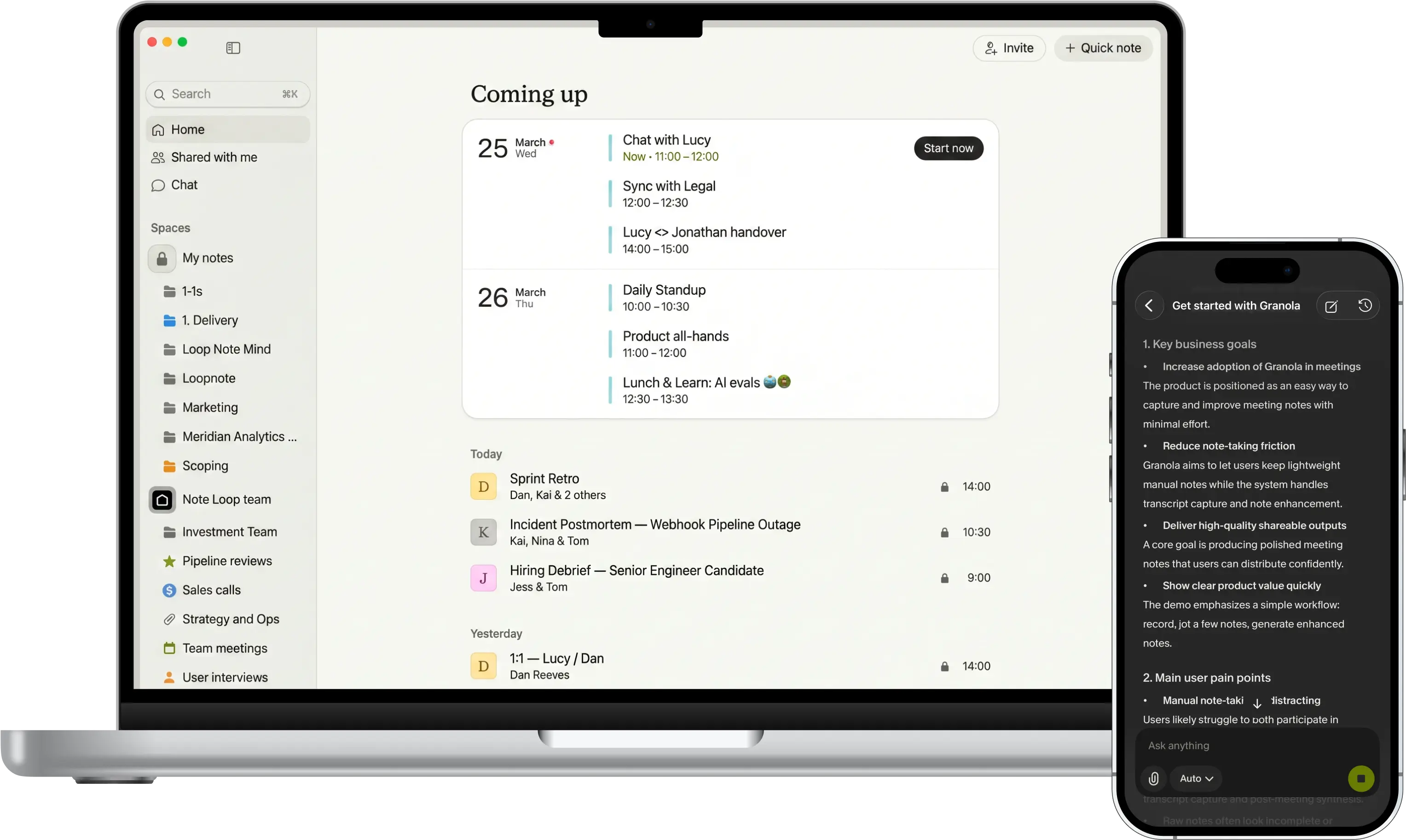
For Granola’s AI notepad, QAwerk built a custom evaluation set covering real-world meeting scenarios, ambiguous audio, and long multi-turn conversations. Version a dataset like this alongside the prompts and model configuration so a regression can be traced to the change that caused it. When comparing LLM testing services, ask how the provider builds and maintains these datasets, since the dataset defines what the testing can catch.
How to Choose Test Data Management Tools
Pick test data management software by the data sources it supports, whether its masking keeps referential integrity across those sources, how it plugs into your CI/CD pipeline, and whether testers can provision data themselves instead of filing a ticket and waiting days.
The same K2view survey found that 90% of test data management (TDM) users rely on tools more than 15 years old. It also found that 49% of C-level executives are satisfied with their TDM, compared with 5% of managers. Before buying, ask the people who provision data daily what slows them down.
Criteria to score every candidate against:
- Source coverage: every database, file store, and SaaS system your tests touch.
- Referential integrity under masking: the same customer masks to the same values everywhere.
- Synthetic generation: rule-based at minimum, AI-assisted for free-text fields as an option.
- Self-service and CI/CD hooks: an API or CLI the pipeline can call to provision and tear down data.
- Compliance reporting: evidence of what was masked, where, and when.
- Licensing model: per-database, per-user, and per-volume pricing diverge sharply as environments multiply.
Test data management tools fall into three categories, and buyers compare the commercial ones on Gartner Peer Insights:
- Enterprise platforms such as Perforce Delphix, K2view, and IBM InfoSphere Optim handle masking and provisioning across many sources at scale.
- Database-focused tools such as Redgate Test Data Manager and DATPROF cover subsetting and masking for fewer databases with less setup.
- Open-source libraries such as Faker generate synthetic values inside test code at no license cost, leaving referential integrity up to you.
A tool does not fix ownership, whichever you choose. Test data management solutions automate provisioning and masking, but someone still has to decide which patterns apply to which suites and retire stale copies. Without that person, buying software moves the problem without solving it.
When Test Data Management Services Make Sense
Bring in test data management services when nobody owns test data, when flaky tests regularly block releases, or when an audit or new regulation forces a cleanup of non-production environments. In each case the gap is people and process, which a tool cannot fill on its own.
The first trigger is organizational. Developers seed their own data, QA keeps a spreadsheet of test accounts that still work, and staging gets refreshed whenever someone remembers. A dedicated QA team can map what each suite needs, choose patterns from the comparison table, and document the setup.
The second trigger is a pipeline nobody trusts. If engineers rerun failing builds out of habit, test data is a likely cause, and the fix means rebuilding fixtures, reset logic, and seeding inside the automated testing framework itself.
The third trigger is external pressure. A GDPR data subject request, a Digital Operational Resilience Act review at an EU financial entity, or a failed audit can reveal real customer data sitting in staging. In Perforce’s 2026 State of Data Compliance and Security Report, 43% of organizations reported audit issues or failures in non-production environments.
Why Partner with QAwerk
Test data problems show up as random regression failures, personal data in staging, and test accounts unlike real users. QAwerk has tested software since 2015, across 300+ projects in North America, Australia, Europe, South Korea, and Africa, and is named in the International Association of Outsourcing Professionals (IAOP) Global Outsourcing 100.
In practice, stable test data is what keeps a release schedule predictable. QAwerk helps ClickHouse maintain weekly releases and reliably deliver updates to Microsoft, IBM, and other top-tier clients. The team has also automated 70% of test scenarios for a microservices-based payment app.
Test data management is ongoing work, and our QA engineers can join at any stage of your test suite. If test data is what holds your releases back, contact us to talk through your setup.
FAQ
What is test data management?
Test data management is the practice of creating, provisioning, protecting, and maintaining the data that software tests run on. Its goal is test data that looks like production, exposes no real personal information, and stays identical between runs, so that every test failure points to a real defect instead of a data problem.
What is the difference between data masking and synthetic test data?
Data masking starts from real production records and replaces sensitive values with fictitious ones, keeping real-world structure and relationships. Synthetic test data is generated from rules or models and was never real. Masking preserves realism but carries re-identification risk, while synthetic data is safer by design but needs validation to match production behavior.
How does test data cause flaky tests?
Test data causes flaky tests when tests share mutable data. One test changes or deletes a record another test relies on, so results depend on run order or timing. In a study of 7,571 flaky Python tests, order dependency caused 59% of them. Test-owned data, resets between runs, and fixed seeds remove most of this risk.
What should I look for in test data management solutions?
Look for coverage of every data source your tests use, masking that keeps referential integrity across systems, synthetic data generation, an API or CLI for self-service provisioning in CI/CD, and audit-ready compliance reporting. Check that licensing stays affordable as environments multiply, and decide who on your team will own the patterns the tool runs.
See how we built and maintained 1,100+ test cases for Granola, an AI notepad, and automated 76% of its regression suite