When a testing team joins your project, they’ll ask for your requirements first. That request feels vague when what you’ve got is old specs, a few tickets, and knowledge that lives in people’s heads. Software testing requirements are the written descriptions of what your product should do, clear enough for somebody outside your team to check the result.
They cover the features you’re building, the business rules behind them, and the conditions that decide whether it works. Testers read them to learn what counts as correct.
However, “having requirements” and “having requirements someone can test against” are two different things. Plenty of teams have documents that describe the product accurately and still leave a tester with no way to prove a feature works. That difference is what this guide is about, because it decides how quickly your testing starts and how much of it runs on guesswork.
You’ll see which documents testers actually use, what makes a requirement testable, how a QA team reviews the ones you send, and where to start when none of it exists yet. If that last one sounds familiar, our technical writing services cover exactly that gap.
What Are the Software Testing Requirements a QA Team Needs?
Most teams hand over the specs and tickets they already have and hope it’s enough. It usually isn’t, though the shortfall is rarely where they expect. Four documents carry the information testers need, and you probably have two of them already:
- SRS, the software requirements specification. This is the detailed one, listing each feature and describing how it should behave.
- BRD, the business requirements document. It sits above the SRS and explains why the product exists and who it serves.
- User stories and use cases. These come at the same thing from the person’s side, showing what somebody is trying to get done.
- Acceptance criteria. These are the shortest and often the most useful, a handful of conditions that settle whether a feature is finished.
SRS
How each feature should behave
Business analyst or product owner
Testers guess at intended behavior, then report working features as bugs
BRD
Why the product exists and who it serves
Business stakeholders
Effort spreads evenly instead of protecting what earns you money
User stories and use cases
What a person is trying to accomplish
Product owner, with the team
Coverage follows screens rather than real journeys, so broken paths survive
Acceptance criteria
The conditions that settle whether a feature is done
Product owner, refined with QA
Every release ends in an argument about whether the work is finished
You don’t need all four to begin. A clear set of acceptance criteria does more for a tester than a hundred-page specification nobody has opened since last year. What matters is that somebody outside the conversation can read your software testing requirements and know what to check.
There’s also an official standard behind all this. ISO/IEC/IEEE 29148, currently in its 2018 edition, covers how requirements should be written and what a specification ought to contain. You almost certainly don’t need to read it, and most teams never do. It’s worth knowing it exists, because an auditor, a regulator, or a large enterprise customer may ask which standard your requirements follow.
What Makes a Requirement Testable?
A requirement is testable when a person who didn’t write it can read it, check the product, and reach the same conclusion as everyone else. That sounds obvious, but it gets lost because whoever wrote it already knows what they meant, so the gaps stay invisible to them.
Here’s the difference in practice.
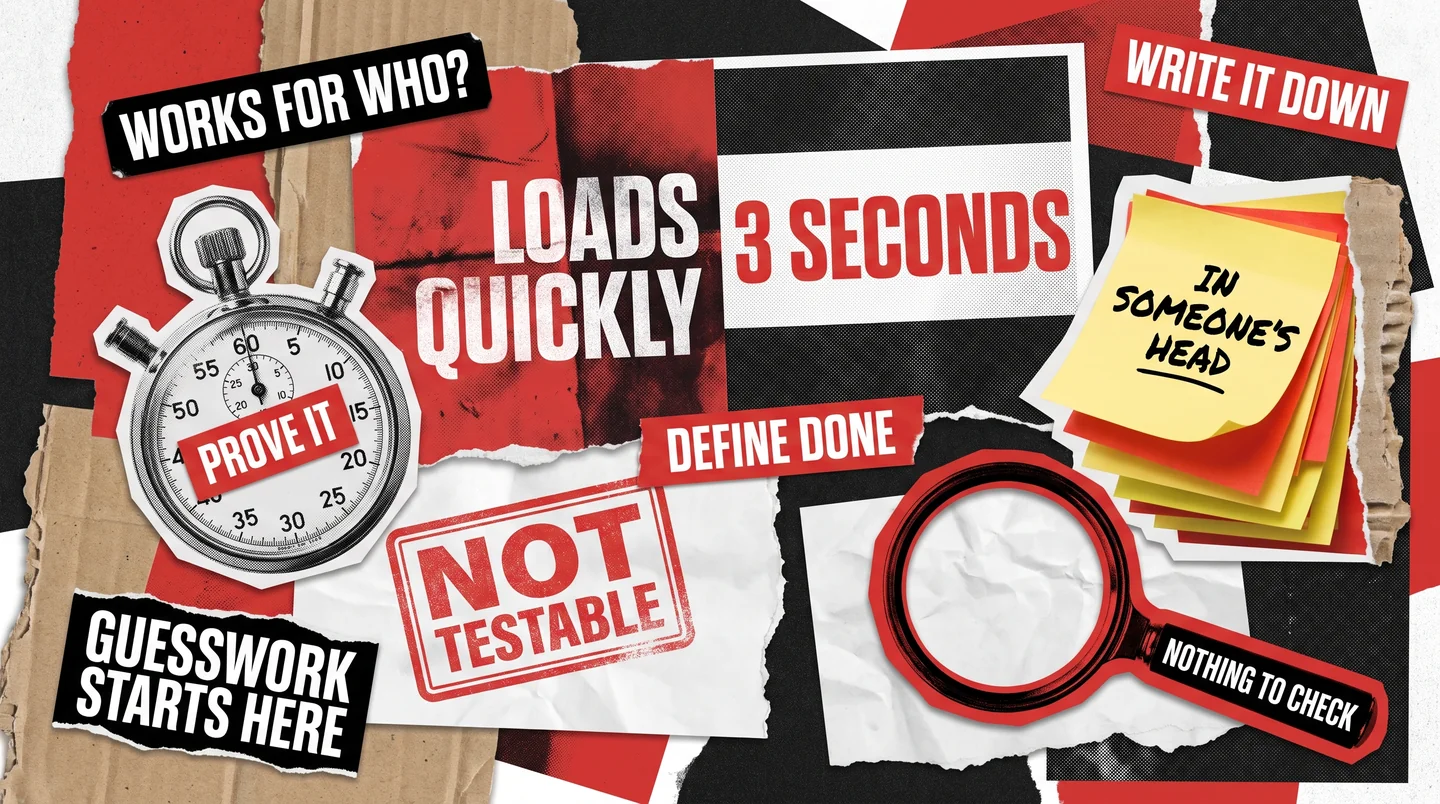
The app should load quickly.
The product list appears within 3 seconds on a normal mobile connection.
Users should be able to reset their password.
A reset email arrives within 2 minutes, and the link stops working after 24 hours.
Checkout should handle errors gracefully.
If a card is declined, the cart keeps its items, no money moves, and the shopper sees the reason.
Notice what changed: each testable version names something a person can observe and agree on. None of them needed more technical detail, only a decision somebody had to make sooner or later.
Three questions will tell you whether a requirement is ready:
- Can you describe what “working” looks like without the words good, fast, or easy?
- Would two people reading it expect the same outcome?
- Can somebody check it without asking the author what they meant?
Answer yes to all three and the requirement turns into a test case almost directly, which is where our functional testing work usually starts.
How Does a QA Team Review Your Requirements?
Before anyone runs a single test, a good QA team reads what you sent and comes back with questions. That review is quick, and it prevents a lot of wasted work later.
A reviewer looks for a specific set of problems:
- What should happen when something fails, since most documents describe only success
- Situations nobody mentioned, such as an empty account, a first-time visitor, or an expired card
- Two documents that say different things about the same feature
- Rules with no number attached, like fast, secure, or user-friendly
- Who is allowed to do what, when nobody has written it down
Every item on that list becomes a question for your team. Answering one while the documents are still being written is quick. The same question after release means changing code, running the tests again, and explaining the delay to whoever reported the problem.
It helps to separate a few related terms. Requirements are what testing starts from. The objectives of software testing are what testing is for. Checking your product against those documents is called verification, and confirming it solves the right problem is validation. We explain the difference in verification vs validation in software testing.
Why You Should Not Wait for Final Documentation
Teams often hold QA back until the paperwork is finished. However, on a product still being built, it never quite is.
Waiting costs you twice:
- Contradictions survive. A conflict between two documents goes unnoticed until somebody writes code against it, and by then fixing it means rebuilding rather than editing.
- You lose your best reader. A QA engineer going through a half-written spec will spot the missing pieces as a matter of habit.
So hand over what exists today, partial as it is. Testers can start building checks from the parts that are settled while the rest catches up, and their questions feed straight back into the documents you’re still writing.
This is why we join projects at whatever stage they’ve reached instead of waiting for a finished handover. Our guide to agile testing shows how that runs sprint by sprint, and our walkthrough of software testing phases covers the stages the work itself moves through.
What to Do When Your Requirements Are Incomplete
Plenty of products reach us with almost nothing written down. It’s normal, especially once the team that built the first version has moved on. You’ve got more raw material than you’d think.
- Write down what the product does now. On a working product, current behavior is a legitimate source, and confirming it beats inventing it from scratch.
- Start with the journeys that earn money. Sign-up, checkout, and renewal deserve written conditions long before a settings screen does.
- Turn what people know into acceptance criteria as you go. Every answer somebody gives in a meeting is a requirement waiting to be captured.
- Put those decisions somewhere findable. A shared page beats a chat thread, which beats one person’s memory.
That work is a writing job rather than a testing job, so most QA vendors will hand it straight back to you and wait. By contrast, we write the missing documents ourselves and then test against them, which spares you paying two companies to agree with each other.
That’s how the Logo Maker Shop project ran. Its Android version reached us with no test documentation at all, and the rules that did exist were scattered as comments on Figma screens. We rebuilt the rest from how the iOS app already behaved, asked for what was missing as we went, and wrote 270 test cases from the ground up.
How QAwerk Closes the Requirements Gap
Clear software testing requirements pay off for a plain commercial reason. They cut the hours your team spends explaining the product, they reduce the defects that turn out to be misunderstandings, and they end the argument about whether a feature is done. Testable requirements are what make all three possible.
When your documents fall short of that, we close the gap in three steps. First we read what you have and come back with the questions it raises. Then we put the missing pieces in writing, so your test cases come from a document instead of an assumption. Meanwhile testing starts on whatever is already agreed, and grows from there. We’ve done this across 300+ projects, with 30+ senior QA engineers on the team averaging 9 years of experience each.
If you’re unsure whether what you’ve got is enough to test against, book a call with our QA team and we’ll go through your documents before you commit to anything.
FAQ
What are software testing requirements?
Software testing requirements are what a QA team works from, usually a specification, a business document, user stories, acceptance criteria, or some mix of those. Their job is to state what the product should do in terms precise enough that a tester can decide, without asking anyone, whether a given result is correct or a defect.
What is an SRS in testing?
An SRS, or software requirements specification, is the long-form document that sets out every feature in detail. Using an SRS for testing means each expected result traces back to a written line, so a tester can tell a real defect from something built that way on purpose. Teams running short sprints often skip it and rely on user stories plus acceptance criteria instead.
What makes a requirement testable?
Look for adjectives. Fast, secure, intuitive, and user-friendly all describe an opinion rather than a result, so two people will judge them differently. A testable version puts something measurable in their place: a loading time, a permission rule, or the exact steps a person completes. Rewriting one usually takes a sentence, and it removes an argument you would otherwise have at release.
Can testing start without complete requirements?
Yes, and holding out for complete documents usually costs more than starting early. A QA team can work from partial specs, the product’s current behavior, and conversations with the people who know it best. The review turns up the gaps for you, which is faster than writing everything first and finding the contradictions later.
Who writes acceptance criteria?
The product owner normally drafts them, then refines them with the developers and testers who’ll work to them. Writing them alone is the common mistake, because the conditions tend to cover only the case where everything works. A short review with QA adds the ones that first draft misses, and that’s where most disagreements about done actually begin.
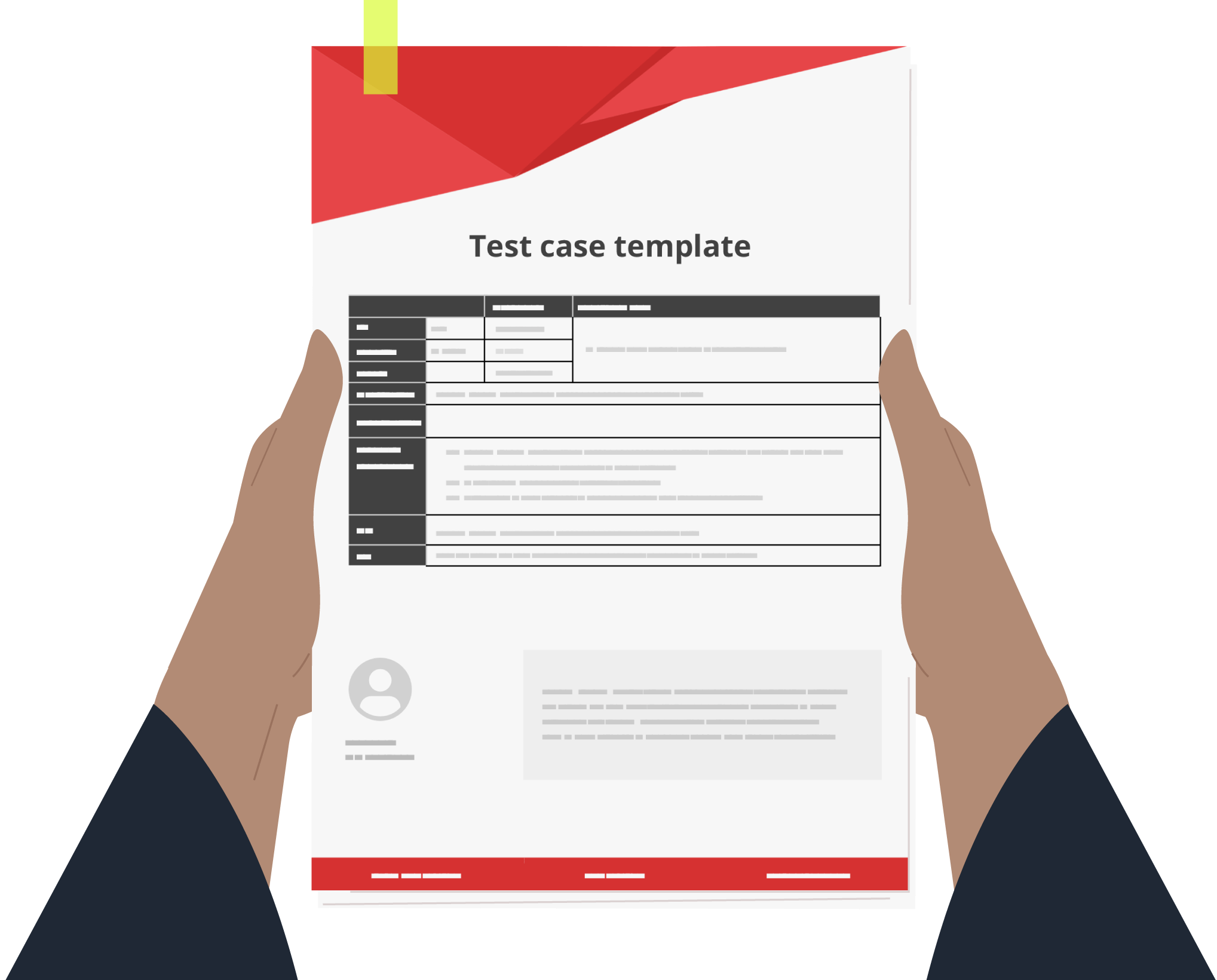
Yours Free: Test Case Template