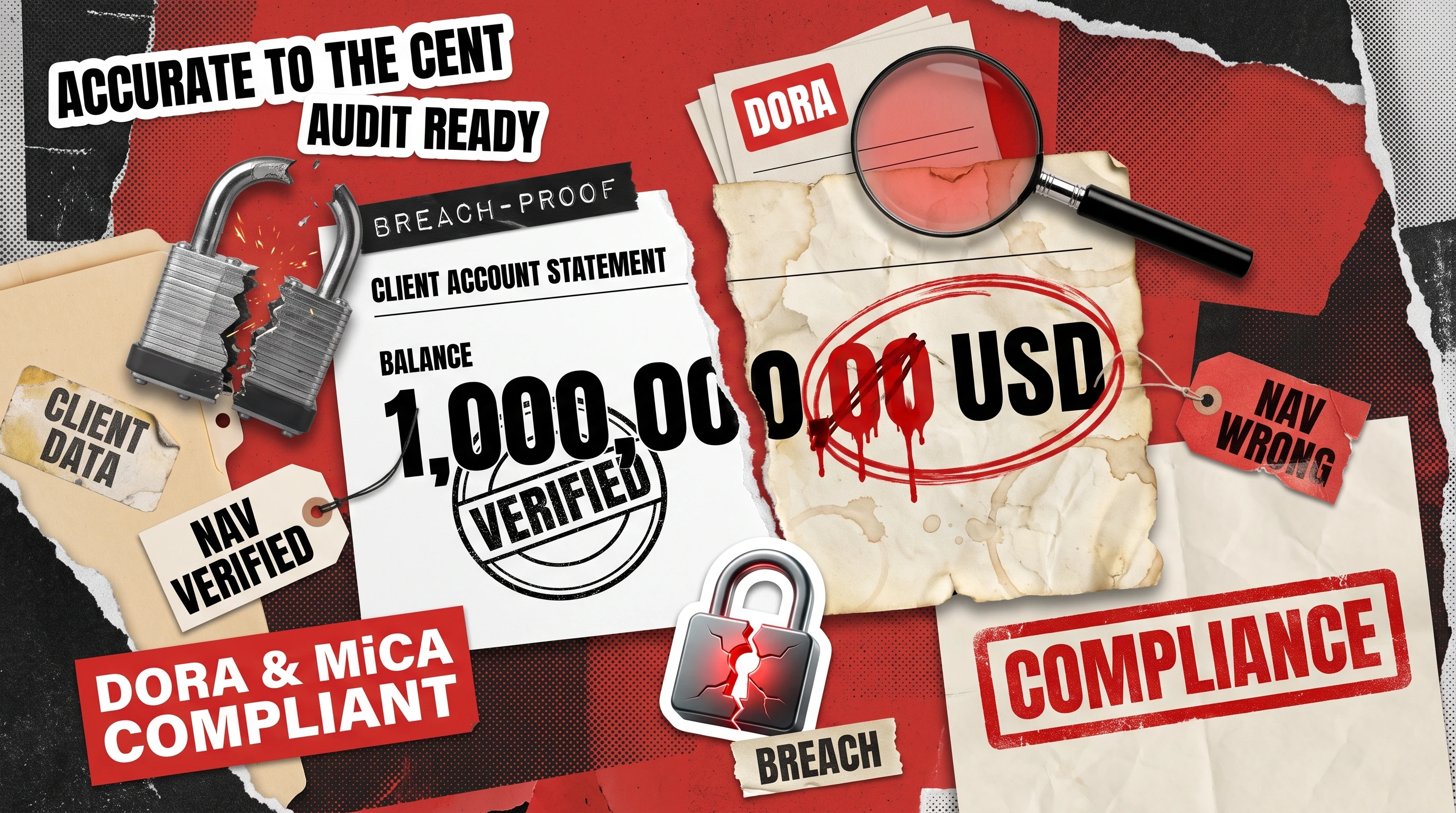
A single overlooked bug in a portfolio valuation formula can quietly turn into a real financial misstatement, the kind that shows up in a client’s statement, an auditor’s report, or a regulator’s inquiry. A data breach on a wealth management platform can do worse: it can end a firm’s reputation in a single news cycle. Wealth management software testing is not a category where “good enough” QA is acceptable, and treating it like a standard web or mobile testing project is how bugs like these reach production in the first place.
Wealth management software testing verifies three things at once: that portfolio, performance, and fee calculations are numerically correct to the cent, that the platform meets financial regulations like DORA, MiCA, and AML/KYC requirements, and that client financial data resists a real attack. Skip any one of the three and the platform is exposed, no matter how solid the other two are.
This guide covers what makes wealth management software testing different from standard QA: financial accuracy, regulatory compliance, and client data security, plus the practical integration and team-coordination challenges that rarely make it into a requirements doc.
If you own quality on a wealth management platform, the real decision isn’t whether to test these three areas, it’s whether your current process actually covers all three at the depth each one needs, or whether it quietly leans hardest on the one your team already knows best (usually functional QA) while compliance and security get a lighter pass. That imbalance is where the expensive bugs live.
Financial Accuracy Testing
Portfolio valuation, performance calculation, and fee calculation are the three places precision matters most, and precision is a different bar than functional correctness. A feature can “work” (the page loads, the number displays) while still being wrong to the third decimal place, and in wealth management, wrong to the third decimal place is a client-facing error.
Portfolio valuation testing checks that net asset value reflects current market prices, corporate actions (stock splits, dividend reinvestment, mergers), and currency conversion correctly, including on the exact day an action takes effect. Performance calculation testing verifies time-weighted and money-weighted returns against a hand-calculated benchmark, not just against the platform’s own prior output. Fee calculation testing covers tiered fee schedules, prorated fees for mid-period account changes, and the interaction between multiple fee types on the same account.
The testing method that actually catches these issues is golden-value regression testing: build a small set of accounts with manually verified, correct expected values, then run every calculation change against that set before it ships. Historical data replay, rerunning real (anonymized) historical market data through the calculation engine, catches edge cases like leap years, zero-balance accounts, and negative cash positions that a synthetic test dataset tends to miss.
Currency conversion and rounding deserve their own test cases, not a single “does the math work” check. A multi-currency account that converts at the wrong rate on the wrong day, or that rounds a fee down instead of up on every single transaction, produces an error too small to notice in a spot check and large enough to matter across a full statement cycle. The fix isn’t more manual review, it’s a test suite built specifically to catch small, systematic errors, not just obviously broken ones.
Regulatory Compliance Testing
Regulatory compliance testing covers two categories: features that exist specifically to satisfy a regulation, and the audit trail that proves the platform followed its own rules.
AML/KYC verification features, identity verification flows, sanctions list screening, and transaction monitoring thresholds, need dedicated test scenarios built around actual regulatory triggers, not a pass through general functional testing. A monitoring rule that never fires in testing because no test transaction was built to trigger it is a rule nobody has actually verified.
Audit trail requirements are just as testable. Every calculation, every access to client data, and every trade recommendation needs to be logged, timestamped, and immutable enough to survive an actual audit, which means testing what happens when someone tries to alter or delete a log entry, not just confirming that logs get written under normal conditions.
This is where QAwerk’s own compliance content is worth pointing to directly rather than making a generic “we test carefully” claim: our DORA Compliance Requirements guide covers the ICT risk management and incident reporting obligations that increasingly apply to wealth management platforms operating in the EU, our DORA Compliance Checklist turns those obligations into an audit-ready checklist, and for platforms that also touch digital assets, our MiCA Compliance Checklist covers the parallel crypto-asset framework. Most competitors writing about wealth management testing gesture at “regulatory compliance” without this kind of published depth behind it.
This is also where fintech testing compliance work tends to get shortchanged under deadline pressure: compliance scenarios take longer to build than functional test cases because they require someone who actually understands the regulation, not just the feature. A test scenario for a sanctions-screening rule needs to know what a real near-match looks like, not just whether the screen returns a result. Treating compliance testing as a checklist to clear rather than a set of regulatory obligations to actually verify is how platforms pass internal QA and still fail an external audit.
Data Security and Penetration Testing
Client financial data, account numbers, balances, transaction history, identity documents, is a high-value target precisely because it’s directly monetizable, which makes wealth management platforms a more attractive target than the average SaaS product handling the same volume of traffic.
Effective testing here goes beyond a general vulnerability scan. It means Penetration Testing Services scoped specifically to the platform’s real attack surface: client portal authentication (including session handling and multi-factor bypass attempts), API endpoints that feed the client-facing app, and the third-party integrations, custodian feeds, market data providers, CRM connections, that most teams don’t think to test because they didn’t build them. Encryption validation, confirming data is actually encrypted at rest and in transit, not just that a policy document says it should be, closes out the core of a real security testing pass.
Session handling deserves specific attention on a wealth management platform in a way it doesn’t on a lower-stakes app: a session that stays valid too long after a password change, or a multi-factor step that can be skipped by replaying an old request, is a small bug with an outsized consequence when the account behind it holds real assets. Test these paths the way an attacker would, not just the way the happy-path user flow does.
When In-House QA Is Enough, and When It Isn't
Not every phase of wealth management software testing needs an outside partner. A team with deep product knowledge and a stable calculation engine can often own financial accuracy testing well on its own, that’s a case where familiarity with the product matters more than specialized tooling.
Regulatory compliance testing and penetration testing are where outside expertise tends to earn its cost. DORA and MiCA obligations change faster than most in-house teams can track alongside a full product roadmap, and effective penetration testing benefits from testers who don’t already know the system’s blind spots, since familiarity is exactly what lets a real vulnerability go unnoticed. The honest answer for most mid-market wealth management platforms is a mix: keep accuracy testing close to the product team, and bring in specialized compliance and security testing on a recurring cadence, not a one-time check before launch.
Practical Challenges: Multi-Stack Integration and Global Teams
Two of the most common financial software testing challenges in this space rarely show up in a requirements doc, because they’re about how the platform is built and staffed, not what it’s supposed to do.
The first is multi-stack integration. Wealth management platforms are rarely built clean; most pair a modern client-facing app with an older portfolio accounting core, plus multiple third-party data feeds for custodian balances, market pricing, and CRM data. Each integration point needs its own contract test, because a change anywhere in that chain, a custodian API updating its response format, a market data feed changing a field name, can break a downstream calculation without an obvious cause. Testing the platform as a single unit and skipping integration-point-level tests is how these breaks reach production.
The second is cross-timezone team coordination. A development team in one timezone, a testing team in another, and compliance reviewers in a third is a common setup for these projects, and without deliberate overlap and a single point of contact, it creates real handoff gaps: a bug found at the end of one team’s day sits untouched for hours before the next team even sees it, and a compliance question raised in review can wait a full day for an answer. This is a genuine argument for a testing partner that works as one team with the client, with overlapping hours and a single point of contact, rather than a vendor silo handing off findings across a time-zone wall.
Both challenges compound each other. A platform with five integration points and a testing team spread across three time zones doesn’t just have two problems, it has a problem that’s harder to diagnose, because a bug that looks like an integration failure might actually be a coordination failure: the fix already exists, it just hasn’t reached the right person yet.
Financial Accuracy vs. Regulatory Compliance vs. Data Security Testing at a Glance
Financial Accuracy Testing
Portfolio valuation, performance calculation, fee calculation
Golden-value regression testing, historical data replay, decimal-precision assertions
A misstated NAV, an over- or under-billed client, a compliance restatement
Regulatory Compliance Testing
AML/KYC verification, audit trail completeness, DORA and MiCA obligations
Compliance scenario testing, audit-log validation, resilience and incident-reporting checks
A failed audit, a regulatory fine, a blocked product launch
Data Security and Penetration Testing
Client financial data, authentication, third-party integrations
Scoped penetration testing, vulnerability scanning, encryption validation
A data breach, client attrition, lasting reputational damage

FAQ
What makes wealth management software testing different from standard QA?
Standard QA checks that a feature works. Wealth management software testing also checks that every calculation is correct to the cent, that the platform can prove compliance with regulations like DORA and MiCA, and that client financial data can withstand a real attack, three separate disciplines that all have to pass at once.
Does wealth management software testing need to cover AML and KYC specifically?
Yes. Identity verification, sanctions screening, and transaction monitoring are core AML/KYC features, and they need dedicated test scenarios built around real regulatory triggers, not just a pass through general functional testing.
How is client financial data protected during testing itself, not just in production?
Test environments should use synthesized or anonymized client data rather than real production financial records, and access to any test environment holding financial data should be logged the same way production access is.
Why is multi-system integration such a common testing gap in wealth management platforms?
Most wealth management platforms combine a modern client-facing app with an older portfolio accounting core and multiple third-party data feeds. Each integration point needs its own contract test, since a change anywhere in that chain can break a calculation elsewhere without an obvious cause.
How long does a wealth management software testing engagement typically take?
It depends on the platform’s scope, but a phased approach, financial accuracy first, then compliance scenarios, then security testing, lets a team start catching the highest-risk issues in the first few weeks instead of waiting for a single end-to-end pass.
Wealth management software testing succeeds when financial accuracy, regulatory compliance, and data security are treated as equally critical, not sequential afterthoughts tacked on before launch. A platform that nails portfolio calculations but fails a DORA audit isn’t ready. One that passes compliance but leaks client data through a weak API endpoint isn’t ready either.
QAwerk brings real, published regulatory compliance depth (DORA, MiCA) alongside dedicated penetration testing, the kind of vertical fluency that’s harder to build in-house than it looks. We haven’t worked with a named wealth management client we can point to publicly yet, and we’d rather say that plainly than imply otherwise. What we can point to: 11+ years testing financial and regulated software, a compliance content library most competitors in this space don’t have, and a team that treats deadline reliability as a deliverable, not a promise.
If you’re bringing a wealth management platform through a testing engagement, talk to us about how DORA Compliance Consulting fits into your QA plan.
See how we optimized onboarding flows for a crypto asset management platform, reducing user drop-off by 15%