

Founders run penetration tests because surprises in production cost real money. A good penetration test lets you see your product the way an attacker would, without the chaos of an actual breach. It pressures your system with the same discipline used in serious QA: controlled conditions, clear evidence, and no room for wishful thinking.
The result? A clear map of where your software stands strong and where it quietly falls apart. And that’s what a penetration test actually uncovers once the testing kicks in.
What a Penetration Test Really Reveals
A penetration test is a structured quality analysis conducted under extreme conditions, such as when your product is subjected to controlled, deliberate pressure. For companies, this is the closest thing to a crash test for software: a clear snapshot of how the system behaves when someone actively tries to break it.
The End Result: A Reproducible Risk Map
A strong pentest captures how your system fails — and how it recovers — with the same discipline used in top-tier QA work. That means:
- repeatable test conditions
- full traceability for every exploit path
- documented evidence instead of assumptions
- clear inputs and clear outputs
This level of clarity matters because it turns the unknown into a roadmap. Engineering teams can scope fixes. Product leads can set timelines. Budget owners can see exactly where investment removes the most risk. A clean, reproducible picture of failure is surprisingly liberating, telling you what to do next.
The Prep Mistakes That Break Pentests
Even the best testers can’t save a penetration test that starts on shaky ground. Poor preparation leads to unreliable results, and unreliable results lead to false confidence — a dangerous flavor of optimism.
The common culprits:
- incomplete asset lists that hide critical systems from the test
- missing test environments that force testers into guesswork
- poor access setup that blocks valid attack paths
- undefined acceptance criteria for what counts as a real finding
- no pre-test baselines, making severity impossible to judge
From a QA perspective, this is a classic story: the quality of an outcome mirrors the quality of the setup. When preparation fails, accuracy suffers, coverage shrinks, and the final report ends up being more fiction than fact. A well-prepared penetration test, on the other hand, generates results teams can trust and act on.
What Powers a Successful Penetration Test
A successful penetration test is powered by a coordinated group of specialists who think differently but work in lockstep. Attackers expose flaws; quality experts prove them, document them, and validate them so the engineering team can fix issues without decoding cryptic notes. It’s a mix of creativity, discipline, and clean execution, and without all three, the test turns into noise instead of value.
The Team You Actually Need
A strong penetration test team looks more like a precision crew than a security team. Each member has a defined role, and together they ensure the test uncovers the right issues and presents them in a way that your product team can actually use.
Lead Pentester
Designs the attack strategy, chooses vectors, and maps how a real attacker would approach your system.
Application & Cloud Security Analysts
Handle modern surface areas: API behavior, container gaps, identity and access management (IAM) weaknesses, and cloud misconfigurations — the usual suspects behind high-impact breaches.
Senior QA / Security Tester (Validation Lead)
The validation lead ensures every finding is:
- Real
- Reproducible
- Supported by evidence
- Written clearly enough for engineering to pick up in a sprint
When QA closes the loop, a pentest becomes engineering-ready.
Documentation Specialist
Transforms raw exploits into readable, actionable documentation. Steps, screenshots, system responses — everything founders expect from serious penetration testing services.
A team like this shows you exactly how and why it broke, so the fix is straightforward.
Governance, Standards & Why Testing Discipline Matters
Security testing works only when it follows a predictable structure. Without discipline, results drift. With discipline, results become trustworthy and ready for real governance conversations.
Modern penetration tests lean on established standards and regulations because they keep testing aligned with real-world threats. For example, many teams use NIST’s updated SP 800-53 controls as a reference point for system hardening. Attack mapping often follows the MITRE ATT&CK 2025 matrix, which reflects current adversary behavior. When reviewing web applications, testers validate their findings against the OWASP Top 10 to ensure nothing slips past accepted best practices.
All of this feeds into clear scoping and documentation, repeatable execution, and defensible results. That discipline is what turns a penetration test from a guess into a confident statement about your compliance posture and your product’s actual resilience.
The Proven Penetration Test Process (From Recon to Reporting)
A pentest is extreme QA. It’s a validated, controlled way to see how your software behaves under hostile conditions, without the chaos of an actual breach. You put your system through tests that simulate real-world cyberattacks to uncover security vulnerabilities, demonstrate how they can be exploited, and evaluate how effectively your team can remediate the threat. A strong penetration test process gives companies clarity.
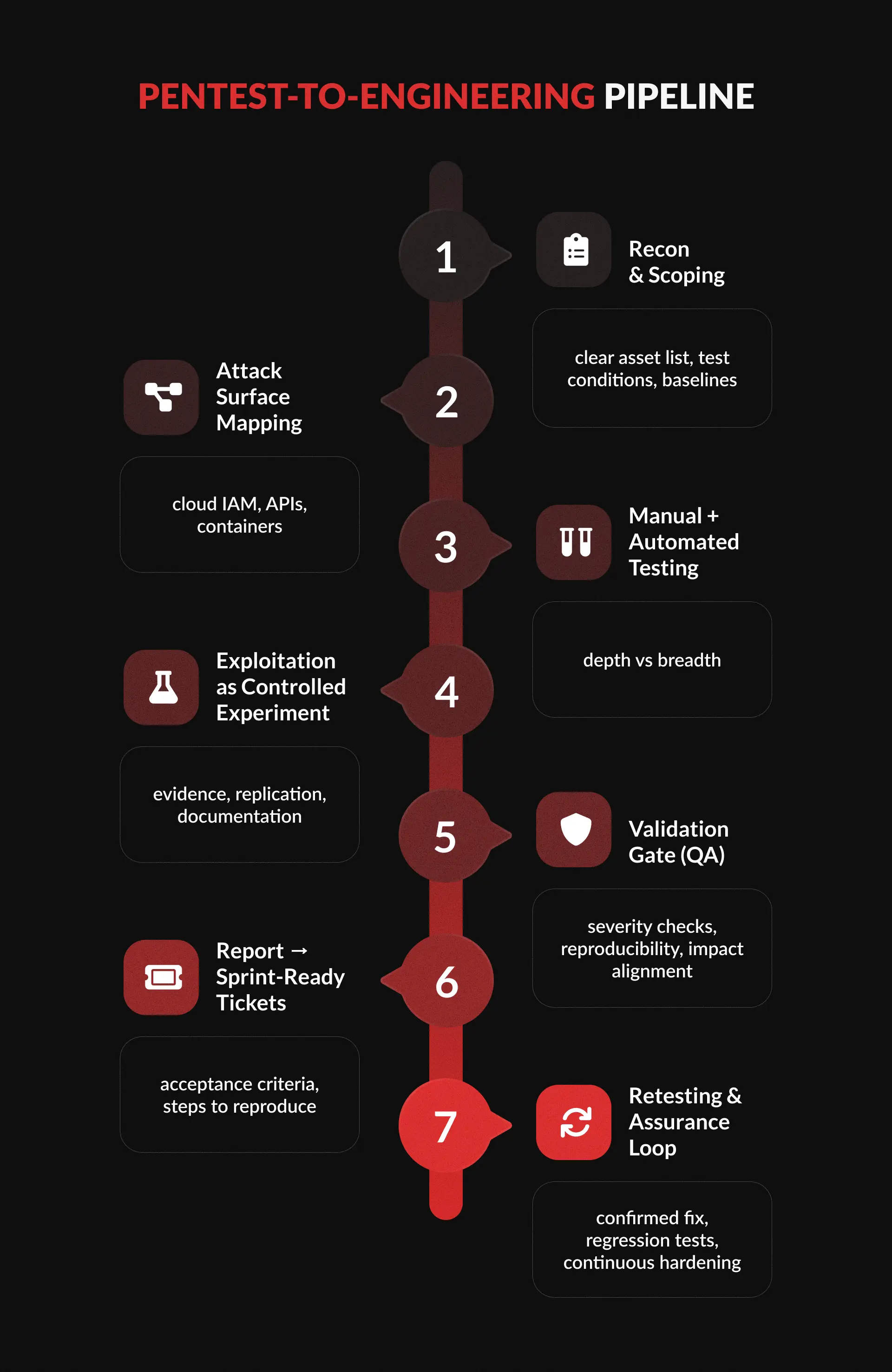
Step 1: Mapping a Test Plan
Every reliable penetration test starts the same way: with a clear, proven test plan. You directly apply here the QA principles, such as scope, coverage, and clarity, to determine how much truth the test will uncover.
Today’s attack surface is bigger than most teams expect. It includes:
- cloud IAM misconfigurations
- container orchestration mistakes
- API endpoints that behave a little too generously
Mapping everything upfront prevents blind spots and ensures the test hits the places where modern systems actually break.
Step 2: Manual and Automation Testing
Tools are useful, but tools alone don’t find business-ending flaws.
- Automation gives you breadth, fast scanning across large systems
- Manual testing gives you depth, as no tools detect the logic flaws and broken trust boundaries
- Strong QA oversight ensures the results are clean: no noise, no false positives, no missed issues
Automation has its place, but relying on it blindly is like checking your software with spellcheck and calling it editing. A human still needs to read it.
Step 3: Exploitation as a Controlled Experiment
If discovery is the setup, exploitation is the experiment, run under controlled testing conditions with the precision of a lab.
A strong exploitation phase includes:
- controlled inputs
- repeatable replication
- cross-verification
- detailed documentation
- evidence (screenshots, logs, payload traces)
Nothing here is chaotic. For a professional security tester, it’s structured, deliberate, and documented.
Step 4: Quality Assurance for Security Findings
A QA mindset pays off when a finding survives validation.
QA reviews each entry for:
- accuracy (does it work exactly as described?)
- reproducibility (can engineering follow the steps?)
- severity (is the impact justified?)
- exploitability (can an attacker really pull this off?)
- impact alignment (does the risk match the asset’s value?)
This final quality assurance pass makes the difference between a report your team trusts and the one they quietly ignore.
Step 5: One Sprint Reporting Fix
A pentest report should feel like a well-written ticket your team can drop into the next sprint with no translation required.
Clear, actionable reporting uses QA clarity principles:
- Acceptance criteria for verifying the fix
- Steps to reproduce, clean and complete
- Expected vs actual behavior
- A simple impact narrative
- Fix-first prioritization that respects engineering time
This way, a chaos of “security issues” becomes a clean, manageable roadmap.
What Strong Pentest Results Really Look Like
Not all penetration test results are created equal. Some reports look impressive at first glance, but offer little you can actually use. Instead, strong results are structured, actionable, and defensible. They help your team fix issues fast without decoding vague descriptions or chasing false alarms.
How to Read a Pentest Report Correctly
A good report tells a story. A QA lead reads that story fast by triaging four essentials:
- Critical chain: Which findings can chain together into a real breach?
- Business impact: Does the issue threaten data, uptime, or customers?
- Reproducibility: Can engineering follow the steps without guesswork?
- False-positive check: Does the evidence match the claim?
A clean report becomes a guide for decision-making. You immediately see what matters, what can wait, and what demands action before the next release.
The Red Flags of a Weak Report
Weak reports tend to share the same DNA: they look noisy, not effective, and your engineering team quietly pushes them aside.
Common warning signs:
- duplicate findings copied and pasted across sections
- vague descriptions that don’t explain the root cause
- missing proof or incomplete evidence
- severity levels that don’t match the real security impact
- no test conditions, making reproduction impossible
- unclear or missing steps to recreate the issue
Signs You’re Working With a Serious Partner
Great reports feel different. They read cleanly, logically, and confidently, a proof you’re working with a truly successful partner, not someone running tools and calling it insight.
Look for:
- clean tables that organize findings by priority
- clear, repeatable steps to reproduce the issue
- strong remediation guidance tailored to your stack
- contextual severity scoring that goes beyond CVSS numbers
- business-layer explanations your leadership team can understand
These are the hallmarks of a partner who respects your time, your engineers, and your product’s integrity.
How a Penetration Test Drives Real Product Quality
A good penetration test feeds directly back into the product lifecycle. QA thinking bridges that gap. It turns raw findings into structured engineering tasks, integrates security into everyday delivery workflows, and ensures your team fixes issues in a predictable, testable way. This is where security work stops being an interruption and becomes a product advantage.
Turning Findings Into a 30-Day Fix Plan Your Team Can Actually Deliver
Strong security improvements follow the same flow as improving any part of your software: clear priorities and realistic timelines.
A practical 30-day plan looks like this:
- Backlog prioritization: Critical chains first, cosmetic issues last
- Sprint planning: Scope fixes into sprint-sized chunks your team can actually deliver
- Dependency mapping: Identify areas where one fix unlocks many others
- Testing gates: Treat each fix like a release: test, validate, and verify before closing the ticket
This is also where founders begin to understand how penetration testing frequency fits into their roadmap. Regular testing reveals recurring mistakes, risky areas of the codebase, and security tasks worth automating or shifting earlier in development.
Integrating Security Without Slowing Down Releases
When well integrated, security becomes just another quality step inside the modern environment.
QA thinking keeps the pipeline efficient by:
- flagging high-risk code paths for automated scans
- adding lightweight checks before merges
- defining when manual review is required versus when automation is enough
- ensuring new features don’t reopen old vulnerabilities
This approach turns security from an after-the-fact audit into a quiet, predictable part of the release flow.
Validation, Retesting, and Maintaining Assurance
Fixing a vulnerability isn’t complete until it’s been validated under controlled conditions. Retesting ensures the fix behaves as expected and does not create new issues.
A strong validation loop includes:
- retesting every critical fix
- verifying unchanged behavior across adjacent components
- documenting test conditions for future checks
- feeding lessons learned back into coding and review practices
This cycle keeps quality steady and prevents regressions. Over time, it builds a predictable rhythm, allowing teams to maintain confidence in their product’s security throughout its entire lifecycle.
Choosing the Right Pentest Partner
Fast-growing teams need a partner who understands product velocity and can strengthen it. The right pentest provider delivers actionable insights and verified fixes without slowing down releases.
A strong partner helps you uncover hidden logic flaws and pinpoint configuration risks. You get predictable timelines and transparent reporting. Many founders use a simple web app penetration testing checklist during vendor calls to make sure they’re choosing a team that can keep pace with their roadmap.
Working with specialists who combine security expertise with QA discipline means your product ships faster, safer, and with fewer surprises. This shows how well that insight fits into your workflow and how smoothly it helps your team deliver a more resilient product.
Final Thoughts
Security needs structure. A clean, disciplined pentest gives you evidence that you can trust, fixes that your team can ship, and a product that grows stronger with every release. Founders who value clarity and simplicity already know the rule: a clean test today saves you months tomorrow. And when your product moves fast, that kind of clarity becomes a competitive edge. Contact us today to start building a more resilient security architecture.
See how we helped a fast-growing design platform achieve launch-ready stability by eliminating critical issues