Welcome to another tech talk where we sit down with our partners to discuss the realities of scaling high-tech solutions and the leadership philosophies that drive them. In this session, we explore our long-standing partnership with VirtaMed, a prominent leader in medical simulation. You will discover how a culture of radical transparency and cross-industry curiosity can accelerate product development, and the strategic value of having a dedicated QA team fully integrated into your internal workflows.
We’ll also dive into the “One Minute Manager” approach to problem-solving, the importance of acting fast on team morale, and why choosing a partner based on trust often outweighs the simple math of hourly rates. There are deep insights here for anyone managing complex software-hardware ecosystems, so stay with us until the end!
Meet Christian!
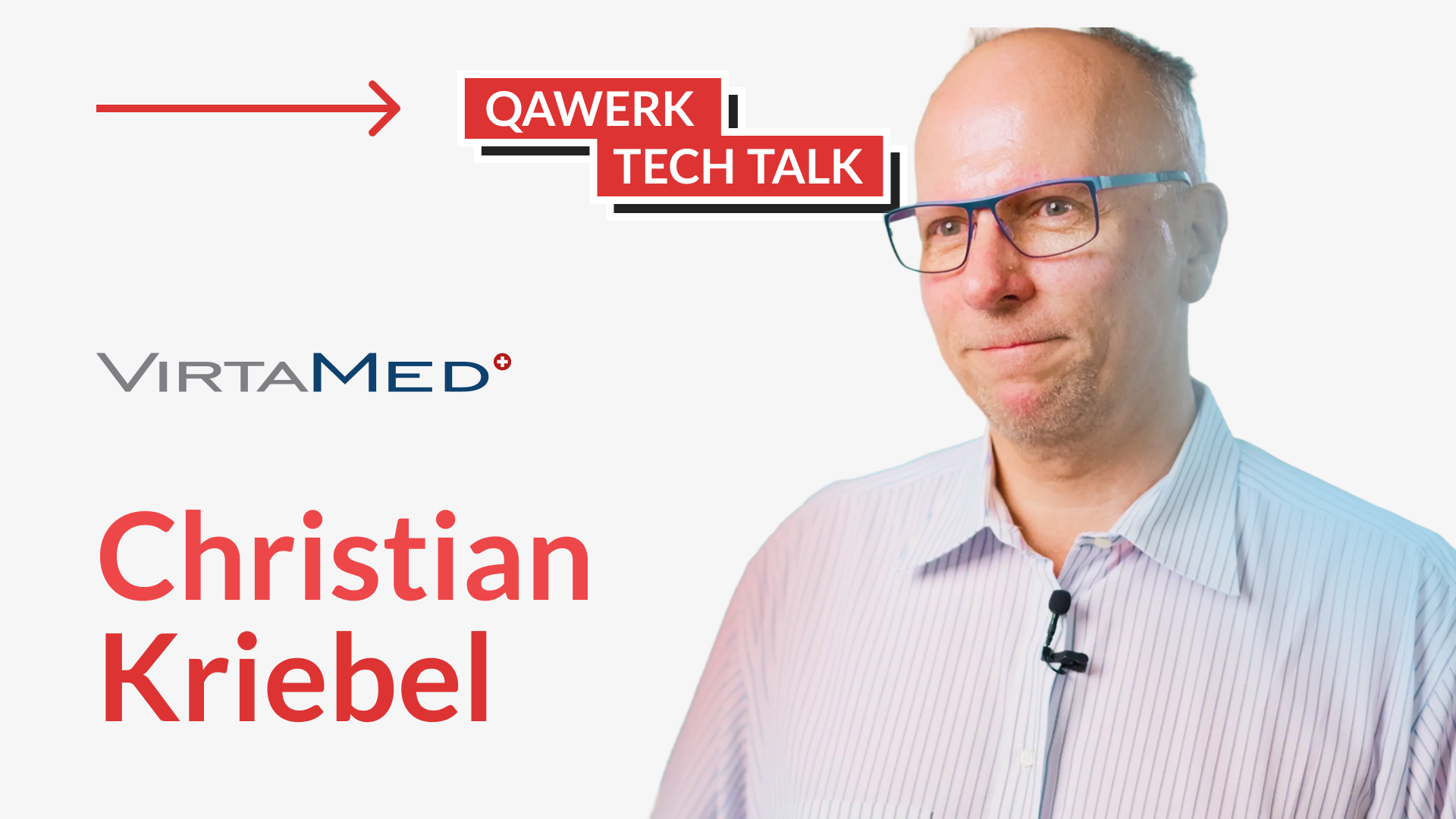
We invited Christian Kriebel, a seasoned leader at VirtaMed, to share his perspective on managing multi-functional teams and maintaining high standards in medical tech. With years of experience in both startups and established companies, Christian discusses the necessity of stepping out of the box to find innovation in unexpected places like the automotive or space industries. He also opens up about the human side of business, from supporting partners during global crises to the personal joy of teaching his daughters MINT-related topics. Let’s dive right in!
Inside VirtaMed: Mission & Culture
Please introduce yourself and tell us about your role at VirtaMed.
My name is Christian. I am the CTO at VirtaMed.
What drew you to VirtaMed in the first place?
I studied chemistry and physical chemistry, and also did my PhD in that field. It had to do with simulation physics, but I never worked in that field. And then, I had several IT programming and architecture-related positions in the past. I was also an IT manager in a financial organization. I founded and owned a company producing software, and so on. And my professional life has always been divided by changing the business domain from time to time to find new challenges and interesting fields. So, at VirtaMed, I found an advertisement which drew my attention, and I started as the Head of Software Development back in 2018.
What’s the company culture like at VirtaMed?
So, company culture at VirtaMed goes back a little bit in history. I started when all these agile development types of processes were not in place — 30 years ago or even longer. And then, this whole process and change in IT and software engineering started to become less of a top-down and command-and-control-like organization. It’s always about working as a team, working in sprints of two weeks or four weeks or so. And this brings more collaboration and interaction between the employees, but also team leads and maybe also the managers. Company culture is open. Everyone can contribute. Almost all information is available to everyone.
What impact does your service have on society?
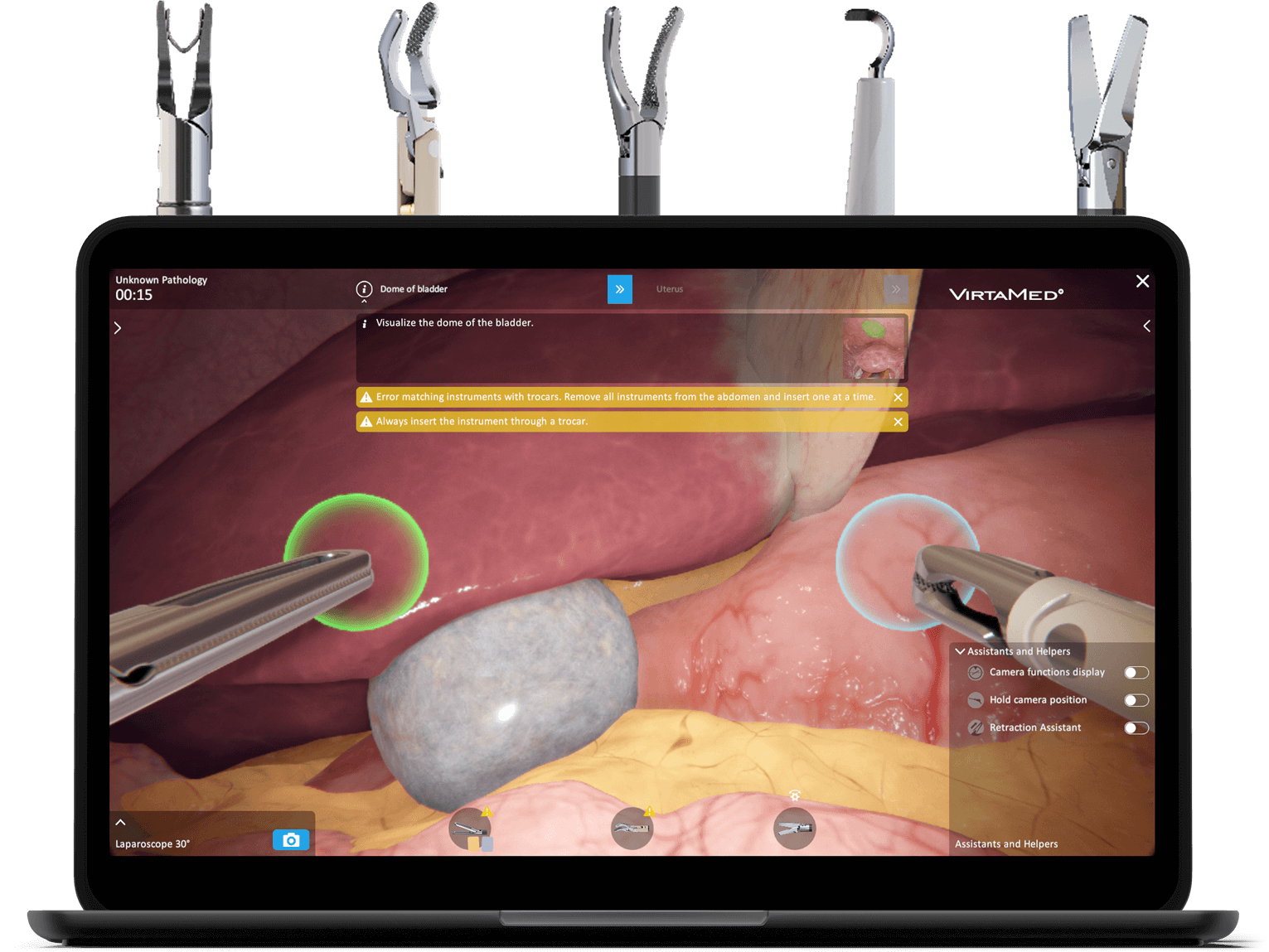
So, I think this is mainly — if you consider, for example, a specific procedure like a prostate treatment, which we as men will probably have an issue with at some point in our lives. There are different types of treatments for a prostate that has grown too large. So, to train a surgeon on a specific medical device that is used, for example, a laser or electric burning instrument that burns away tissue, and in order not to hurt the patient, it’s good that they learn on a specifically designed instrument how to use it and how to perform the procedure. They can repeat it as often as they want, but not on a real patient. It’s the outcome — the patient safety thing — where we can contribute.
Collaborating with QAwerk
Before QAwerk, how did VirtaMed handle quality assurance, and what were the limitations of that approach?
Before we made the contract and hired QAwerk, we tested everything on our own. I think that everything that is not our core business has a good chance of being outsourced. It’s the same for IT infrastructure, for example. If you have something that is recurring every week, every month, and you have to retest again and again, why should I not outsource this task, right?
So, before QAwerk, we did everything on our own. Our people got bored with doing and running the same thing over and over again. And then we thought, “Hey, is there a partner or a potential company out there who can help us with that?” And then we did research on potential companies, did a few interviews, and finally found QAwerk. It was exactly at the time back in 2022 when the war started in Ukraine, and there was some fear that we should not make this deal with QAwerk, but I insisted on doing it with them to support them as well.
When you began searching for a QA partner, what qualities or criteria were most important to you and your executive team?
So, discussing external companies I would consider hiring for something: it’s the personal relationship and appearance of the sales guy, or the people who want to sell their services to us. Imagine, I get bombarded with calls and messages every day, and usually, I delete them all. If, in the first meeting, I cannot trust this person because of body language, what they say, or how they behave, then it’s a red flag.
It takes a few meetings. It’s not that everything is just an online meeting to hire someone. I can give an example: we were looking for an IT outsourcing partner here in Switzerland, and they showed up with three people here in our office. And then I said, if they have three people for the first contact to show up here, maybe it is a little bit of overkill, right? So, it is not related to the skills that they have; it’s the trust.
Of course, in the first place, my boss, the CEO, would say, “Hey, you go for the cheapest company you find out there,” and maybe a $10-per-hour job somewhere remotely. And it’s not like this. Of course, they want me to have, from a financial perspective, the best source there. But it’s always a package, right? If you hire the wrong person, even remotely or externally, it’s much more expensive than paying a good price for the service.
Can you break down what VirtaMed handles in-house versus what you outsource?
So, QAwerk is doing testing for our cloud platform, for example. They also helped us with annotating images and videos for machine learning purposes. So, we have a team working with QAwerk very directly on a daily basis, so to speak, and they are integrated; the people from QAwerk are integrated into the team.
Of course, they are joining remotely using Teams and so on, but the team lead or the project managers know the output from them. Also, it’s teamwork: if a developer develops something, they test it, and this is a recurring feedback cycle between developer and tester. We do not very extensively measure things like how many bugs they have found, but we keep an eye on whether they find the right things. If it’s something simple — the “start” button is not red, it’s blue — that’s easy. But if we were to deploy or finalize a device and send it to a customer and then find a bug, it is much more expensive than figuring it out before. And I like the way QAwerk approaches this; in the end, it’s again about good people: interested, motivated to do things, and sometimes even achieving more than we expect.
Lessons in Leadership
What is the hardest skill to hire for today?
I think the hardest skill to hire at this time in 2025 is related to soft skills. Finding people who are interested in doing work at all. People who can spend some extra effort if needed. And also — how can I say this? — it’s a commitment, right? So, a commitment to what you do. So, especially at VirtaMed, it’s not just a job like a construction worker, for example, where every day you go there and do the same work; here, you have something else every day. It requires commitment, interest, and also the ability to develop yourself. All these skills, technical skills, you can train, you can learn; but the soft skills, like wanting to do it, wanting to learn — this is, I think, the crucial thing if you hire people today. Yes, being able to commit is the key point.
What’s the best way to communicate within an organization, in your opinion?
So, the most important thing to communicate within a company is to have a policy like ‘open doors,’ not hiding problems, and being fast in decisions. Imagine, sometimes you have employees who are not fitting into the team, and then team morale goes down. You have to act fast because the good people on the team will get quiet, and then they leave. You don’t want that. Another thing is: if you have a bad year in terms of profitability, you should communicate this because people realize it somehow. So, this is an open style of communication and it’s on both sides. It’s top-down, but also bottom-up, to recognize and hear what every employee has to say and thinks.
What does it take for a company like VirtaMed to stay ahead and maintain its position as a leader?
If you have a problem in your product development and no one has an idea how to solve it, I say we can solve it. We can make it ten times faster, for example, even if every engineer thinks it’s not possible. Because, from my experience, it is possible to some extent. Of course, if the goal is not too ambitious. But ambitious goals can be achieved if you just hop out of your box and look around at what’s out there in the world. Don’t always have this tunnel view on how you did things in the past; and so, that’s, I think, my answer to this.
So, if you just look around at what others are doing, for example, in the automotive industry, space, even telecom, or whatever — they have hardware, they have software, they do something. So, how are they doing it? How are they successful? How do they produce ideas?
Is there a book you’d recommend to our audience, and why?
So, I have a team of six team managers. I recommended and gave them this book, The One Minute Manager. I forgot the author there, but it’s a small book and it always repeats the same topic. It is this: if you as a manager come to me and ask a question about how you would solve a problem, I say, “Go back, think about it, and come back with a proposal.” This is my message, and this works very well. If you cannot solve it alone — hey, let’s gather our team and discuss it as a team. So, in most cases, you as a team lead or employee are able to solve a problem. If you start thinking about it, you will have a few ideas on how to solve it. But I know people tend to say, “Hey, I have a problem; my boss has to solve it for me.” But we have to change this.
What motivates you to keep moving forward with your projects?
I have to say, I was always curious about things that I don’t understand. I’m still like this, so I am also having fun with what I’m doing. I couldn’t work for a company where I’m bored; I would look around and look for something else. My wife always complains, “Hey, you are sitting all the time at the computer. You are working.” And I’m saying, “No, I’m not. I’m just interested in learning new things, so, this is learning.” And also, of course, my family is a huge part of my life: engaging with them and helping my daughters to learn math or any MINT-related topics.
What’s the most difficult decision you’ve had to make in your career?
Sometimes in professional life, you have difficult decisions to make. For example, if the business is not running very well, you have to separate from people to cut costs. This happened, and it is not a very nice thing, even if it happens two times in a row. I think this is, in professional life, one of the worst situations. Of course, when I had my own company and the team was fighting all the time and not working together, this was another reason that I left.
Closing Thoughts
The partnership with VirtaMed highlights a crucial business truth: it is much cheaper to find a bug during development than to fix it once the product is in the customer’s hands. By integrating our team directly into the developer feedback cycle, we help our partners save time and protect their reputations. At QAwerk, we are committed to the long-term quality and financial health of your project.
If you need help scaling your testing efforts or want to integrate a high-performing QA team into your workflow, reach out to us for a free consultation. Let’s talk about your project and start building a reliable solution together.
See how we helped bug-proof a VR training solution for surgeons and secure a CHF 12M government project