
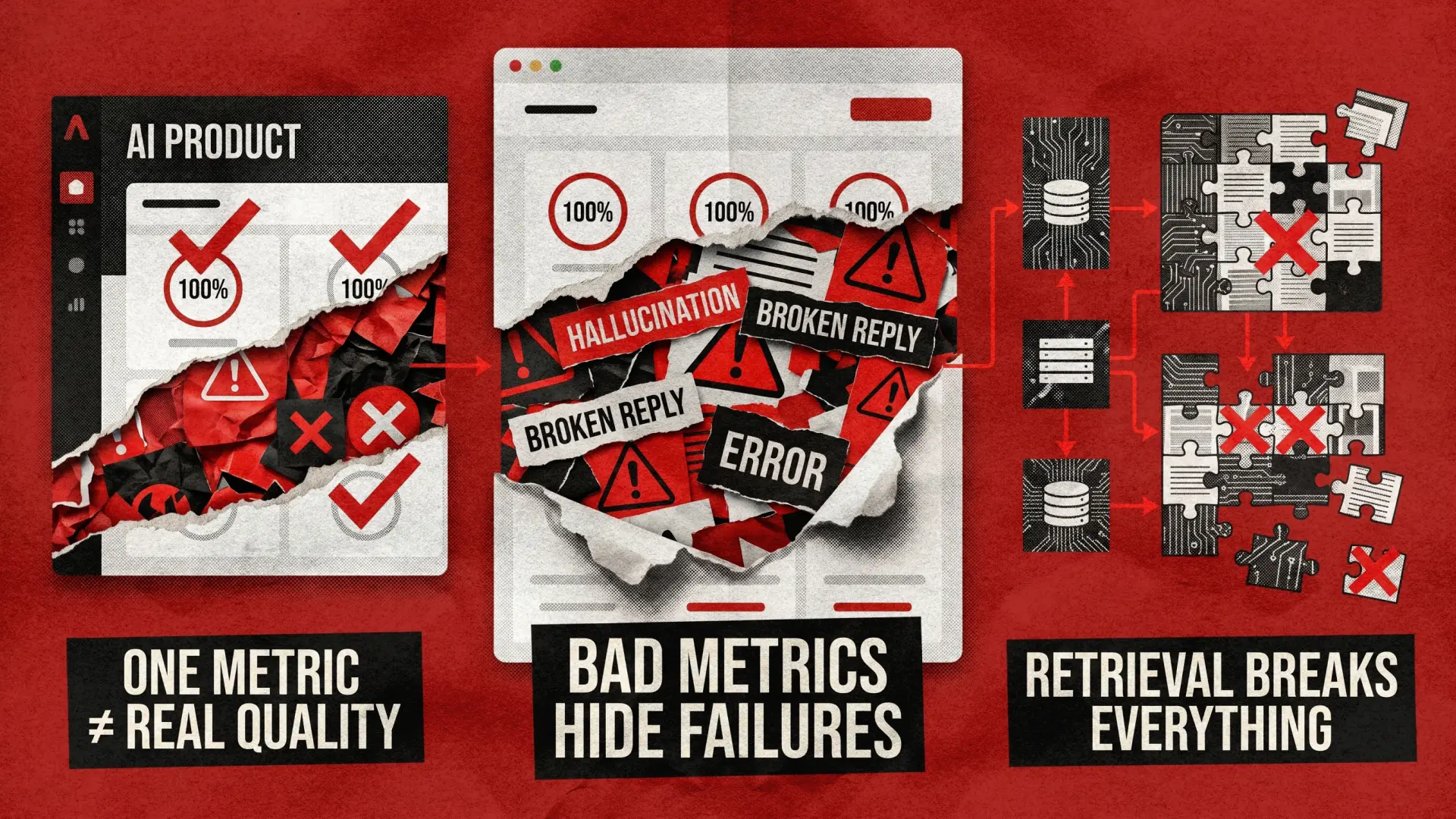
Shipping an LLM without a proper evaluation strategy is a gamble most teams don’t realize they’re taking. 67% of organizations worldwide now run LLMs in production, but the majority still rely on LLM evaluation metrics designed for 2018-era machine translation or skip structured evaluation altogether. The result is predictable: hallucinations that make headlines, chatbots that give illegal advice, and model updates that silently break things no one notices until users start leaving.
This article covers the LLM evaluation metrics that actually matter. We’ll discuss what each one measures, when to use it, what score to aim for, and the details most teams miss. If you are thinking of hiring a dedicated QA team or engaging any other type of testing services to evaluate your LLM-powered tools, you definitely need to know this information.
Top 10 LLM Evaluation Metrics That Truly Matter
Before diving in, here’s one thing you should know: the right metrics for LLM evaluation depend on which of three contexts you are operating in:
- Base Model Evaluation
Choosing or fine-tuning an LLM and benchmarking raw capability. - RAG Pipeline Evaluation
Combining an LLM with a retrieval system and evaluating the full chain, not just the model. - Agentic Evaluation
An LLM takes actions, calling tools, and making multi-step decisions, which require specific LLM agent evaluation metrics that most standard LLM benchmarks do not cover.
Keep your context in mind as you read. The metrics below map to all three, and the summary table shows which apply where.
Faithfulness
Output stays within the source material, no invented claims
RAG pipelines
Answer Relevance
Response actually addresses the user’s question
Chatbots, Q&A tools
Context Precision & Recall
Quality of what the retriever pulled, not just what the model generated
RAG pipelines
Hallucination Rate
Percentage of outputs with factually incorrect claims
High-stakes domains
BLEU / ROUGE
Text overlap between the generated output and the reference answer
Translation, summarization
Perplexity
Model’s fluency and confidence in predicting the next token
Base model evaluation
Toxicity & Bias Score
Rate of harmful, offensive, or discriminatory output
All customer-facing products
Task Completion Rate
Whether the agent actually finished the job end-to-end
Agentic systems
Latency vs. Quality
Speed and quality relationship under real load
All production deployments
LLM-as-a-Judge (G-Eval)
Human-like quality scoring using a secondary LLM as evaluator
Open-ended generation
Faithfulness
Faithfulness measures whether the model’s output contradicts the source material it was given. If your LLM is answering based on retrieved documents, a faithful response makes only claims directly supported by those documents. Any claim that goes beyond the source is a hallucination.
This evaluation metric is essential to consider when implementing the RAG best practices and building a pipeline. This is non-negotiable if your product answers questions based on internal documents, knowledge bases, or external data. The score to aim for is above 0.8 on a normalized 0-1 scale, as measured by frameworks such as Ragas or DeepEval. Below 0.7, and you likely have an LLM hallucination detection problem at scale.
Bear in mind that faithfulness only indicates whether the model stayed within the source. It does not tell you whether the source itself was the right one to retrieve. That is a separate problem covered by context precision and context recall.
Answer Relevance
The answer relevance metric is essential for customer support bots, internal Q&A tools, documentation assistants, and any interface where users ask direct questions and expect direct answers. It measures whether the response actually addresses the user’s question. A model can be completely faithful to its source material and still give an answer that drifts off-topic or answers a different question than the one asked. When evaluating, aim for scores of 1+, as anything below 0.75 usually indicates the model is paraphrasing the context rather than answering the user.
It’s essential to consider that answer relevance is sensitive to prompt design. Therefore, a poorly structured system prompt often causes relevance scores to tank even when the model itself is capable. So, be sure to check the prompt before blaming the model.
Context Precision and Context Recall
These are two sides of the same coin in LLM evaluation metrics, and they live at the retrieval layer of your RAG pipeline, not the generation layer.
- Context precision indicates how much of what was retrieved was actually useful in answering the question. High precision means the retriever is not pulling in noise.
- Context recall tells you how much of the information needed to answer the question was present in the retrieved chunks. If the recall level is high, the retriever is not missing critical content.
You need to consider these LLM evaluation metrics whenever you are debugging a RAG system that yields low faithfulness or relevance scores. Often, the model is fine, and the problem is upstream in the retriever.
Many teams measure only LLM output quality and overlook that 60 to 70% of RAG evaluation failures stem from retrieval, not generation. If you skip these two metrics for LLM evaluation, you are flying blind on half your stack.
Hallucination Rate
This is one of the top LLM evaluation metrics that measures the percentage of outputs that contain factually incorrect claims. Unlike faithfulness, which compares the output to a retrieved context, the hallucination rate measures factual accuracy against the ground truth, making it harder to automate but more meaningful for high-stakes use cases.
This is a crucial evaluation metric for AI solution development in legal, medical, financial, or compliance applications, where a factual error can have real consequences. In addition, it’s essential for any product where users are likely to act on model outputs without verifying them.
For most LLM evaluation metrics for production, aim for a hallucination rate below 5%. If you are in a high-stakes domain, that threshold should be closer to 1%.
Bear in mind that LLM hallucination detection is expensive to measure at scale because it often requires human review or a secondary LLM as a judge. Therefore, it’s essential to budget for this before you commit to it as a key metric.
BLEU and ROUGE
Some reference-based LLM performance metrics compare a model’s output against a known correct response. They are:
- BLEU (Bilingual Evaluation Understudy)
It measures n-gram overlap between the generated and reference text, with a focus on precision. It was originally designed for machine translation. - ROUGE (Recall-Oriented Understudy for Gisting Evaluation)
It focuses on recall and is commonly used to evaluate the quality of summarization.
You need to use these metrics when building translation pipelines, structured summarization tasks, and document generation tools, where you have a defined correct output. The score to aim for is highly domain-specific. BLEU above 0.4 is generally acceptable for translation. Meanwhile, ROUGE-L above 0.5 is a reasonable baseline for summarization.
However, you should never use BLEU or ROUGE as standalone metrics for LLM evaluation in open-ended applications. Research published in 2024 confirmed that both metrics are poor predictors of real-world LLM performance for conversational or reasoning tasks. They penalize valid paraphrases and miss semantic equivalence. They belong in your toolkit but not as your primary signal.
Perplexity
This LLM evaluation metric is unrelated to Perplexity AI. It measures how confidently the model predicts the next token in a sequence. Lower perplexity means the model is more certain about its outputs. It is a proxy for fluency and coherence at the language modeling level.
You need to evaluate model perplexity during base evaluation and fine-tuning. It’s useful for comparing model versions or measuring the impact of a training run on output fluency.
However, remember that perplexity tells you nothing about factual correctness, relevance, or task completion. A model can have very low perplexity and still produce confident nonsense. Therefore, you should use it as a supporting signal during model development, not as a production-level quality gate.
Toxicity and Bias Score
The toxicity score is the measure of how often a model produces harmful, offensive, or discriminatory content. This evaluation metric allows you to flag outputs that include slurs, threats, or explicit material. Meanwhile, bias scores surface patterns in which the model systematically treats groups differently, for example, by giving better answers to questions framed around one demographic than another.
You should implement these LLM evaluation metrics for every customer-facing deployment, full stop. Beyond user experience, the EU AI Act, which has been in force since 2024, requires high-risk AI systems to demonstrate testing for accuracy and safety across protected characteristics. This is now a compliance requirement, not an optional quality check.
To evaluate this in your product, you can use Google’s Perspective API (for toxicity) and custom LLM evaluation sets tailored to your specific domain. But bear in mind that generic toxicity classifiers often miss subtle, context-specific harm. A legal document generator might produce content that passes standard toxicity filters but still exposes your organization to liability. Domain-specific evaluation sets matter here, so be sure to account for this with a custom AI testing plan.
Task Completion Rate
The task completion rate is used to determine whether the LLM actually accomplishes the goal it was given. This is the most important of the LLM agent evaluation metrics and the one most teams measure last, if at all. For an agentic system, task completion rate asks: Did the agent finish the job? It’s not “did it produce a response” but “did it achieve the objective, use the right tools, and reach a valid end state?”
Any system in which the LLM takes actions rather than just generating text must be evaluated on this parameter. Booking systems, code generation agents, workflow automation, and data analysis pipelines are some of the top examples where a high task completion rate is a mandatory requirement. Depending heavily on task complexity, you should aim for 90%+ for simple single-step tasks. For multi-step agentic workflows, 70% is often considered strong, and anything below 50% means the agent needs rework before it ships.
Note that the task completion rate is almost impossible to measure without a proper LLM evaluation framework. Therefore, you need to define success criteria for each task type before you start measuring. If your team has not written those criteria yet, that is the first thing to fix.
Latency vs. Quality Trade-off
This one is a bit different in terms of LLM evaluation metrics. It is not a single metric but a relationship between two things: how long the model takes to respond and how good the response is. In production, these two dimensions are in constant tension. A slower, more capable model might produce better outputs but frustrate users who expect answers in under two seconds.
Every production deployment needs to define acceptable latency thresholds alongside quality thresholds. Knowing how to evaluate LLM performance in isolation gives you an incomplete picture of whether the model is actually ready to ship.
What to track:
- Time to first token (for streaming interfaces)
- Total response latency (for batch or non-streaming)
- Quality score at each latency bucket
Teams often optimize for quality during development and discover latency problems at load testing. If you are using performance testing as part of your QA process, make sure LLM latency is included in the test plan from day one, not added as an afterthought.
LLM-as-a-Judge Score (G-Eval)
In this case, a secondary LLM is used to evaluate AI model outputs against a set of natural language criteria. G-Eval, introduced in research by Liu et al. (2023), is one of the most widely adopted implementations of the LLM-as-a-judge evaluation approach. Instead of relying on n-gram overlap or rule-based checks, a judge model reads the output and scores it on dimensions such as coherence, relevance, and task completion.
You need to account for this LLM evaluation metric with open-ended tasks where there is no single correct answer, long-form generation, reasoning tasks, and any case where you need a scalable human-like quality signal without paying for human annotators on every evaluation run.
The power of LLM-as-a-judge evaluation is that you control the scoring criteria. Define them clearly before you run evaluations. However, do not forget that LLM judges have their own biases. They tend to prefer longer responses, more confident-sounding text, and outputs that mirror their own training distribution. Mitigation strategies for this include using a different model as the judge than the one being evaluated, running multiple judges and averaging scores, and calibrating the judge against human annotations on a sample set.
How to Pick the Right Metrics for Your Use Case
Not every metric applies to every product. However, there is one rule that applies across all of them. It’s always best to combine at least one reference-based metric with one reference-free metric and one task-specific metric. A single metric is never enough, and using more than five without a clear purpose is noise.
Customer support chatbot
Answer relevance, hallucination rate, toxicity
Latency, LLM-as-a-judge
RAG pipeline
Faithfulness, context precision, context recall
Answer relevance, hallucination rate
LLM agent
Task completion rate, faithfulness
Latency, hallucination rate
Code generation assistant
Task completion rate, functional correctness
BLEU, latency
Summarization tool
ROUGE, faithfulness
Answer relevance, LLM-as-a-judge
Fine-tuned base model
Perplexity, accuracy benchmarks (MMLU)
Bias score, BLEU
Key Metrics for ROI of LLM Evaluation Platform Investment
Building an LLM evaluation pipeline costs time and money upfront, but not building one costs more. Here is how to frame the ROI case:
- Cost of a single production hallucination incident: Air Canada’s chatbot hallucination case resulted in a court ruling requiring the airline to honor a price the bot never should have offered. The reputational and legal costs of that incident far exceeded any investment in LLM evaluation infrastructure.
- Cost of poor model selection: Only 5% of GenAI programs achieve rapid revenue acceleration. One of the most consistent failure modes is teams selecting or fine-tuning a model without a structured LLM evaluation process to measure LLM output quality and verify it actually works for their use case.
- Cost of no regression testing: Every model update introduces the possibility of regression. Without LLM evaluation metrics tracked over time, you have no early warning system. Therefore, regression testing integrated into your QA pipeline is a must.
Teams that implement structured LLM evaluation pipelines consistently report lower defect escape rates and faster iteration cycles because they can safely update models without fear of silent regressions. QAwerk’s AI testing services are structured around exactly this approach. Contact us today and let’s develop a plan tailored to your business goals.
See how we helped this AI-powered app scale nationwide