
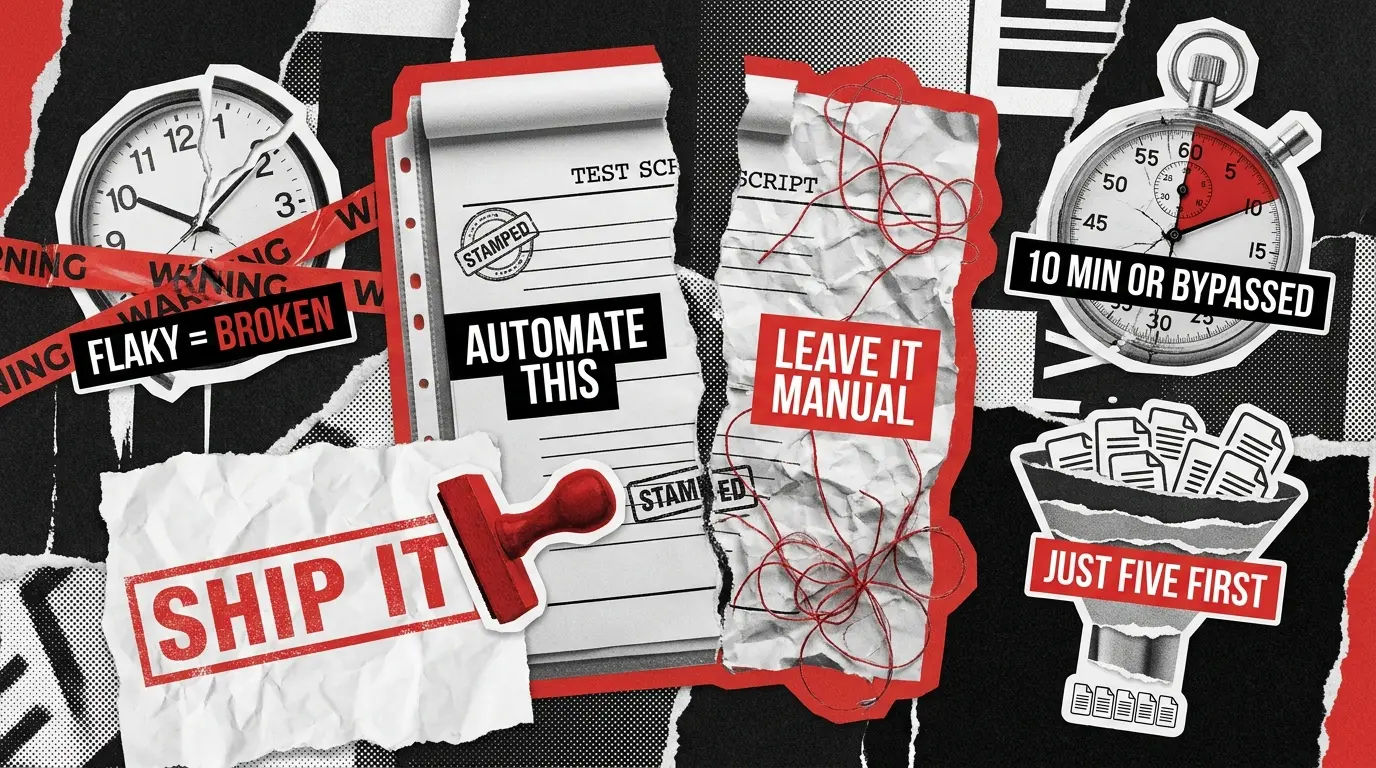
Every QA lead has watched the same movie. A team decides to automate everything, celebrates the coverage numbers for a quarter, then spends the next year drowning in flaky tests and rewriting scripts every sprint. The suite that was supposed to save time is now the reason releases slip, developers merge around a red pipeline, and the CFO starts asking why the QA line item keeps growing while shipping velocity does not.
The lesson from 300+ projects: the ROI of automated regression testing comes as much from what you don’t automate as from what you do. This guide walks through the decision framework, the six-step setup, the CI/CD placement, and the practices that keep a suite alive past year two. Locking down the fundamentals of regression testing matters before any automation strategy scales, because automating the wrong thing faster is still the wrong thing.
One quick answer for readers scanning: you automate regression testing by prioritizing stable, high-frequency paths, wiring them into your CI/CD pipeline behind stable locators, and budgeting time for maintenance from day one.
What to Automate, What to Leave Alone
The fastest way to burn a QA budget is to treat “automate more” as a strategy. According to the World Quality Report, average automation coverage across organizations sits at only 33%, and just 8% report a fully established automation strategy. The gap is not effort. It is knowing where automation actually pays back.
Where Automation Pays Off
Five categories consistently return the investment:
- Stable, high-traffic user paths. Login, checkout, account CRUD, core search. These flows change slowly; they are run by every user, and a broken login costs revenue within minutes.
- Repetitive smoke vs sanity checks. Anything that runs on every build. Manual execution burns tester hours that scripts do in seconds.
- Data-driven tests with many input permutations. One script covers hundreds of currency, locale, or payload combinations. Manual coverage is fantasy.
- Cross-browser and cross-device compatibility. Impossible to do manually at any real scale, trivial once scripted and parallelized in a cloud grid.
- API contract tests. Fast, stable, close to the business logic, and cheaper to maintain than end-to-end UI tests.
The wins in these categories compound quickly. On e-commerce platforms where we automate regression testing across core checkout and account flows, the release cycle can tighten enough to move from monthly to weekly shipping, which is often what unlocks the next stage of growth. Choosing the right automated regression testing tools matters as much as choosing what to automate in the first place, because the tool ceiling is often the coverage ceiling.
Where Automation Burns Money
The opposite list is where most doomed suites are born:
- Volatile UI still in active design iteration. Every sprint changes the DOM; every change breaks the test. Maintenance eats the gain.
- One-off exploratory checks. Zero return on script cost when you run something once.
- Usability and visual polish judgments. A script cannot tell you that the button feels wrong. A human can.
- Features on the deprecation runway. Automating what you plan to remove is a waste.
- Anything you run once per release. The tester was faster.
The gray zone in between is real: features that are stabilizing but not yet stable. Wait one or two release cycles before scripting them. A useful rule of thumb: if the feature has changed shape twice in the last three sprints, it is not ready. If the same test scenario has passed manually across three consecutive releases without needing rewrites, it is a candidate. Locking in a script to a moving target is how suites rot, and no amount of self-healing tooling can fix a fundamentally unstable target.

How to Automate Regression Testing: A Six-Step Setup
Order matters here. Most teams skip step one, and it is exactly why their suite starts leaking value in month six. Below is the sequence we walk clients through when we set up how to automate regression testing from scratch, and how to do automated regression testing without ending up with a suite nobody trusts.
- Audit what you already have. Inventory the manual test suite and tag each case with frequency, criticality, and stability. You cannot automate what you have not mapped, and you should not automate what is already dying.
- Rank by ROI. Frequency of execution multiplied by business criticality multiplied by stability. The easy tests to script are rarely the ones that pay back. The Mordor Intelligence report notes that 68% of DevOps practitioners now run automated tests on every commit, up from 51% a year earlier. That volume only works when the right tests were picked in the first place.
- Match the framework to your stack. Selenium for legacy web breadth, Cypress or Playwright for modern JavaScript apps, Appium for mobile. Framework choice cascades into everything downstream, which is why building an automated testing process around the wrong tool is expensive to unwind later.
- Script the critical five first. Not fifty. Five. Pick the paths that hurt most if they break, prove their value within 4 weeks, and use that credibility to expand scope.
- Build for maintenance from day one. Page Object Model, shared components, versioned test data in Git. A well-designed test framework is what makes this step possible without a rewrite six months in.
- Plug it into CI/CD. Trigger on pull request, run in parallel, notify the right channel on failure. A suite that runs nightly on someone’s laptop is not automation; it is a hobby.
The teams that treat these as sequential are the ones whose suites are still delivering value three years in.
Where Regression Automation Fits in CI/CD
Automation without pipeline integration is a filing cabinet full of scripts nobody runs. The point of automating is fast feedback, and fast feedback means the tests fire at the right stage of the pipeline. The principle is tiering: cheap, fast tests early and often; expensive, slow tests less frequently. A team running the full regression suite on every commit is wasting compute; a team running nothing on commit is shipping blind.
Four stages, four different suites:
- Pre-merge on every pull request. Fast smoke plus unit regression. Target under 10 minutes total. If it takes longer, developers stop trusting the gate and start merging around it. Anything over 20 minutes will be bypassed within a quarter.
- Post-merge to main. Broader integration regression that catches interaction bugs the smoke suite misses. Runs in the background, blocks nothing, but posts results to the team channel so failures get triaged before they compound.
- Nightly. The full cross-browser and cross-device matrix. Parallelization keeps it under an hour on modern grids. This is where the long tail lives: obscure browsers, edge-case viewports, low-traffic locales.
- Pre-release. The exhaustive suite, including performance and visual regression. This is the last gate before production. If pre-release finds a bug the earlier tiers missed, that gap is a lesson: something belongs in an earlier stage.
On the Evolv engagement, wiring automated regression testing into CI/CD compressed release regression cycles by roughly 50%, from three or four days to two. That gain came from tiering, not from writing more tests. The same suite, run at the wrong stage, would have produced the opposite result: developers waiting on pipelines, testers waiting on developers, releases delayed.
Automated Regression Testing Best Practices
The difference between a suite that lasts twelve months and one that lasts five years is discipline, not tooling. Below are the automated regression testing best practices that recur in every long-running engagement.
- Keep tests independent. No shared state between cases. If test B needs test A to have run first, both tests are broken. Reset state in setup and teardown, every time.
- Version test data like production code. Git-tracked fixtures, seeded in the pipeline, no manual database setup. Test data that lives in a shared staging DB will drift, and drift causes false failures.
- Quarantine flaky tests immediately. A flaky test is a broken test. Pull it out of the main suite the moment it flakes twice, root-cause it, then fix it or delete it. Once developers stop trusting the suite, the suite is finished. That trust is easier to lose than to rebuild.
- Set a maintenance budget. 20% of QA engineering time is spent on suite hygiene rather than on new tests. Skip this, and you will build faster than you can maintain. The Capgemini report cited above found that 60% of organizations still struggle to secure and scale test data, which is a maintenance problem masquerading as a tooling problem.
- Use stable locators.
data-testidattributes negotiated with developers, not brittle XPath expressions that break on the next markup shuffle. This one requires developer buy-in, and the QA lead who cannot get it will lose the maintenance war. - Parallelize aggressively. Sub-15-minute feedback on the PR-gate suite is the target. Modern cloud grids and containerized environments make this cheap.
- Monitor suite health metrics. Pass rate, execution time, flakiness trend, defect-catch efficiency. A suite you do not measure is a suite you cannot fix.
Teams that skip practices three and four see automation ROI collapse inside twelve months. It happens quietly: pass rates drift down, developers start ignoring reds, the suite becomes noise, someone proposes rewriting from scratch, and the cycle repeats. The rewrite rarely fixes it, because the missing discipline was never a tooling problem.
The Teams That Win at Automation, and Why
Winning teams are rarely the ones with the biggest suites. They are the ones with the right suites: stable paths automated, volatile ones left manual, everything wired into CI/CD, maintenance budgeted like any other engineering cost. Automation ROI is a discipline, not a tool purchase.
Since 2015, QAwerk has built CI/CD-integrated regression suites across 300+ products, helping e-commerce, SaaS, and fintech teams cut release friction and ship faster without sacrificing stability. If your suite feels brittle, or you are staring at a manual regression cycle you know should be automated, contact us, and we will tell you which cases pay back first.
FAQ
What percentage of regression tests should be automated?
Aim for 70 to 80% of tests to be stable and repeatable, keeping the remaining 20 to 30% manual for exploratory work and features still in flux. The right coverage matters more than full automation. Over-automating volatile areas creates more maintenance work than the tests save.
Can all regression testing be automated?
Automation handles repetitive, deterministic validation well, but does not replace exploratory testing, usability judgment, or checks on features still under active design. On volatile UI and one-off scenarios, a script costs more to write and maintain than to run manually, so the ROI drops sharply.
How often should automated regression tests run?
On every code commit for smoke suites, targeting under 10 minutes. On every merge to main for broader integration checks. Nightly for the full cross-browser matrix. Pre-release for the exhaustive suite, including performance and visual regression checks.
See how we helped Kazidomi automate 284 regression and functional tests, cutting release friction across an e-commerce platform serving 17 countries