
If you develop Android apps, your compliance to-do list just got longer. A wave of US age verification laws is forcing Google Play to rethink how apps reach younger users — and your development roadmap needs to reflect that. Four states have passed App Store Accountability Act legislation that shifts age-checking obligations to app stores and, by extension, to you. California took a different route, targeting OS providers instead. As for the deadlines, Utah kicks in May 2026. Louisiana follows in July 2026. Alabama and California’s requirements land in January 2027. Texas was set for January 2026 but is paused by a court injunction.
Bottom line: if your app lives on Google Play and serves a US audience, Google Play age verification is no longer a “nice to have.” It’s the price of admission.
This guide breaks down the new age verification laws by state, explains how Google Play responded, and gives you a practical compliance checklist.
App Store Accountability Acts: The Laws Rewriting the Rules
Most states with age verification laws have focused on social media or adult content. But a newer category, such as App Store Accountability Acts (ASAAs), takes a different approach. Instead of making each app handle age checks independently, ASAAs push that responsibility to app stores, which then pass requirements down to developers. Four states have enacted ASAAs so far.
Utah Age Verification Law
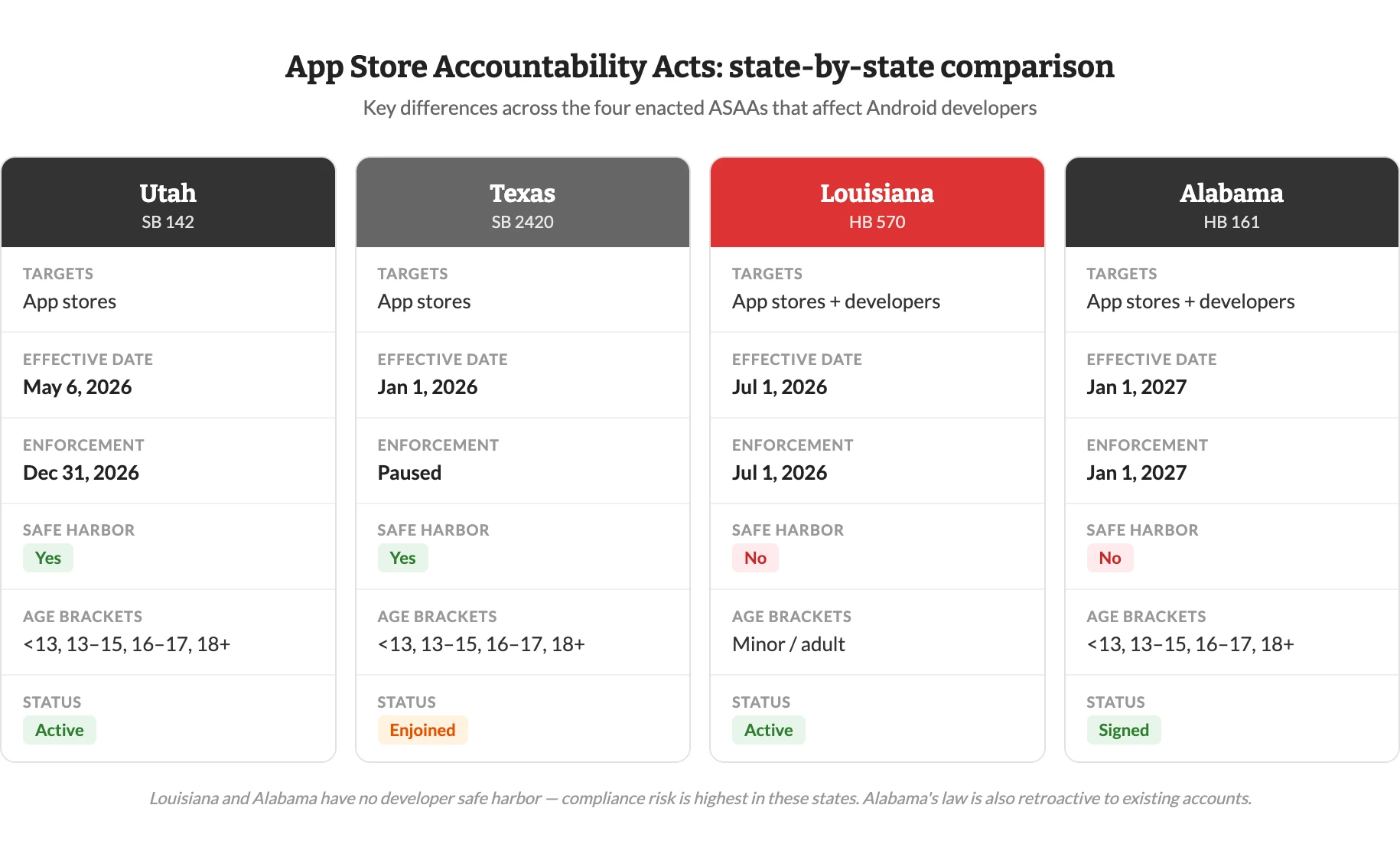
Utah led the charge. Signed March 26, 2025, the Utah age verification law (SB 142) requires app stores to verify user ages and sort accounts into four brackets:
- child (under 13)
- young teen (13–15)
- older teen (16–17)
- adult (18+)
Developer requirements take effect May 6, 2026, with enforcement starting December 31, 2026. The silver lining: SB 142 provides a safe harbor for developers who rely on app store-provided age data. If you use the signals Google gives you, Utah won’t come after you for getting someone’s age bracket wrong.
Texas Age Verification Law
The Texas age verification law (SB 2420), signed May 27, 2025, requires app stores to verify age at account creation and link minor accounts to parent accounts. It was set to take effect January 1, 2026, but a federal court issued a preliminary injunction on December 23, 2025, pausing enforcement.
Google paused its Texas-specific API rollout accordingly. Still, developers should prepare: injunctions can be lifted, and Texas age verification requirements could snap back into force with little warning. If you’re building mobile applications for the US market, Texas should stay on your radar.
Louisiana Age Verification Law
The Louisiana age verification law (HB 570), signed June 30, 2025, takes effect July 1, 2026. It requires both developers and app stores to verify age and obtain parental consent. The catch: unlike Utah, Louisiana offers no safe harbor for developers. Even if Google verifies a user’s age, you’re still on the hook if something goes wrong. That’s a meaningful risk difference.
Alabama Age Verification Law
Alabama became the most recent state to enact an ASAA when Governor Ivey signed HB 161 on February 17, 2026. The law takes effect January 1, 2027, with a retroactive requirement: app stores must verify age and obtain parental consent for all existing accounts by October 1, 2027. Unlike the other ASAAs, Alabama’s law explicitly covers pre-installed apps. Violations are treated as deceptive trade practices with penalties up to $7,500.
California: A Different Approach
California didn’t pass an ASAA — it went a different route. The state’s California age verification law framework starts with the Age-Appropriate Design Code Act in effect since July 1, 2024, which requires businesses offering online services likely to be accessed by children to implement age-appropriate design and privacy measures.
On top of that, the Digital Age Assurance Act (AB 1043), enacted October 2025 with a January 1, 2027 effective date, targets operating system providers — meaning Google at the Android level — rather than app stores. AB 1043 requires OS-level age prompts and age signal APIs for developers. Age verification baked into the device, not just the store.
If you’re tracking regulatory complexity across your product, this multi-state patchwork might remind you of other compliance landscapes — like the challenges we covered in our breakdown of DORA compliance requirements. Different domains, same lesson: compliance is architecture now, not afterthought.
Following the national trend, lawmakers in states like Alabama, Florida, New York, and Ohio also pushed forward age verification legislation during 2025.
How Google Play Responded: New Policies and Tools
The latest Google Play age verification news centers on a suite of tools designed to help developers meet their legal obligations. Google doesn’t mandate API use — the laws do. Google provides the plumbing.
Play Age Signals API (Beta)
The Play Age Signals API is Google’s primary response to the ASAAs. This client-side API lets Android apps retrieve age-related signals from Google Play — verification status, supervision status, and age ranges — across four default brackets: 0–12, 13–15, 16–17, and 18+ (customizable in Play Console).
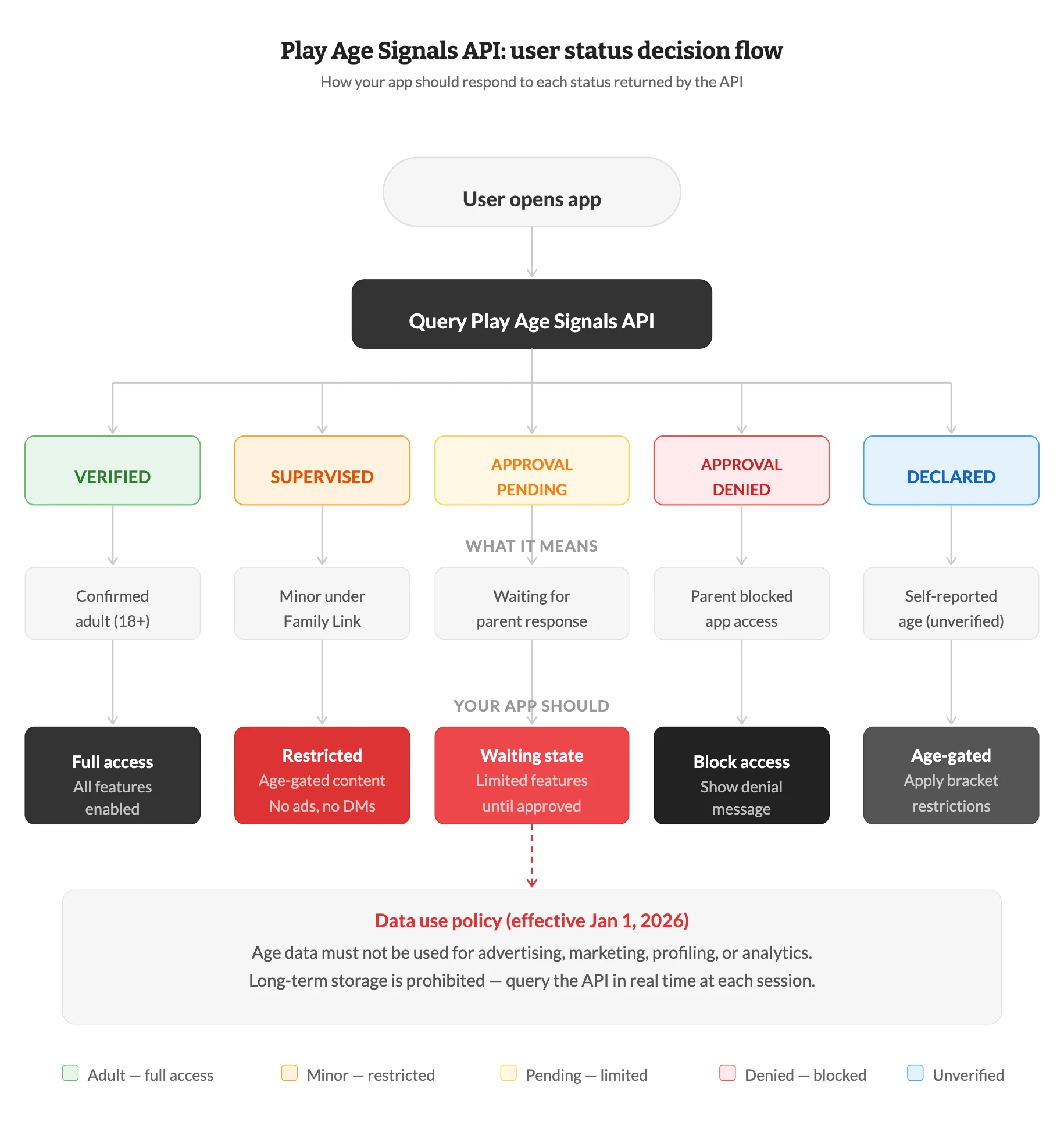
The API returns statuses like VERIFIED, SUPERVISED, and DECLARED, so your app can respond to each scenario. A strict data-use policy (effective January 1, 2026) prohibits using age data for advertising, profiling, or analytics. Long-term storage? Also prohibited — you query in real time.
As of March 2026, the API is live for users in Brazil. Texas responses are paused due to the injunction. Developers should prepare for Utah (May 2026) and Louisiana (July 2026) deadlines.
User-Facing Age Verification on the Play Store
Since late October 2025, Google has been verifying ages for new Play Store users in applicable US states with age verification laws. Methods include government-issued ID upload, facial age estimation via selfie, credit/debit card (temporary refundable charge), and third-party email-based age inference. Currently, only new users in applicable jurisdictions face this requirement.
New Content and Functionality Policies
Google also tightened policies around age-restricted content. Since January 28, 2026, apps facilitating real-money gambling or dating must use the “Restrict Declared Minors” setting in Play Console, blocking users under 18. The Child Safety Standards policy (mandatory since March 2025) requires social and dating apps to publish child abuse prevention standards and designate a safety point of contact.
What This Means for Android Developers in Practice
For developers, navigating US age verification laws means that compliance is now an architectural requirement, not just a policy footnote. Instead of treating an age gate like a quick fix, your app must now be built from scratch to integrate real-time platform age signals and offer rock-solid privacy protections for younger users.
Account Creation Flows Must Become Age-Aware
Simple date-of-birth entry is baseline but no longer sufficient alone — the FTC explicitly warns against relying solely on age gates. If you’re using the Play Age Signals API, your account creation flow must handle every possible user status: verified adults, supervised minors, pending parental approvals, denied access, and self-declared ages. Your age screen must also be neutral. That means no “you must be 13+” prompts that hand users a cheat sheet.
Social Features Face the Heaviest Restrictions
Messaging, following, and content sharing are the most regulated features for minor accounts. If your app includes any social functionality, study how the big players adapted:
- Instagram restricts teen messaging to existing connections
- Discord blocks DMs from unknown users by default for teens
- Roblox disabled chat entirely in November 2025, requiring age verification to unlock it
The pattern is clear: default to locked down, unlock with verified age.
Data Collection Rules Under the 2025 COPPA Update
The 2025 COPPA amendments (full compliance by April 22, 2026) expand the definition of personal information to include geolocation data, biometric identifiers, and persistent identifiers like device IDs. Separate, opt-in parental consent is now required for using children’s data for targeted advertising. Every third-party SDK, including analytics, attribution, crash reporting, and ads, must be audited for COPPA compliance. The compliance rigor here echoes what we’ve seen in fintech with the crypto compliance Travel Rule: regulators are closing loopholes on data handling, fast.
The penalties aren’t theoretical. Epic Games paid $520 million in FTC settlements. Google/YouTube paid $170 million to settle COPPA charges. Per-violation state penalties range from $2,500 to $50,000.
Age Verification Compliance Checklist for Android Developers
Here’s your action plan, broken into four areas. Treat this as a living document — new bills surface almost monthly across states with age verification laws.
1. Legal Assessment and Jurisdictional Mapping
- Determine which laws apply based on your app’s content, features, audience, and distribution geography.
- Map your exposure: COPPA (apps with child users), state social media laws (apps with social features), ASAAs (all apps on Google Play in Utah, Texas, Louisiana, California), and Age-Appropriate Design Codes (California, Maryland, Nebraska, Vermont, South Carolina).
- Maintain a compliance calendar tracking effective dates and enforcement deadlines.
2. Technical Implementation
- Integrate the Play Age Signals API and handle all user statuses: VERIFIED, SUPERVISED, SUPERVISED_APPROVAL_PENDING, SUPERVISED_APPROVAL_DENIED, DECLARED, and UNKNOWN.
- Integrate the Play Integrity API to prevent spoofing. Build a neutral age gate UI — no hints about minimum age thresholds.
- Implement at least two FTC-approved parental consent methods (credit card, government ID check, facial recognition matching, email-plus, or text-plus).
- Create separate data handling paths for each age group: under 13 (full COPPA), 13–15 (age-appropriate experiences), 16–17 (enhanced privacy defaults), 18+ (standard).
3. SDK Audit and Data Mapping
- Inventory every third-party SDK: what data it collects, whether it supports COPPA-compliant modes, whether it can be disabled for minors.
- Disable non-essential identifiers for children: ad IDs, fingerprinting, third-party cookies, retargeting.
- Build a data flow diagram showing all collection, processing, sharing, and storage paths.
- Maintain a children’s privacy policy covering data collection, usage, disclosure, and parental rights.
4. Testing and Ongoing Monitoring
- Use Google’s FakeAgeSignalsManager to test all user statuses and age ranges without hitting production.
- Test consent revocation flows, data deletion workflows, content filtering across age brackets, and ad serving appropriateness.
- Simulate users in different jurisdictions. Include COPPA review in every release cycle.
- Re-complete the content rating questionnaire whenever app content changes materially.
Ship Compliant: QAwerk’s Google Play Compliance Testing
Google relies heavily on automated checks that scan apps for permission misuse, outdated SDKs, privacy issues, and data collection inconsistencies. A single flag can delay your launch by weeks. At QAwerk, we test Android apps before release to detect policy and compliance risks that can block Google Play store age verification submission, using Google’s own compliance checklist together with real-device testing.
What our Google Play compliance testing covers:
- Play Policy Compliance Audit. We analyze your Android product against official Google Play submission requirements — permission usage, privacy disclosures, data transparency, and policy alignment.
- Data Safety & Privacy Validation. We verify how the app collects, processes, and shares user data to ensure declared information matches real behavior.
- Permissions Compliance Testing. We validate sensitive permissions, background activity, and SDK integrations against Google Play compliance expectations.
- Monetization Policy Review. We review ad placements, subscription transparency, and billing behavior to prevent rejection during review.
- Metadata Verification. We check descriptions, screenshots, permissions explanations, and store assets for accuracy and policy compliance.
- Rejection Investigation. If your app fails the Google Play review, we reproduce the issue, analyze policy feedback, and provide clear recommendations for resolution.
Ready to test your app for compliance? Explore our Google Play compliance testing services.
From the Field: ChitChat on Android
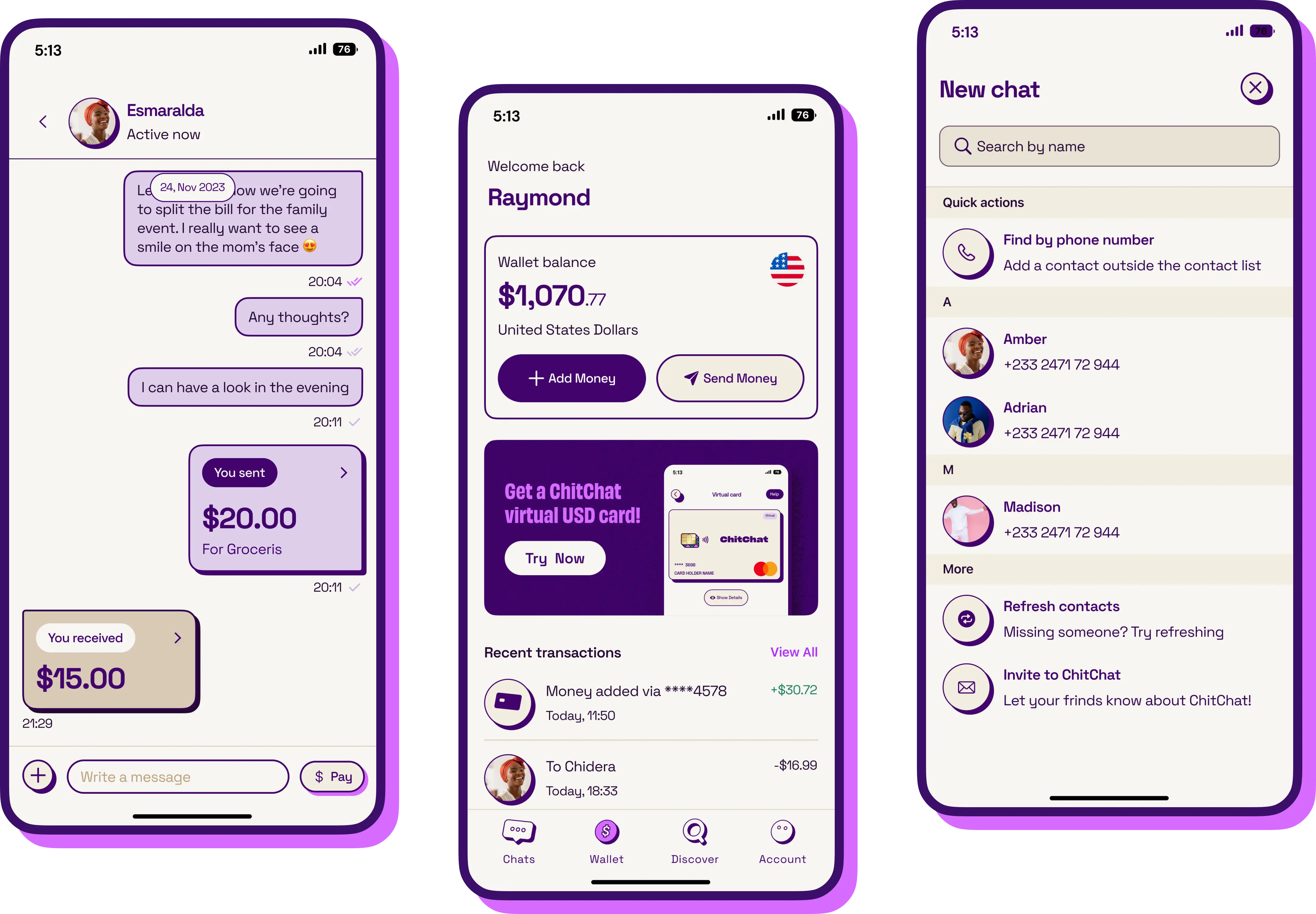
When ChitChat, a social commerce app combining encrypted messaging with in-chat payments, needed to prepare for its Android release, they brought QAwerk in from the early development stages. Our QA engineers built the entire testing process from scratch, covering functional, integration, compatibility, and automated testing across 24 devices.
We tested in-chat payment flows, validated third-party integrations (including identity verification services), and ensured the app met the security standards required for financial transactions. Given that ChitChat combines social features with payments — two areas now heavily regulated by age verification laws — this kind of thorough pre-release Android app testing is exactly what keeps apps compliant and launch-ready.
The Takeaway
The age verification laws landscape has shifted from a single federal rule to a multi-layered system of 30+ state laws, updated federal rules, and new platform tools. The App Store Accountability Acts in Utah, Texas, Louisiana, and Alabama represent a structural shift: age verification is moving from individual apps to the app store level, with Google’s Play Age Signals API as the technical bridge.
Enforcement is real: nine-figure settlements and five-figure per-violation penalties leave zero room for “we’ll get to it later.” The developers who build this age verification system infrastructure now will have a clear advantage as the remaining states follow suit. The patchwork shows no signs of simplifying — so start checking boxes today. Contact us today to get your app ready for a seamless, risk-free Google Play submission.
FAQ
What states have age verification laws?
It depends on the type of law. App Store Accountability Acts (most relevant to Android developers) have been enacted in four states: Utah, Texas (currently enjoined), Louisiana, and Alabama. California took a different approach with its Age-Appropriate Design Code, effective since July 2024, and the Digital Age Assurance Act, which targets OS providers rather than app stores.
Social media and minors’ access laws have been enacted in roughly 17 states, including Arkansas, California, Connecticut, Florida, Georgia, Louisiana, Maryland, Minnesota, Mississippi, Nebraska, New York, Ohio, Tennessee, Texas, Utah, and Virginia — though several are enjoined or in litigation.
Adult content age verification laws exist in 25+ states but primarily target websites with explicit content, not typical app developers. Age-Appropriate Design Codes have been enacted in California, Maryland, Nebraska, Vermont, and South Carolina. Several more states — including Alaska, Hawaii, Illinois, Michigan, New Jersey, South Dakota, and Wisconsin — have introduced pending ASAA or social media bills. At the federal level, COPPA 2.0 passed the Senate in March 2026.
What states don’t have age verification laws?
Approximately nine states have neither enacted nor actively advanced age verification legislation: Delaware, Maine, Massachusetts, Nevada, New Hampshire, New Mexico, Oregon, Rhode Island, and West Virginia. This list is shrinking fast — nine new state laws took effect in 2025 alone, and federal legislation like COPPA 2.0 could impose nationwide requirements regardless.
Does the Play Age Signals API work in all US states?
Not yet. As of March 2026, the Play Age Signals API (beta) is live for users in Brazil and preparing for Utah (May 2026) and Louisiana (July 2026). Texas responses are paused due to a court injunction. California targets OS-level signals with a January 2027 date. Developers should integrate now and test using Google’s FakeAgeSignalsManager.
What happens if my app doesn’t comply with age verification laws?
Google can reject or remove your app from the Play Store. Beyond that, COPPA violations carry FTC fines of up to $50,120 per incident, while state penalties range from $2,500 (Nebraska) to $10,000 per violation (Arkansas), with Virginia at $7,500 per incident. For reference, Epic Games paid $520M and Google/YouTube paid $170M in COPPA-related settlements.
Do age verification requirements apply to apps that aren’t aimed at children?
Yes. COPPA covers any app with “actual knowledge” of child users, Age-Appropriate Design Codes apply to services “likely to be accessed by” minors, and App Store Accountability Acts apply to all apps distributed via Google Play in Utah, Texas, Louisiana, and California — regardless of target demographic.
See how we helped ChitChat achieve a seamless Google Play store submission by eliminating over 200 critical bugs