Most RAG failures don’t look like failures at first. The model sounds confident. The response reads well. But the retrieved context was wrong, or the answer drifted from the source entirely. A Stanford study on legal RAG tools found hallucination rates between 17% and 33% even with retrieval augmentation in place.
Teams ship without measuring what matters: retrieval precision, groundedness, and the feedback loop from production back into the dataset. This article breaks 8 RAG evaluation tools into what they actually do and which team profile each fits. No feature dumps — just the comparison we wish we had when building AI testing pipelines for our clients.
What a RAG Evaluation Tool Should Measure
Before comparing specific RAG evaluation frameworks, here’s the short list that actually matters.
- Retrieval quality. Did the system pull the right documents? Context precision, recall, and mean reciprocal rank (MRR) tell you whether your chunking and embeddings work or just return semantically similar noise.
- Groundedness and faithfulness. Does the generated answer stick to the retrieved context? A 2025 study on medical RAG chatbots showed hallucination rates dropping to near-zero with curated retrieval, but spiking above 35% without it.
- Answer relevance. A faithful answer to the wrong query is still a failure. Relevance checks close this gap.
- Experiment comparison. Can you compare prompt A vs. B, or embedding model X vs. Y, with metrics side by side? Without this, optimization is guesswork.
- Production feedback loops. Offline eval is not enough. You need a path from real user interactions back into your test dataset.
The 8 RAG Evaluation Tools That Matter The Most
We organized this section from metric-first tools to platform-first tools. That progression mirrors how most teams actually grow: start with scoring, then layer in tracing, CI/CD gates, and production observability.
Ragas
Open-source Python library that pioneered reference-free RAG evaluation using LLM-as-judge approaches. Scores context precision, context recall, faithfulness, and answer relevancy without ground-truth labels.
- Fastest path to separate retrieval and generation evaluation
- Integrates with LangChain, LlamaIndex, Haystack, and DSPy
- The Ragas evaluation framework remains the most widely used in academic and open-source RAG evaluation frameworks
- Synthetic test data generation is built in
- No observability, no experiment tracking, no production monitoring
- You get metrics rather than a workflow
DeepEval
This is an open-source LLM evaluation framework built as a pytest plugin. DeepEval RAG evaluation contains unit testing, writing assertions against retrieval and generation metrics, running them in CI/CD.
- 14+ built-in metrics including a dedicated RAG triad
- Self-explaining metrics with improvement suggestions
- CI/CD-ready with quality gates on pull requests
- Targets engineering teams only with the limited support for non-technical stakeholders
- Limited production observability, so you’ll need another tool for live monitoring
LangSmith
LangChain’s native tracing, evaluation, and monitoring platform with LLM-as-a-judge evaluators and retrieval metrics.
- Smoothest integration if your stack runs on LangChain
- Automatic trace capture, experiment tracking, dataset management, and prompt versioning in one dashboard
- Its best instrumentation path for automatic instrumentation is through LangChain
- Framework-agnostic teams lose the plug-and-play advantage, as it creates lock-in
Arize Phoenix
Open-source observability platform for LLM applications with tracing, embedding visualization, and retrieval diagnostics.
- Embedding clustering and drift detection help you see why retrieval failed
- Self-hosting options suit teams with strict data residency requirements
- Framework-agnostic, working with LangChain, LlamaIndex, and more
- Manual configuration for evaluation workflows
- No built-in simulation, typically supplemented with Ragas for metrics
Braintrust
AI observability and evaluation platform connecting offline experiments with production scoring.
- Same scorers run in development and production, so there’s no mismatch
- Loop AI auto-generates better prompts and datasets from production data
- Used by Notion, Stripe, and Cloudflare
- Not open-source
- Specialized for LLM evaluation only
Maxim AI
Full-stack AI evaluation and observability platform unifying experimentation, simulation, evaluation, and production monitoring.
- Cross-functional collaboration and product managers can configure evaluations without code
- Multi-level evaluation (session, trace, span) for precise debugging
- Framework-agnostic
- Heavy for small teams that need just metric scoring
- Enterprise-oriented pricing and has a smaller community than Ragas or LangSmith
TruLens
Open-source solution for evaluating and tracing AI agents and RAG apps. Uses feedback functions to score groundedness, context relevance, and coherence.
- The TruLens RAG evaluation tool provides a metrics leaderboard for comparing application versions
- OpenTelemetry-based tracing for interoperability with existing stacks
- Smaller community, slower updates than Ragas or DeepEval
- Documentation lags — less CI/CD integration out of the box
Langfuse
Open-source LLM engineering platform with observability, prompt management, and cost tracking. Self-hostable via Docker or Kubernetes.
- Full self-hosting control with SQL access to trace data for custom reporting
- Prompt versioning and cost analytics included
- Evaluation capabilities are more basic than Ragas or DeepEval
- More of a tracing layer than a full RAG evaluation framework
How to Choose the Right Tool for Your Team
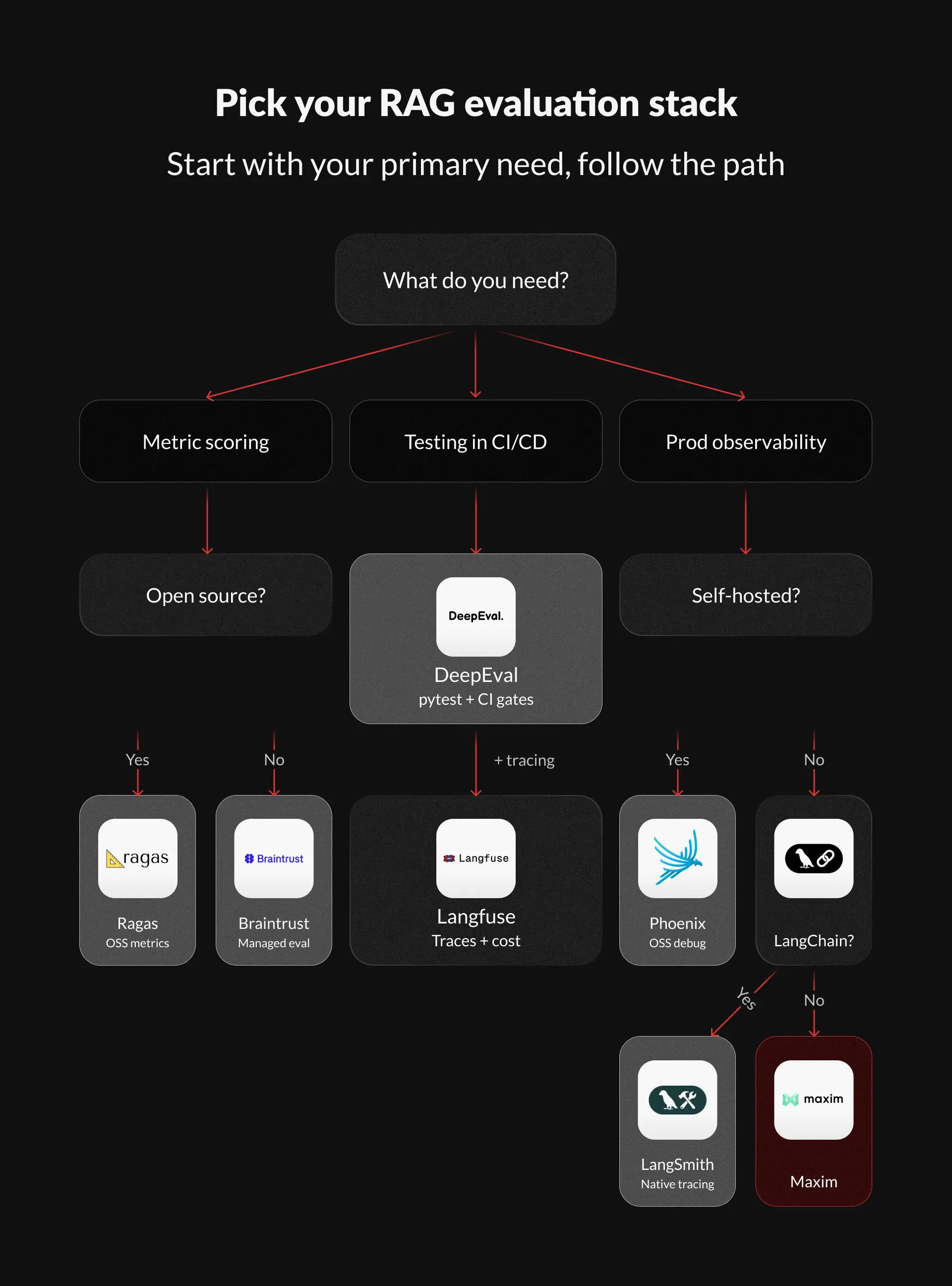
Feature lists don’t help without context. Here’s the same 8 tools for RAG evaluation mapped to buyer profiles:
Open-source metric evaluation: Ragas. The most mature evaluation framework for RAG. For a pytest approach, go DeepEval.
Test-driven engineering: DeepEval RAG evaluation fits natively. Write assertions, run in CI, gate pull requests. Add Langfuse or Phoenix for tracing.
LangChain-heavy workflows: LangSmith. Don’t fight the ecosystem. Just know that switching frameworks later means re-instrumenting.
Observability and debugging: Arize Phoenix for self-hosted open-source. Braintrust for managing production scoring.
Production feedback loops: Braintrust or Maxim. Both close the loop from production failures to updated test suites.
Self-hosted / privacy-sensitive: Langfuse or Phoenix. Both open-source with full data control.
Quick Comparison:
Ragas
Metric scoring
Strong
No
Yes
OSS eval baseline
DeepEval
Test-driven dev
Strong
Limited
Yes
CI/CD pipelines
LangSmith
LangChain tracing
Good
Yes
No
LangChain stacks
Phoenix
Observability
Basic
Yes
Yes
Self-hosted debug
Braintrust
Prod eval loops
Good
Yes
No
Prod AI teams
Maxim AI
Full lifecycle
Good
Yes
No
Cross-functional
TruLens
Version comparison
Good
Limited
Yes
OTel-based teams
Langfuse
Tracing & ops
Basic
Yes
Yes
Self-hosted ops
Mistakes Teams Make When Evaluating RAG
We’ve seen these mistakes across dozens of LLM testing engagements. More common than you’d expect.
- Using only answer-level scores. A high RAG score on answer relevancy means nothing if your retriever pulled the wrong documents. Always evaluate retrieval and generation separately.
- Skipping retrieval evaluation. Many teams jump to “Does the answer look good?” and skip the real question: “Did the system retrieve the right content?” This is one of the primary gaps between RAG evaluation platforms.
- Trusting one judge model blindly. A single model evaluating itself is like grading your own exam. Use multiple evaluators and validate against human review for critical flows. We covered related hidden risks of AI agents recently.
- Evaluating offline only. Your test dataset has the queries you imagined. Production has the ones you didn’t. RAG assessment needs real-time production feedback.
- No path from production failures back into the dataset. Teams that improve fastest treat every bad response as a candidate test case. Braintrust and Maxim automate this loop. The rest require manual effort, and manual effort doesn’t scale.
What a Practical RAG Evaluation Stack Looks Like
No single RAG tool covers everything. The teams that ship reliable LLM applications tend to compose two or three tools into a stack that fits their maturity, budget, and team structure. Here are the three patterns we see working best.
Lean Open-Source Stack: Ragas + Phoenix or Langfuse
If you’re an early-stage team building advanced RAG on a tight budget, this combination gives you the essentials without any licensing cost. Ragas takes care of retrieval and generation metrics, including context precision, faithfulness, answer relevancy, while Phoenix or Langfuse adds the tracing and observability layer you need to actually debug what went wrong in production. Both Phoenix and Langfuse support full self-hosting, so you keep complete data control from day one.
Code-First QA Stack: DeepEval + CI/CD + Tracing
For engineering-led teams that want every pull request evaluated before it ships, DeepEval runs evaluation suites as standard pytest tests and plugs directly into GitHub Actions for automated quality gates. Pair it with Langfuse for trace capture, and you get a lightweight but rigorous pipeline that catches regressions before they reach users. This is the stack we recommend to teams that want testing rigor for chatbots, copilots, and recommender systems without committing to a heavy managed platform.
Managed Production Stack: Braintrust, LangSmith, or Maxim
When your application is already in production and you need dashboards, alerting, and experiment comparison out of the box, a managed platform makes sense. LangSmith is the natural pick for teams running on LangChain, since the instrumentation is automatic. Braintrust fits evaluation-first teams that want identical scorers in dev and production with a clear failure-to-test-case loop. And Maxim works best in organizations where product managers, not just engineers, are involved in defining and tracking quality standards.
We applied similar thinking when QA-testing Sitch, an AI matchmaking app where recommendations had to stay relevant across rapidly shifting user data.
Whatever stack you pick, make sure it answers: Is the retrieval right? Is the generation faithful? Does the system improve over time? If your tooling can’t close that loop, you’re building on sand. And if you need help setting up AI search and recommender testing, we help teams design testing frameworks and AI QA strategies.
Wrapping It Up
The best RAG evaluation tool isn’t the one with the longest metric list. It’s the one that matches your workflow and closes the loop from failure to improvement.
Start by measuring retrieval and generation separately. Automate what you can in CI/CD. Monitor production from day one. And treat every bad response as a signal to make your system better.
The tools are here. The real differentiator is how fast your team can go from “that answer was wrong” to “that failure is now a test case.” Pick the stack that makes that cycle shortest, and if you need help getting there, reach out to our team.
FAQ
What is the most popular RAG evaluation tool?
Ragas is the most widely adopted open-source option and the most popular RAG evaluation tool in academic benchmarks. For managed platforms, LangSmith and Braintrust lead production adoption.
What’s the difference between RAG evaluation and standard LLM evaluation?
Standard LLM evaluation checks output quality. RAG evaluation adds retrieval-specific metrics: did the system pull the right documents, and did generation stay faithful to them?
Can I use multiple RAG evaluation tools together?
Yes. A common pattern is Ragas or DeepEval for metrics plus Phoenix or Langfuse for tracing. The RAG evaluation tools and templates ecosystem is composable by design.
What is the ARES RAG evaluation tool?
The ARES RAG evaluation tool stress-tests retrieval with adversarial examples. Useful for robustness testing, less common in production than Ragas or DeepEval.
How do I evaluate RAG without ground-truth labels?
Use reference-free metrics. Both Ragas and DeepEval support LLM-as-judge scoring for faithfulness and relevancy without predefined answers. Ragas pioneered this for label-free RAG rating.
What does a RAG risk assessment include?
A RAG risk assessment evaluates data quality, retrieval coverage, hallucination rates, and compliance risks. Combine automated scoring with expert review to catch what metrics alone miss.
See how an AI matchmaking app stabilized onboarding, chat flows, and payments before scaling nationwide