Developing custom AI models or integrating existing ones into digital products is an exciting journey, but it’s also fraught with unique challenges. Unlike traditional software, AI models learn and evolve, making their behavior less predictable and their testing more complex. At QAwerk, we’ve been at the forefront of QA for AI, helping tech startups and enterprises navigate these complexities. We understand that effective AI model testing is a continuous process that adapts to each phase of the AI development lifecycle.
This article will guide you through the crucial AI model lifecycle stages, shedding light on how to test AI models and activities that are essential at each point. Whether you’re at the drawing board with an MVP or managing a live, evolving AI system, understanding these nuances is key to building robust, reliable, and responsible AI.
Testing AI Models: Stages and Typical Activities
Before diving into the stages, let’s acknowledge a fundamental truth: testing artificial intelligence is different. Traditional software testing often focuses on deterministic outcomes—input X should always produce output Y. With AI, the outcomes can be probabilistic, influenced by vast datasets, and subject to continuous learning. This is why a comprehensive AI testing framework is indispensable.
PoC & MVP Stage: Validating Feasibility Quickly
The AI development lifecycle begins with an idea, and at the proof of concept (PoC) or minimum viable product (MVP) stage, the primary objective is to validate that idea with minimal investment. The focus here is not on perfection, but on demonstrating that your model can learn patterns from data and produce meaningful outputs. This is where your initial QA efforts lay the groundwork.
Goal: Prove feasibility quickly.
Key Testing Activities:
- Data Sanity Checks: They are foundational for any QA testing in an AI project. Is your data correctly formatted, free of corruption, and accurately labeled? Before any training occurs, ensure data quality.
- Initial Evaluation Metrics: At this stage, you need to quickly ascertain if the model is learning anything at all. This involves monitoring basic metrics like accuracy (the proportion of correct predictions), loss curves (which indicate how well the model is learning over time), and early signs of overfitting (where the model performs well on training data but poorly on new data).
- Bias Detection: Early bias detection in AI model testing is a non-negotiable step. It prevents these biases from becoming deeply embedded in your pipeline as the model evolves.
Pitfalls at MVP Stage:
- Over-Interpreting Metrics: Achieving high accuracy on a small or potentially biased dataset can create a false sense of security, resulting in misleading feasibility decisions. Remember, a small, unrepresentative dataset might not reflect real-world performance.
- Skipping Bias Checks: As mentioned, early models can embed dataset biases deeply into the pipeline, making them much harder and more expensive to rectify later.
- Ignoring Data Quality: Jumping straight into modeling with unvalidated data is a recipe for disaster. It wastes valuable time debugging a model that’s trying to make sense of flawed input.
Pre-Production: Ensuring Real-World Readiness
Once you’ve proven the core concept, the AI development lifecycle moves into the pre-production stage. Here, the focus shifts from mere feasibility to ensuring the model performs reliably on real-world data, generalizes well beyond its training set, and is robust, fair, and explainable enough for deployment. This is where your AI QA testing becomes more comprehensive, preparing the model for the complexities of a live environment.
Goal: Validate real-world readiness.
Key Testing Activities:
- Integration Testing: AI models rarely operate in isolation. They are typically integrated with APIs, front-end user interfaces, and back-end logic. Testing AI systems means ensuring that all these components work seamlessly together.
- Performance Testing: Does the model’s inference time (the time it takes to make a prediction) meet your service level agreements (SLAs) and provide a smooth user experience? This involves testing under various loads and conditions. This is where you would conduct load, stress, and spike tests to ensure the model can handle anticipated user traffic and deliver timely responses.
- Security Testing: AI models are susceptible to unique security vulnerabilities, including adversarial input attacks (where malicious inputs can trick the model into misclassifying) and injection attacks. Testing artificial intelligence in this context involves proactively trying to “trick” the model to understand its weaknesses and implement safeguards.
- Usability Testing: Beyond technical performance, it’s crucial to assess how users interact with and perceive the AI’s outputs. Do they trust the recommendations? Is the AI’s behavior intuitive and helpful? This often involves user acceptance testing (UAT) with real users.
Pitfalls at Pre-Production Stage:
- Overfitting on Validation Data: Excessive hyperparameter tuning, while aiming for better performance, can inadvertently cause the model to memorize the validation data, leading to poor generalization on new, unseen data.
- Ignoring Real-World Data Distribution Shifts: Your hold-out validation sets must accurately reflect the characteristics of the data the model will encounter in production. If the training data is significantly different from real-world data, the model’s performance will degrade rapidly.
- Insufficient Robustness Testing: Models may perform well in standard tests but fail catastrophically with slightly altered inputs if adversarial or stress testing is skipped.
- Neglecting Explainability: Even highly performant models can face rejection from business stakeholders or compliance teams if their decision-making process is opaque. Explainable AI (XAI) is increasingly important, and model testing should include evaluating the clarity and accuracy of these explanations.
Production & Maintenance: Sustaining Performance and Compliance
The model is now live, operating in a dynamic production environment. The focus in this final stage of the AI development lifecycle shifts from building to sustaining and continuously improving performance, ensuring reliability, and maintaining regulatory adherence over time. This is where ongoing AI QA testing and proactive monitoring become paramount.
Goal: Monitor performance degradation and compliance.
Key Testing Activities:
- Data Drift and Concept Drift Detection: Over time, the characteristics of your input data (data drift) or the underlying relationship between inputs and outputs (concept drift) can change. Implementing automated systems to detect these drifts is critical for long-term AI model testing.
- Model Retraining Validation: Retraining models on new data is a common practice in production AI systems to keep them updated. However, retraining can inadvertently introduce regressions, where the model performs worse on previously learned patterns. For example, retraining a credit-risk assessment model with fresh economic data should not deteriorate its predictive accuracy.
- Latency and Throughput Testing: For real-time AI applications such as recommendation engines, fraud detection systems, or voice assistants, response time and throughput are critical for both user experience and system stability. Continuous monitoring and periodic performance testing under production load are necessary to ensure the model maintains its speed and efficiency as data volumes and user demands fluctuate.
Pitfalls at Production & Maintenance Stage:
- No Automated Monitoring: Without robust, automated monitoring systems for drift and performance, silent failures can persist for weeks or even months, leading to significant negative impacts on users, revenue, and brand reputation.
- Over-Retraining: Retraining too frequently without sufficient new data or thorough validation can lead to “catastrophic forgetting,” where the model unlearns previously acquired knowledge, degrading overall performance.
- Ignoring Explainability Updates: As models are updated or retrained, their internal workings and feature importance might change. It’s crucial to ensure that the explanations provided by the model remain accurate and relevant for compliance purposes and to maintain user trust.
- Latency Creep: Newer, larger models or increasing data volumes can gradually increase inference time, potentially causing your system to miss critical SLAs if not regularly tested under production-like conditions.
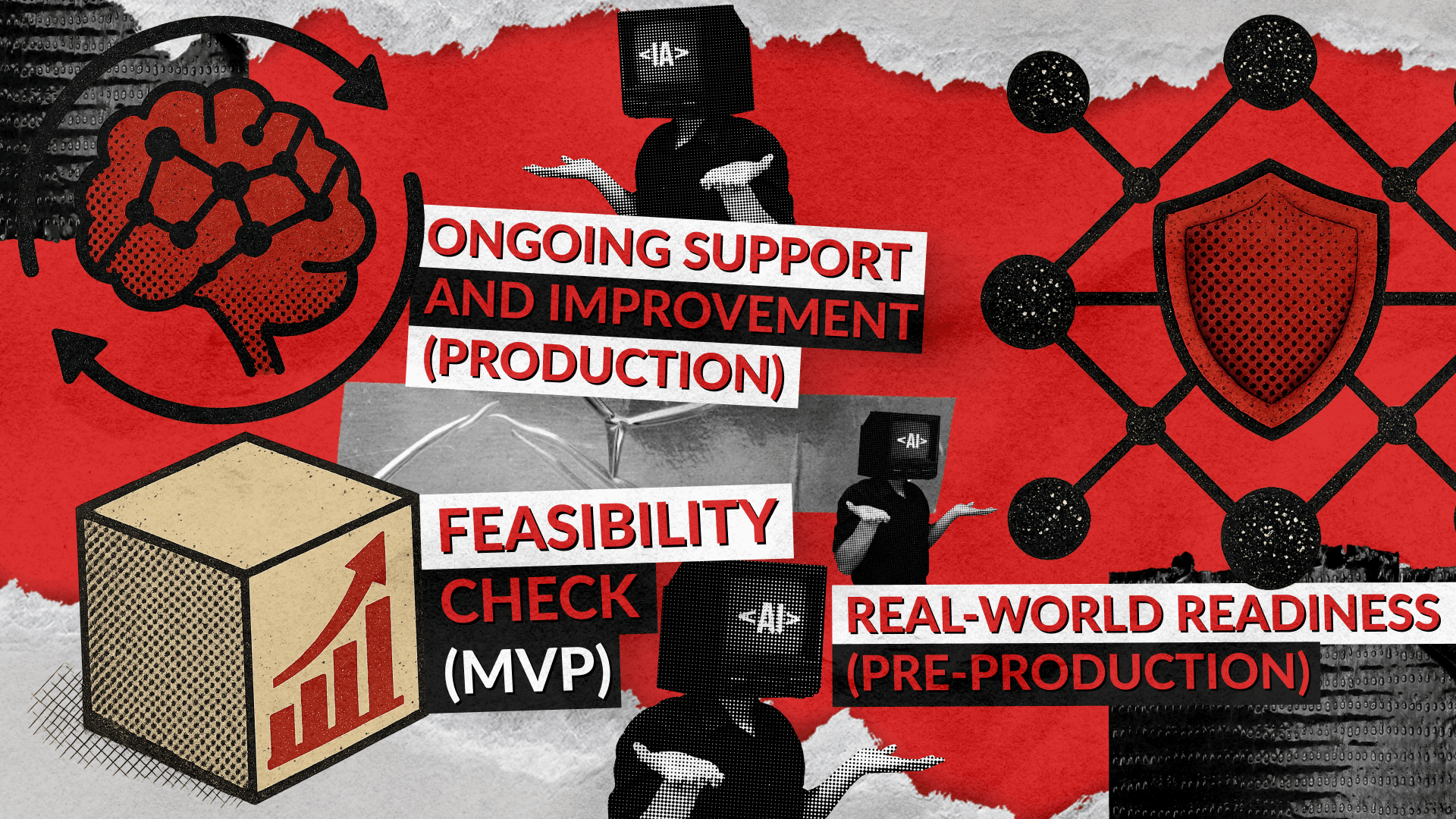
MVP/PoC
Prove feasibility quickly; check if model learns meaningful patterns
Over-interpreting high accuracy; ignoring data quality; skipping early bias checks
✅ Run data sanity checks before modeling
✅ Evaluate basic metrics and loss curves
✅ Perform quick bias sanity tests to detect obvious issues early
Pre-Production
Validate performance, generalization, fairness, and robustness before launch
Overfitting on validation data; neglecting real-world edge cases; ignoring explainability needs
✅ Use cross-validation + hold-out tests
✅ Conduct stress and adversarial testing
✅ Perform explainability tests with SHAP/LIME to gain stakeholder trust
Production & Maintenance
Monitor for degradation, drift, and compliance; ensure model reliability over time
No drift monitoring; silent performance decay; retraining regressions; latency creep
✅ Automate data and concept drift detection
✅ Validate each retraining for regression risks
✅ Conduct latency & throughput testing regularly for real-time models
Why Partner with QAwerk for AI Model Testing?
The journey from an MVP to a mature, production-ready AI system is complex and demands a specialized approach to quality assurance. At QAwerk, we possess the expertise to test AI models thoroughly, with hands-on experience in implementing robust AI testing frameworks for a wide range of applications. These include AI-driven UX testing platforms, shopping agents, investment agents, and AI-powered language learning apps.
Our expertise in QA for AI encompasses every stage of the AI lifecycle, ensuring that your models are not only high-performing but also fair, secure, and reliable. We work closely with tech startups, scaleups, and enterprises, acting as an extension of their team to deliver comprehensive solutions.
Reach out to us today to discuss your specific needs and discover how our tailored AI model testing services can help you build truly exceptional AI products. Let’s ensure your AI journey is a success, from concept to continuous improvement!
Frequently Asked Questions
What is the role of QA for AI?
QA ensures that AI models work correctly, fairly, and safely. It checks if AI predictions are accurate, unbiased, understandable, and integrate well into real applications.
How do QA requirements change at different stages of an AI product’s lifecycle?
The AI model testing approach evolves across the product lifecycle:
- MVP Stage: Focus on quick feasibility checks to see if the idea works at all
- Pre-Production Stage: Ensure performance, fairness, and robustness before launch
- Production Stage: Monitor continuously for data drift, model degradation, and compliance issues
What types of testing are most important in the early MVP stages of AI development?
In the MVP stages, manual testing of core features, basic data validation, and early exploratory testing of model behavior with limited datasets are most important. The focus is on quickly identifying show-stopping bugs and ensuring fundamental functionality.
How does the testing approach change when an AI product enters the growth phase?
Testing shifts to:
- Validating scalability (handling more users or data)
- Ensuring consistent performance on new data
- Adding fairness, robustness, and explainability tests for wider deployment
What security aspects are critical for mature AI systems?
For mature AI systems, critical security aspects include resilience to adversarial attacks (tested via stress tests), robust data privacy and security measures (e.g., anonymization), continuous fraud detection, and ensuring the integrity of data, models, and infrastructure against cyber threats (part of MLOps).
See how we tested an AI digital growth solution, increasing regression-testing speed by 50%