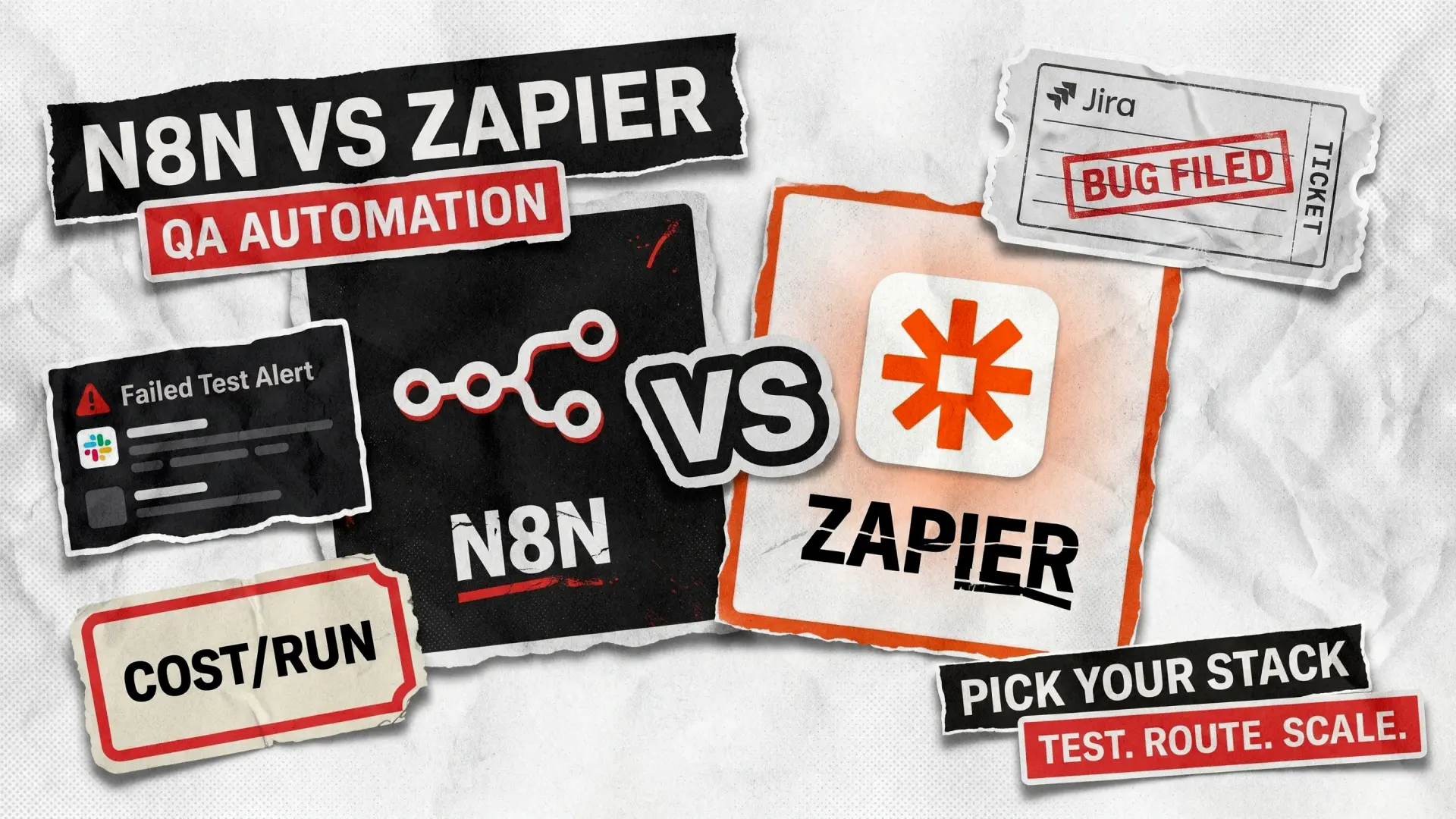
Your QA team spends most of its week on work that isn’t testing. Running regression suites, parsing output, filing Jira tickets, posting to Slack, chasing flaky reruns. The tests themselves are fine, but everything around them eats the week. That’s why the n8n vs Zapier decision matters for QA teams in a way it doesn’t for ops teams: you’re picking the tool that orchestrates the connective tissue between your test runner and the rest of your stack.
The stakes are bigger than a tooling choice. The World Economic Forum’s Future of Jobs Report 2025, surveying over 1,000 employers across 22 industries and 55 economies, found that 86% of employers expect AI and big data analytics to drive business transformation by 2030. Forrester’s 2026 automation predictions describe the same moment from the buyer’s perspective, where enterprises are aligning deterministic and cognitive automation into a common framework for stable, value-oriented autonomy. QA is one of the functions most exposed to that shift, and the platform you pick now shapes what you can automate for the next three years.
Where n8n and Zapier Show Up in a QA Workflow
Before comparing features, it’s worth being precise about what these tools actually do in a QA context. Neither n8n nor Zapier runs your tests. Test runners like Selenium, Playwright, Cypress, and Newman handle execution, while n8n and Zapier handle the orchestration layer around those runners, the glue that ties test execution to the rest of your stack.
If you think of testing as a sequence of phases (planning, design, execution, triage, reporting, closure), workflow automation plugs into the seams between those stages. That framing matters because it sets the scope of the decision you’re making. You’re picking a coordinator, not a replacement for your test suite, and the full sequence of software testing phases stays the same whichever platform you choose.
Here’s the testing work QA teams actually automate with n8n or Zapier:
- Triggering regression or smoke runs from a git push, schedule, or deploy event.
- Parsing test results and filing failures as Jira or Linear tickets, with screenshots and logs attached.
- Detecting flaky tests and triggering auto-reruns before human attention gets spent.
- Seeding and cleaning test data in staging environments.
- Posting digest summaries to Slack, Teams, or Discord so the team sees failures fast.
- Orchestrating API test suites (Newman runs, Postman monitors, contract checks).
- Routing bug reports from customer support tools into the engineering backlog.
Feature Comparison: n8n vs Zapier at a Glance
The comparison below focuses on what QA teams actually care about when choosing between the two platforms. The marketing-side features neither team wants to discuss at 2 AM during a broken test run are left out on purpose.
Pricing model
Per workflow execution
Per task (each step counts)
Self-hosting
Yes, free under fair-code license
No, cloud only
Code nodes (JS, Python)
Native
Limited, via code steps
Pre-built integrations
1,000+
8,000+
HTTP Request flexibility
Full, with GraphQL and webhook support
Basic webhooks, less configurable
AI/LLM nodes
Native LangChain, agent memory
Zapier Agents, simpler model
Error handling and retries
Customizable per workflow
Non-customizable autoreplay
CI/CD integration
Direct, Git-friendly workflows
Via Zaps, shallower depth
Compliance and data residency
You control (on-prem, VPC, region)
Managed by Zapier
Setup time (first workflow)
30 to 60 minutes
Under 10 minutes
Three trade-offs drive most decisions. Zapier wins on speed to value, since your ops lead can ship a working Zap during a lunch break. N8n wins on cost at scale and data control, both of which stop being edge cases once your test volume gets serious. Everything else is secondary to those two dimensions.
Where n8n Wins for Testing Workflows
For QA teams, three structural advantages make n8n the stronger fit as test workloads get heavier. The first two show up in your compliance posture and your monthly invoice. The third shows up every single time test output doesn’t match the tidy example in the documentation. Together they explain why engineering-led QA shops tend to pick n8n once their pipelines mature, even when they started somewhere else for something simpler.
Self-Hosting Changes Your Compliance Math
Testing often touches staging data, and staging data often looks suspiciously like production data. Real email addresses, partial payment records, PII that auditors notice the moment they scroll into view. Zapier’s cloud-only model means that data flows through their infrastructure, which creates a compliance conversation you’d rather not have under GDPR, HIPAA, SOC 2, or the newer DORA rules. n8n lets you host inside your VPC, pick your region, and keep test data on your side of the firewall. For regulated industries, that isn’t a nice-to-have. It’s often the first question your security officer asks.
Execution-Based Pricing Scales With You
Zapier counts every action as a task. A regression pipeline that fires 3 actions per run, 500 runs per day, produces 45,000 tasks a month just for test orchestration, before anything else your business needs to run. n8n charges per workflow execution regardless of step count, and self-hosted deployments have no ceiling at all. Teams running high-frequency pipelines usually find that their bill stops scaling once they migrate. That pricing difference matters most for regression testing at scale, where sheer execution volume makes n8n’s model pay off fast.
Code Nodes Handle the Messy Parts
Test output isn’t clean. Stack traces span multiple lines, Playwright produces structured JSON one day and a screenshot path the next, and half your custom assertions need post-processing before anyone can act on them. n8n’s JavaScript and Python nodes let you parse whatever comes out without leaving the platform. Zapier’s code steps exist but feel bolted on, and anything beyond happy-path parsing starts to hurt as soon as your test suite grows. The difference compounds fast for API testing workflows, where response parsing and validation dominate the workload.
To make it concrete, a typical n8n testing flow looks like this. A Playwright regression suite finishes its nightly run. A webhook catches the result payload, a Function node parses pass/fail and extracts failing test IDs with stack traces, and an IF node routes failures into a branch that creates a Jira ticket via the Jira node, uploads the screenshot, assigns based on file ownership, and posts a formatted summary to Slack. If the failure matches a known flake signature, same test name and same error across the last three runs, a second branch triggers a rerun instead of pinging a human. The whole flow takes about 12 nodes and runs in under four seconds per failed test.
Where Zapier Earns Its Keep for QA-Adjacent Work
N8n isn’t the right answer for everything, and pretending otherwise leads to over-engineered solutions for simple problems. That’s exactly the thing automation was supposed to eliminate in the first place.
Zapier’s 8,000+ integrations mean that connecting TestRail to a Google Sheet, PractiTest to Microsoft Teams, or a bug report form to your HubSpot CRM takes ten minutes. n8n can do all of that too, but you’ll write more HTTP Request configuration and read more API docs to get there. For quick, standard integrations, Zapier is simply faster and that speed has real value.
It also wins on who can build workflows. A QA lead who doesn’t code can ship a working Zapier flow without pulling in a developer. On n8n, anything non-trivial eventually touches JavaScript or at least a headscratch over data mapping. If your QA team is three manual testers and one part-time contractor, Zapier meets you where you are without forcing an engineering hire.
The use cases where Zapier genuinely earns its place in a QA stack:
- Routing inbound bug reports from Intercom, Zendesk, or Typeform into Jira.
- Sending weekly test status digests from TestRail to a Slack channel.
- Syncing customer feedback into your QA backlog.
- Bridging your support-ticket workflow to your engineering workflow.
- Kicking off simple scheduled tests, like a smoke suite at 2 AM daily.
The ceilings show up quickly once you push beyond these patterns. Task-based pricing hurts at regression-testing volume. Error handling is shallow so flaky tests generate noise instead of signal. Code steps are constrained so complex parsing requires workarounds, and cloud-only deployment means regulated teams have a line they can’t cross. Zapier is often the right second tool in a mature QA stack, but it’s rarely the right only tool once your test suite gets serious.
Which One Fits Your Team
Skip the generic “it depends.” Here’s the n8n vs Zapier decision tree that actually holds up in practice, broken down by the boxes worth checking against your current reality.

Pick n8n if you have two or more of these points:
- You run more than 500 test-triggered events per day.
- You have compliance requirements (GDPR, HIPAA, SOC 2, DORA) or sensitive test data.
- You have at least one engineer who can own self-hosted infrastructure.
- You’re building AI-augmented testing workflows where testing AI agents is part of the scope.
- You want Git-tracked workflows you can code-review like any other part of your stack.
Pick Zapier if you have two or more of these points:
- Your QA team is under five people and mostly manual testers.
- You’re connecting simple SaaS-to-SaaS flows with no complex logic.
- You want something running by the end of the week, not the end of the month.
- You have no DevOps capacity to maintain self-hosted infrastructure.
- Your test volume is low and unlikely to 10x this year.
Run both if:
- Ops teams already live in Zapier and you don’t want to migrate them.
- Your engineering pipelines are heavy enough to justify n8n.
- You can afford two tool-ownership stories instead of one.
One final layer worth flagging. Workflow automation is getting AI-shaped fast, and both platforms now ship native AI agent features. If you’re deploying those into a testing context, accuracy and governance become testing problems instead of feature problems, which is exactly where AI testing earns its place in the stack. Most articles frame this choice as zapier vs n8n, as if one tool has to beat the other. For QA teams, the better frame is “which trade-off can we live with,” because they’re different tools built for different realities.
Your Move
N8n wins for serious test orchestration at scale, compliance-heavy teams, and engineering-led QA. Zapier wins for small teams, fast setups, and integrations that aren’t worth building from scratch. Neither one replaces your test runner, tests your product for you, or tells you which tests to write. That’s still the work of skilled QA engineers, and it’s where the real leverage lives no matter which platform you pick.
If you want a sharp, honest look at which of these platforms fits your setup and what a dedicated QA team would build around it, contact us.
See how an e-prescription platform automated 40+ Playwright tests with daily Slack alerts, boosting orders 15% across 700,000 patients.