

Most founders never really get the difference between penetration testing vs vulnerability scanning, and it costs them greatly. They run a vulnerability scan, tick a compliance checkbox, and move on, only to find out during due diligence for a bigger deal that their app had three exploitable authentication flaws the scanner never flagged. Or they pay for a full pentest before they even have a stable product, which is like hiring a fire marshal to inspect a building that’s still under construction.
Penetration testing and vulnerability scanning are not interchangeable. They answer completely different questions, and choosing the wrong one doesn’t just waste budget but leaves you exposed in the exact place you thought you were covered.
Today, QAwerk’s security testing experts will explain how to tell them apart and, more importantly, how to pick the right one for where you actually are.
What Is a Vulnerability Scan?
A vulnerability scan is an automated process that compares your application, network, or infrastructure against a database of known security issues. The scanner checks for issues such as outdated software versions, missing patches, open ports, misconfigurations, and common weakness patterns, for example, SQL injection and cross-site scripting.
The output is a prioritized list (high, medium, low) indicating what might be exploitable. The keyword is “might” because a scanner doesn’t actually try to exploit anything. Instead, it flags potential problems and moves on.
What vulnerability scanning covers:
- Known CVEs (Common Vulnerabilities and Exposures) matched against a database of 50,000+ entries
- Misconfigured servers, exposed APIs (Application Programming Interfaces), and outdated dependencies
- All 10 categories from the Open Worldwide Application Security Project (OWASP) Top 10:2025 in automated form, including Broken Access Control (#1) and Security Misconfiguration (#2), which together account for the majority of exploitable web app weaknesses
- Compliance requirements for frameworks like PCI DSS, which mandates quarterly internal and external scans, and HIPAA
What vulnerability testing doesn’t cover:
- Business logic flaws (for example, things like “a user can manipulate their own order total by changing a hidden field”)
- Zero-day vulnerabilities not yet in any database
- Chained attacks, where no single vulnerability is critical, but three combined are catastrophic
- Whether a finding is actually exploitable in your specific environment
Vulnerability scans run in hours, and they are repeatable and easy to automate. The limitation is that scanners generate a significant volume of false positives, meaning your team can burn days triaging findings that turn out to be non-issues. Without expert triage, that noise drowns out the signal.
What Is Penetration Testing?
Penetration testing, or pentesting, is what happens when a trained security engineer actively tries to break into your application the way a real attacker would. They use a mix of automated tools and manual testing techniques, follow your app’s logic, and look for vulnerabilities a scanner would never find.
A pentest doesn’t just ask “does this pattern exist?”. It asks, “Can I actually get in using this, and what can I do once I’m inside?” As our team puts it when explaining the insides of a successful penetration test: a pentest is extreme QA (Quality Assurance). It means this is a validated, controlled way to see how your software behaves under hostile conditions, without the chaos of an actual breach.
What a pentest uncovers that a scan misses:
- Business logic vulnerabilities: authentication bypasses, privilege escalation, insecure direct object references
- Chained exploits: combining a low-severity misconfiguration with a medium-severity data leak to escalate to admin access
- Zero-day vulnerabilities specific to your codebase
- What an attacker can actually do with what they find, not just that a door is unlocked, but whether they can reach the vault from there
The numbers behind the investment in pentesting speak for themselves. For example, according to IBM’s Cost of a Data Breach Report 2025, the global average breach cost dropped to $4.44 million, but U.S. companies hit a record high of $10.22 million, driven by regulatory penalties and slower detection times. A $10,000–$15,000 pentest that prevents even a partial breach pays back many times over, not counting the reputational damage, customer churn, or legal exposure that follows a public incident.
A web application pentest typically runs 5–10 business days and costs between $5,000 and $30,000, depending on scope and complexity. It’s not a recurring monthly line item but a targeted investment, done annually and at key product milestones. If you want to understand how often to run a pentest based on your deployment cadence and risk profile, we’ve covered that in detail separately.
Penetration Testing vs Vulnerability Scanning: The Real Difference
The analogy that actually holds up is that a vulnerability scan is like a home security audit, where someone walks around to check whether your doors and windows are locked. Meanwhile, a pentest is someone actually trying to break in, testing the locks, checking if the side gate is weak, and seeing if they can reach through the mail slot to unlock the door from inside.
Both are useful, but for different things.
Type
Automated
Manual (expert-led)
What it finds
Known vulnerabilities
Known + unknown, including logic flaws
Exploitation
No — flags only
Yes — proves exploitability
Report output
Ranked list of potential issues
Full narrative with exploited paths and remediation steps
Duration
Hours
1–3 weeks
Cost
$100–$5,000/year
$5,000–$30,000+ per engagement
Frequency
Monthly or quarterly
Annually or at key milestones
Compliance use
PCI DSS quarterly scans, HIPAA
SOC 2, ISO 27001, PCI DSS annual testing, DORA
Who reads it
DevOps / security team
CISO (Chief Information Security Officer), CTO (Chief Technology Officer), board-level reporting
A vulnerability assessment is a structured evaluation that uses both scanning tools and manual review to identify, classify, and prioritize vulnerabilities. It’s broader than a raw scan because the human element helps filter false positives, contextualize findings, and map your full attack surface. Think of it as the diagnosis stage.
Penetration testing takes the output of that assessment and goes further, actively trying to exploit findings to measure real-world impact. It’s the stress test stage.
In practice, we at QAwerk combine both into what’s called a VAPT (Vulnerability Assessment and Penetration Testing) engagement: an application vulnerability assessment first to map the attack surface, followed by targeted manual exploitation to validate what’s actually dangerous. You get the breadth of a scan with the depth of a manual test. Our security testing practice is built on exactly this combined methodology.
Vulnerability Assessment and Penetration Testing: Which Do You Actually Need?
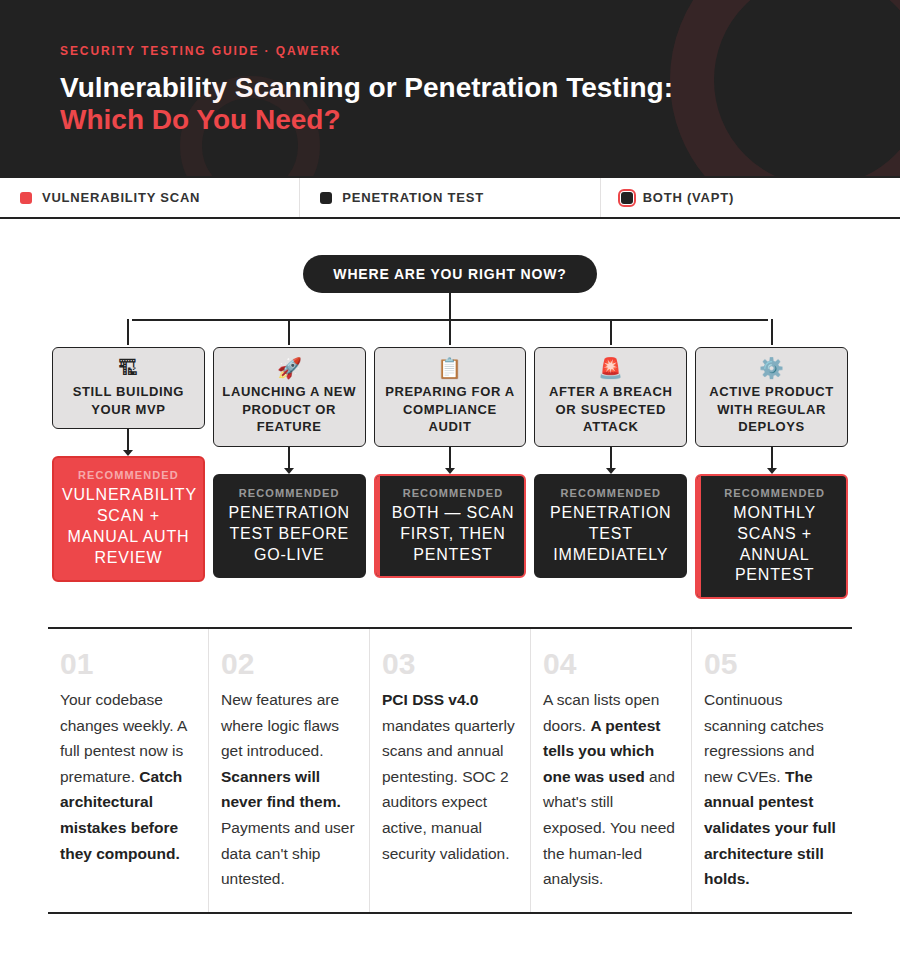
Here’s a scenario-based breakdown to help you determine which route to take based on your current business conditions, scope, and goals.
If you’re pre-product or early-stage, building your MVP (Minimum Viable Product).
What you need: A vulnerability scan + manual review of your authentication and data handling flows.
A full pentest at this stage is premature, as your codebase is changing weekly. Invest in secure development practices and a targeted application vulnerability assessment of your core user flows. Catch architectural mistakes before they compound by reviewing the OWASP Top 10:2025, a solid starting checklist for what to look for at this stage. Broken access controls, security misconfigurations, and insecure designs account for the vast majority of early-stage app security debt.
If you’re launching a new product or a major feature (especially anything touching payments, health data, or personal info).
What you need: A focused web application pentest before going live.
New features are where business logic flaws get introduced, so a scanner won’t find them, but a pentest will. If you’re handling payment flows, user authentication, or sensitive personal data, you cannot afford to ship without one. Our web application penetration testing checklist walks through exactly what a pre-launch test should cover, from session management to authentication logic to API exposure. The QAwerk web application testing team runs these engagements every week, so contact us if you want to scope one before your next release.
If you’re preparing for a compliance audit (SOC 2, ISO 27001, PCI DSS).
What you need: Both vulnerability assessment and penetration testing.
Run a vulnerability scan first to clear the low-hanging fruit. Then commission a pentest so auditors see evidence of active, manual security validation.
- PCI DSS v4.0 (Requirement 11) explicitly mandates quarterly internal and external vulnerability scans and annual penetration testing.
- SOC 2 (Service Organization Control 2) Type II doesn’t mandate a pentest, but auditors expect evidence of active security validation, and organizations that skip it often face conditional reports or additional scrutiny.
- ISO (International Organization for Standardization) 27001 doesn’t require a pentest directly, but it’s expected as part of your risk assessment program.
- DORA (the European Union (EU) Digital Operational Resilience Act) requires annual Threat-Led Penetration Testing (TLPT) for in-scope financial entities. QAwerk offers dedicated DORA compliance consulting if that’s on your radar. You can go through our DORA checklist first to understand what you’ll need.
If you’ve had a security incident or suspect a breach.
What you need: An immediate pentest.
A scanner tells you which doors might be open, but a pentest tells you which ones an attacker used, what they could have accessed, and what else is still exposed. After an incident, you need the human-led analysis, not an automated checklist. Read more about why penetration testing matters, particularly in the section on post-incident validation.
IBM’s 2025 report found that phishing was the most common attack vector (16% of breaches, at an average cost of $4.8M per incident) and that the average breach lifecycle dropped to 241 days, the fastest in nine years, largely thanks to AI-powered detection. The takeaway is that faster, proactive testing shortens the window attackers have to move laterally through your systems.
If you’re a funded startup selling to enterprise clients.
What you need: Recurring vulnerability scanning + an annual pentest, minimum.
Enterprise procurement teams ask for your security posture documentation during vendor evaluation. A SOC 2 report combined with a recent pentest and remediation evidence is the standard bar. Not having it doesn’t just delay deals, it kills them. If your prospects are running security questionnaires and you’re still relying on a quarterly scan, that’s a revenue problem, not just a security problem.
If you have an established product with regular deployments.
What you need: Automated vulnerability scanning on every deployment + annual pentest + targeted retests after major releases.
This is the mature security program that covers continuous scanning, catches regressions, and newly published CVEs as they emerge. The annual pentest validates that your overall architecture still holds under real attack conditions. The National Institute of Standards and Technology (NIST) Cybersecurity Framework recommends exactly this layered approach: continuous detection and monitoring paired with periodic manual adversarial testing. Need to test mobile apps as part of this program? Our mobile app security testing team handles that side of the stack as well.
What Happens After the Report?
This is the question most articles skip, and yet it’s the most important one. A vulnerability scan gives you a list, while a pentest gives you a report with exploited paths, proof-of-concept screenshots, and remediation recommendations. However, neither is worth anything if your team doesn’t act on it.
IBM’s 2025 breach data makes this point sharply: of the organizations that experienced a breach, most took over 100 days to recover, and nearly half planned to raise prices to cover the cost. The companies with lower breach costs weren’t necessarily harder to attack, but they detected and contained faster.
The best security testing engagements include:
- Remediation guidance: not just “fix this,” but prioritized steps tied to your actual codebase
- Retest/verification: confirming that patches actually closed the vulnerabilities found, not just that a ticket was closed
- Clear prioritization: separating critical exploitable issues from theoretical risks, so your team works on what actually matters
At QAwerk, remediation support and retesting are part of every security engagement. We don’t hand you a 40-page report and disappear; instead, we stay involved until the findings are resolved. Check out our case studies to see how this plays out across different product types and industries.
Ready to start with securing your product? Give us a call.
FAQ
What is the difference between a vulnerability scan and a vulnerability assessment?
A vulnerability scan is automated, so it runs tools against your systems and outputs a list. A vulnerability assessment is broader: it includes scanning plus manual analysis, prioritization based on your specific context, and more thorough coverage of your attack surface. Most serious security programs use assessments rather than raw scans alone.
How often should I run a vulnerability scan?
Monthly is the industry standard for active products. At a minimum, quarterly, and always after significant infrastructure or codebase changes. PCI DSS v4.0 mandates quarterly external scans regardless.
Is penetration testing required for SOC 2?
Pentesting is not explicitly required, but strongly expected. SOC 2 Type II auditors want evidence of active security validation. Organizations that skip pentesting often face additional scrutiny or conditional reports. Most compliance consultants recommend an annual pentest as part of any SOC 2 program.
How long does a web application pentest take?
A focused web app pentest typically takes 5–10 business days, depending on scope. Larger applications with multiple user roles, integrations, and complex business logic take longer. Allow 2–3 weeks total, including scoping, testing, and report delivery.
Can I do a vulnerability scan myself?
Yes, multiple security testing tools are available for self-service scanning. The challenge is triaging results accurately. Without context, it’s easy to deprioritize something critical or waste time on a non-issue. A managed scan with expert review is usually worth the cost delta.
See our security code review for a US-based e-commerce platform that highlights exploits and explains how to remedy them.