
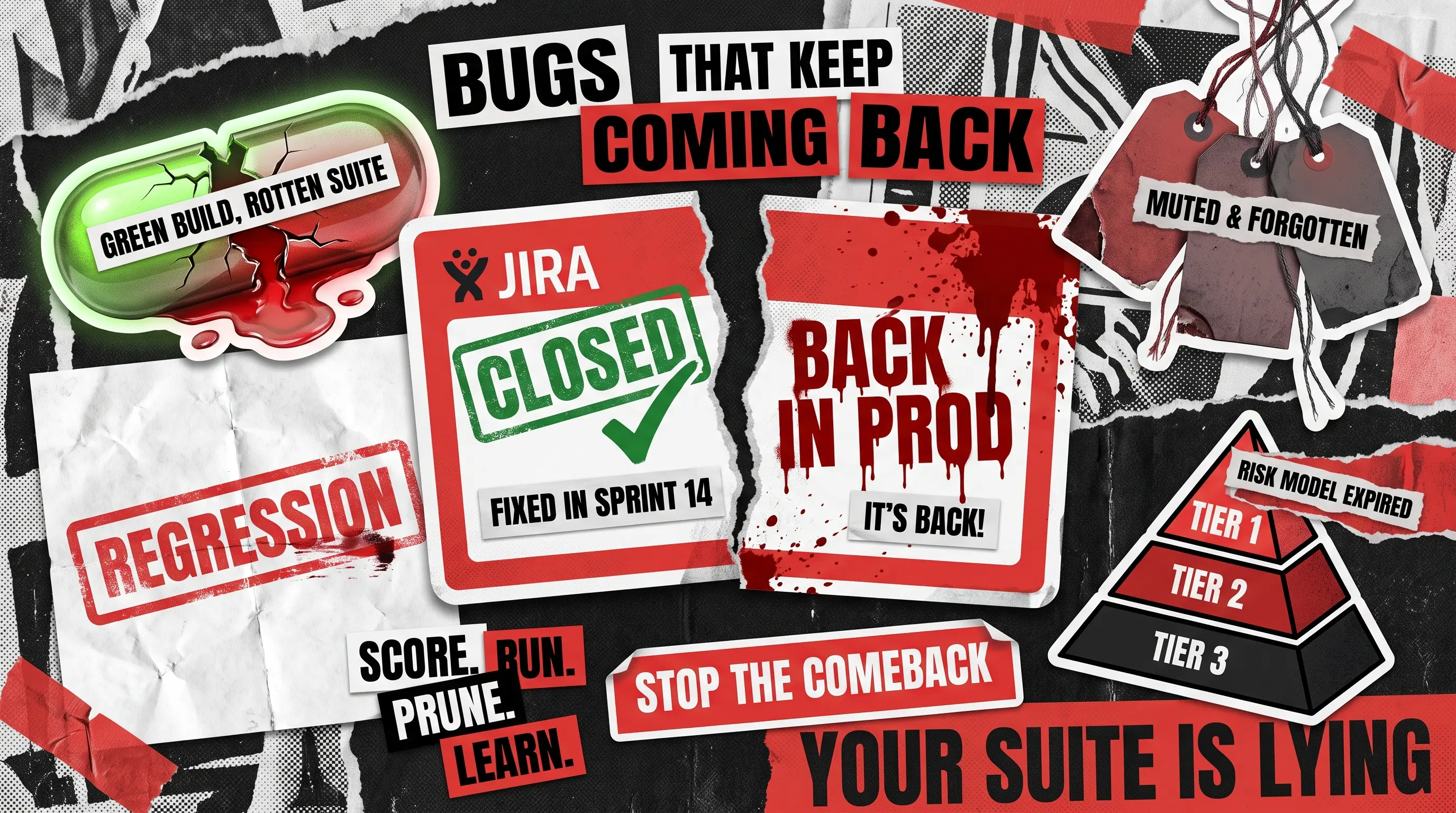
You ship a release. Within 48 hours, a bug you “fixed” three sprints ago is back in your inbox. Sound familiar? You are not alone, and your team is not careless. What you are dealing with is a regression problem, and a process gap that most companies never close.
Software failures cost the US economy over $2 trillion a year, with $1.81 trillion in operational failures and another $260 billion in development failures, according to figures published by IEEE Spectrum in November 2025. A meaningful share of that comes from defects that were already known and already “resolved.” The fix is not more testing. It is a real regression testing strategy: why bugs come back, what an actual strategy includes, how to score risk, when to run what, how to prune a bloated suite, and the signals that tell you when your team has hit its ceiling.
Why the Same Bugs Keep Returning
Returning bugs rarely come from one source. They come from four, and most teams underestimate how much each contributes.
Bug fixes are the first culprit. When a developer patches a defect, they touch existing logic, and that logic often connects to other features in ways nobody documented. A patch closes one ticket and quietly opens two more.
The second source is suite rot, and its main driver is flaky tests. When a test fails intermittently, teams mute it to keep the build green. Muted tests stop catching regressions, coverage shrinks without anyone noticing, and the dashboard keeps showing green long after the safety net has thinned. The Bitrise Mobile report found that the share of teams hitting flaky tests jumped from 10% in 2022 to 26% in 2025, with pipeline complexity up 23% over the same window. More flake means more mutes, and more mutes mean more rot.
Third, configuration changes get treated as low-risk even though they reshape system behavior. Feature flags, environment variables, third-party SDK updates: all of these can resurface old bugs without a single line of application code changing. Fourth, risk models go stale. The features you classified as “critical” two years ago might no longer be the ones driving revenue, and the ones you labeled “minor” might now sit on the user’s first three screens.
A real strategy ties these four sources into one feedback loop, which is what turns recurring incidents into solved problems.
What an Actual Regression Testing Strategy Contains
A real strategy is a system with five working parts. If any one of them is missing, bugs will keep slipping through, no matter how much testing you do.
The five components:
- Scope rules. Which features always get tested, which run on-demand, and which have been retired from the suite.
- Risk model. How each feature is scored on business impact, change frequency, and blast radius if it breaks.
- Execution cadence. What runs per commit, per pull request, per release, and on a quarterly schedule.
- Suite governance. Who owns adding tests, retiring tests, and unflaking tests, with clear authority to delete.
- Feedback loop. How production incidents and escaped defects feed back into the risk model and the test suite.
You can see why so many teams stall. They have parts one and three, sometimes parts of four, and almost never the risk model or the feedback loop. The result is a regression test suite that grows but never improves. It catches what it already caught, misses what it never saw, and consumes more CI minutes every quarter without raising confidence.

Risk Scoring Before the First Test Case
Before you write or rewrite a single test, score the features you are protecting. Three axes are usually enough.
- Business impact is what happens if this feature breaks. Checkout failing on a Friday night sits in a different universe from the admin export button failing on a Tuesday morning.
- Change velocity is how often the underlying code touches this feature. High-velocity code is high-risk code by definition.
- Blast radius is how many other features depend on this one. A bug in your authentication layer touches everything; a bug in the help center touches almost nothing.
Score each on a one-to-five scale and you get a tier. Tier 1 features (high on at least two axes) get end-to-end coverage, multiple data variants, and a place in every release-blocking run. Tier 2 features get happy-path coverage and selective edge cases. Tier 3 features get smoke tests only, or get excluded from regression entirely until something changes.
Two practical notes. First, the scoring is a team conversation, not a solo exercise; product, engineering, and QA should all sit at the table. Second, recalibrate every quarter. The Tier 1 from last year may be Tier 2 today, and what is currently Tier 3 may need to move up as your user base shifts. This is the heart of risk-based testing, and it is how mature QA teams cut execution time while keeping confidence high.
Cadence Matrix: What Runs When
A good cadence keeps the right tests running at the right moment. Run too much, and your CI queue becomes a bottleneck. Run too little, and bugs ship. Here is a reference matrix that works for most agile teams.
Per commit
Unit tests + critical-path smoke
Under 5 minutes
Developer
Per PR merge
Core regression on changed modules + dependencies
Under 30 minutes
Developer + CI
Pre-release
Full risk-weighted regression on Tier 1 and Tier 2
2 to 6 hours
QA lead
Quarterly
Full retest-all + suite audit + risk model review
1 to 2 days
QA lead + product
This is where regression testing in agile environments actually starts to work. Instead of running everything before every release and watching the suite balloon out of sprint boundaries, you tier the runs by what changed and what could break. Engineers get fast signal on small changes. QA gets deep signal before a release. And once a quarter, the whole team gets a clear picture of what the suite is actually doing versus what you think it is doing.
McKinsey’s research reports that top performers see 31–45% improvements in software quality and track outcome metrics like release frequency and defect rates rather than activity metrics. A tiered cadence is what makes those outcome metrics observable in the first place.
Suite Pruning as a Discipline
Most teams keep adding regression tests and never remove any. After two years you have a suite of 3,000 tests, a 90-minute pre-release run, and a flake rate that would embarrass a finance forecast. The fix is deliberate pruning, treated as a recurring discipline rather than a one-time cleanup.
Three rules that work in practice:
- Retire tests that have not earned their seat. If a test has not caught a real regression in six months and does not cover a Tier 1 feature, remove it. Maintenance time is finite; spend it where defects actually appear.
- Quarantine flaky tests fast. Within 48 hours of a flake, the test gets quarantined. Within two weeks it is fixed or deleted. Permanent mutes are how suites quietly die. The Bitrise data above suggests that without an active flake policy, your flake rate will keep climbing as your pipeline grows.
- Deduplicate aggressively. When two tests cover the same path, keep the one with the clearest failure message and delete the rest. Duplicate coverage is not extra safety; it is extra noise.
Pruning is also where in-house bandwidth runs out fastest. Adding tests feels productive, deleting them feels risky, and nobody on the team wants to be the one who removed the test that “might have caught it”. A dedicated regression testing team brings outside judgment to the pruning decision, plus the audit trail to defend it. That is often the difference between a suite that stabilizes and one that drifts for another two years.
The Feedback Loop From Slippage to Risk Model
The metric nobody talks about is risk-weighted defect slippage: how many Tier 1 and Tier 2 defects escape to production over a given quarter. When a high-tier bug slips, the test suite failed, but more importantly, your risk model failed. Something you scored low turned out to be high. That is data, and you should act on it.
After every production incident worth a post-mortem, run a three-question audit:
- Was the affected feature in the active regression set? If not, why not, and should it move up a tier?
- Did a test cover this user path? If yes, why did it pass when the bug was live?
- Did the underlying risk score reflect reality? Update the score and the test before the ticket closes.
This is what closes the loop. The regression suite stops being a static artifact and starts being a living system that learns from every escape. Done consistently over two or three quarters, slippage drops measurably, and the team’s trust in the suite goes up. That trust is the real asset; without it, engineers stop running tests, and without runs, you are back to firefighting.
Three Signs Your Regression Load Needs a Second Team
There is a point where in-house QA cannot keep up, and stretching it further only buys you slower releases and more burnout. Three signals tell you that you have reached it.
First, your team is permanently behind on feature work because regression keeps eating sprint capacity. If more than 20% of QA hours go to running and maintaining the regression suite, you are spending feature time on maintenance. Adopting solid regression testing best practices at this scale becomes a full-time function, and the in-house team rarely has the headroom to redesign while still shipping.
Second, the flake rate sits above 15% and is not falling. The industry trend is moving the wrong direction, and an internal team without dedicated capacity to fight flakes will lose ground every quarter.
Third, production hotfixes are eating more than 20% of engineering sprint capacity. At that point the cost of escaped defects is already higher than the cost of bringing in outside help, and downtime in enterprises routinely exceeds $300,000 per hour for more than 90% of mid-size and large companies according to ITIC’s survey.
Treat these as growth signals rather than failure signals. They appear in almost every successful product company as the user base scales. The real question is whether you scale the team, partner with one, or watch the bugs win. A mature regression testing process owned end-to-end by an outside partner means your developers go back to shipping features instead of patching the same bug for the fourth time.
When Recurring Bugs Stop Recurring
A real regression strategy is a closed loop, not a checklist. Score risk before writing tests, run the right tests at the right cadence, prune the suite as a discipline, and feed every escaped defect back into the model. Do that for two quarters and the pattern of returning bugs breaks. The team stops firefighting, releases get predictable, and the suite becomes something engineers actually trust.
If the last three releases shipped with returning bugs, the pattern is the answer. To talk through where your suite stands and what would change first, contact us and we can take a look together.
FAQ
What should a regression testing strategy include?
Five components: scope rules defining what is in or out of the suite, a risk model scoring features by impact and change velocity, an execution cadence matching test depth to trigger, suite governance assigning ownership, and a feedback loop that updates the model from production incidents.
How do you prioritize regression test cases?
Score each feature on business impact, change frequency, and blast radius. Tier 1 features get full coverage and run before every release; Tier 2 gets happy-path coverage; Tier 3 gets smoke tests or exclusion. Recalibrate quarterly because priorities shift.
How often should regression tests run?
Smoke tests on every commit, core regression on every PR merge, full risk-weighted regression before every release, and a complete retest-all plus suite audit once per quarter. Tiered cadence keeps CI fast while keeping coverage intact.
Why do the same bugs keep returning after every release?
Usually one of four reasons: bug fixes touching connected logic without impact analysis, suite rot from muted flaky tests, configuration changes treated as lower risk than code, or a risk model that has not been recalibrated. A strategy addresses all four.
When should you outsource regression testing?
When more than 20% of QA hours go to suite maintenance instead of new coverage, when flake rates sit above 15%, or when production hotfixes consume more than 20% of engineering sprint capacity. At that point the cost of staying in-house exceeds the cost of bringing in a partner.
See how an AI-driven SaaS platform cut its regression testing time in half and shipped monthly releases without recurring bugs.