
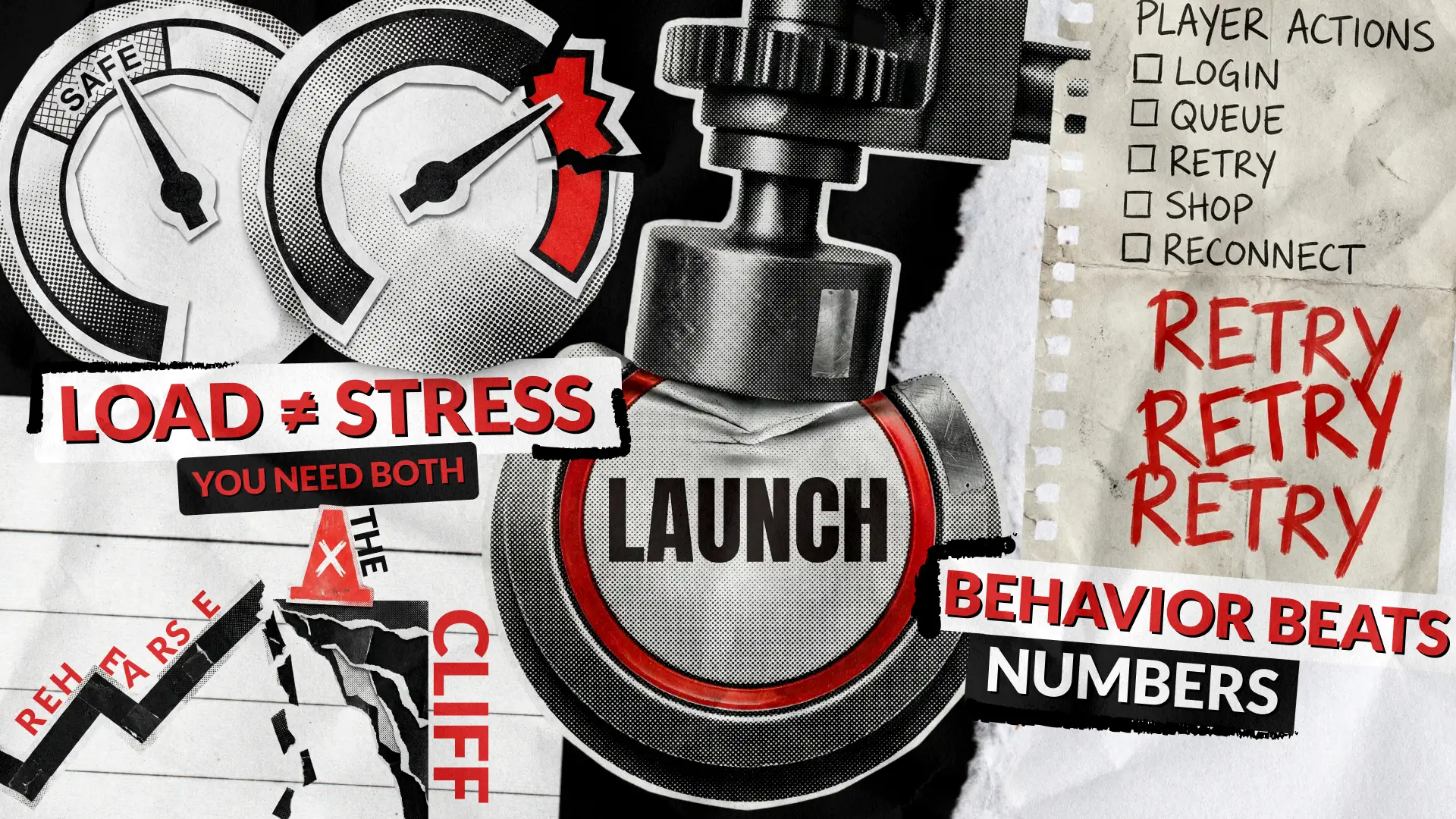
Launch day is the one moment you don’t get to rehearse in public. You could have the most innovative mechanics and breathtaking graphics of the decade, but if your infrastructure can’t handle the weight of your own success, your game is effectively dead on arrival. And in games, that reaction spreads fast: a few technical hiccups can turn into a headline, a meme, or a warning thread before your team even finishes the first incident call.
We’re a game testing agency, and this is the work we’re brought in for: making sure launch-day pressure doesn’t become launch-day chaos. In this article, we’ll demystify performance testing for decision-makers and provide you with a clear, actionable roadmap. By understanding how to simulate real-world player behavior before the public gets their hands on your build, you can ensure a headache-free launch, one where the only thing people are talking about is how much they love your game.
Game Launch Performance: Load vs. Stress Testing
In game development, performance testing is the umbrella term for evaluating how a game performs in terms of stability, speed, and scalability. It’s all about measuring how your digital infrastructure holds up under various levels of pressure.
If you’ve ever heard people use “load test” and “stress test” interchangeably, you’re not alone. The terms get mixed up constantly, especially outside of performance engineering teams. But the distinction matters because load testing and stress testing answer two different business questions. Here is a breakdown of a load test vs. stress test.
Load Testing
A load test verifies performance at your expected peak (and slightly above). With load testing, you can check if the game stays fast and stable when things go as planned. If your marketing data suggests you’ll have 50,000 concurrent players on opening night, a load test simulates exactly that. Load testing helps you confirm that your current hardware and cloud subscriptions are right-sized for your launch. It ensures that when a player clicks “join match,” the match starts in milliseconds, not minutes.
What you learn:
- response times (how fast actions feel)
- error rates (how often things fail)
- concurrency capacity (how many players you can safely support)
- cost estimates (what it takes to run at peak)
When
Run load tests at moments when player volume or visibility is about to jump:
- pre-launch milestones (alpha, beta, release candidate)
- before major marketing beats
- before platform featuring or large-scale promos
Stress Testing
A stress test pushes beyond expected levels to find the breaking point and observe failure behavior. It’s about resilience when things go better than planned (or when something degrades). Stress testing helps answer the question: “What happens if we’re too successful?” If 100,000 players show up instead of 50,000, do the servers shut down gracefully, or does the entire database corrupt?
What you learn:
- what fails first (auth, matchmaking, database writes, or third-party calls)
- how it fails (slowdown, timeouts, cascading errors)
- whether it recovers cleanly when traffic drops (or stays stuck)
When
Stress tests work best when you already have a stable baseline from load tests. We typically schedule them:
- after baseline load results look healthy (you’re not failing at expected peak)
- before big public betas (the kind that can attract far more players than planned)
- any time infrastructure changes materially, such as adding a new region, migrating to a new database, swapping matchmaking/session services, changing login/auth, store, or major backend dependencies
When it comes to load vs. stress testing, it’s never an either/or conversation. You shouldn’t be choosing one over the other; a successful launch requires both. Don’t just take our word for it — learn from the industry’s high-profile missteps. When Microsoft Flight Simulator 2024 debuted with its highly anticipated new features, it remained largely unplayable for 48 hours. The team had performed load tests, but they capped them at 200,000 users, a figure that was quickly overwhelmed by actual demand.
Load testing gives you the confidence that you’re ready for the players you expect, while stress testing gives you a contingency plan for the players you didn’t see coming. Together, they create a comprehensive safety net that protects your game’s reputation from the moment the servers go live.

How Player Behavior Breaks Systems
In normal operations, traffic has patterns. In a day-one launch, traffic is a pile-up. Here’s what we see again and again:
- Everyone logs in at once. Not literally everyone, but enough to create a sharp spike: time zone waves, preload unlock timers, “servers live” announcements, coordinated Discord communities counting down together. Even if your marketing forecast is accurate, the shape of the load is often more extreme than expected.
- Players do “setup actions” all at the same time. Day-one behavior is front-loaded with things that are heavier than regular play: account creation, first-time entitlements, linking accounts, choosing regions, claiming welcome rewards, customizing avatars, selecting loadouts, and hitting the store to see what’s available.
- Matchmaking is repeated and messy. Players queue, cancel, re-queue, swap modes, join friends, leave parties, rejoin parties, and try again. If queue times feel off, they don’t patiently wait — they hammer the system by retrying.
- “Login failed” becomes a refresh storm. The moment players feel something is slow, they act like a human load generator. They restart the game, spam buttons, refresh, reconnect Wi-Fi, switch regions, and repeatedly attempt login. That creates a multiplier effect: the system is stressed, which causes failures, which causes retries, which adds more load, which causes more failures.
- Streamers amplify peaks and synchronize actions. A single big stream can turn thousands of players into one coordinated wave. Everyone logs in. Everyone queues in the same mode. Everyone hits the store for the same bundle, basically, crowds moving together.
When studios experience a rough launch, the narrative is often the same: they conducted load testing and assumed it was sufficient. While they typically test tangible metrics, such as concurrency, response times, and server CPU, the reality is that launch day never behaves like a controlled lab environment.
What separates a smooth release from a public meltdown is rarely just the user count. It is defined by the specific actions those users take and how the system reacts when every variable hits at once. Effective pre-release pressure testing must incorporate a realistic player behavior simulation to reflect how users actually interact with a game when it is brand new and excitement is at its peak. Day-one load testing needs to account for traffic that isn’t just heavier; it is more synchronized, more volatile, and far more unpredictable than a standard test script.
Ensuring Launch Success: Player Behavior Simulation
So, how do we actually replicate the chaos of thousands of players without hiring a small army? Below is the playbook we use when a studio wants confidence that launch day won’t turn into a public incident.
Step 1: Map the Bottlenecks
Not all player actions are equal. Reading data (loading a map) is easy for a server. Writing data (saving a new character or buying an item) is “heavy” because the server has to pause and permanently record that information in the database. We map the first 30 minutes of gameplay to find where players cluster. Our goal is to identify which specific service (like the Store or the Login screen) will be the first to “redline” when the gates open.
Step 2: Script Headless Personas
Real players don’t need a 3D UI to break a server; they just need to send data packets. We create headless API scripts that mimic specific behaviors without rendering a single pixel of graphics.
Step 3: Find the Cliff
We use a gradual ramp-up strategy. We start with a few hundred players to establish a baseline, then scale up in waves. Our goal is to reach (and then exceed) your maximum forecast. We want to see the breaking point so we know exactly what your Plan B (like login queues) looks like before the hardware melts.
During our load testing for Couple Up!, an interactive mobile romance game, we gradually increased the number of server requests while monitoring response times. Based on our analysis of the system’s expected and peak loads, we established the following test parameters:
Test Case Scenarios:
- Baseline: 1 user ramped up in 1 second
- Low Load: 100 users ramped up in 1 second
- Medium Load: 1,000 users ramped up in 10 seconds
- High Load (Stress): 10,000 users ramped up in 1,000 seconds
Throughout these tests, we monitored server performance by tracking active threads, error rates, and response times. The results revealed that the server struggled to handle sharp, rapid increases in traffic. This led to system instability, prolonged response times, and a spike in internal server errors. For instance, when ramping up to 1,000 users in 10 seconds, most API requests took over 3 seconds to process, with latency peaking at a staggering 27 seconds.
Step 4: Watch the System Health
While the simulation is running, we aren’t just looking at whether the game is up or down. We are tracking:
- Database Latency: Is the game taking longer to save progress as more players join?
- API Response Times: Are the behind-the-scenes calls to the storefront or inventory system slowing down?
- CPU/Memory Spikes: Where is the hardware struggling most?
This data allows us to tell your developers exactly where to optimize before the real launch.
Final Thought: Expertise Over Luck
You didn’t start a game studio to spend your nights configuring scripts or analyzing database deadlocks; you started it to create something unforgettable. That is where a professional game testing team comes in. As your testing partner, we handle the technical heavy lifting so you can focus on creative excellence. We bring specialized tools, time-proven game testing techniques, and player behavior simulation to the table, acting as an extension of your studio to ensure your infrastructure is as polished as your gameplay.
A successful release is a product of rigorous math and preparation. Understanding the nuances of load testing and stress testing is critical to surviving the initial surge. If you take one lesson from this article, let it be this: don’t just simulate high traffic. Invest in comprehensive day-one load testing that accounts for the logins, retries, party churn, write-heavy progression, and store bursts that make launches unique.
Don’t leave your reputation to chance. Test early, test often, and give your game the launch it deserves. Contact us today for a free consultation!
See how we helped Couple Up!
perform load testing
and significantly improve
server performance
on multiple devices