Localization QA has always been a labor-intensive process. Every new locale multiplies the strings, screens, and edge cases your team must verify, and the budget grows with them. AI localization tooling promises to break that equation, and the promise is real, but only in specific parts of the workflow.
This guide is written for decision-makers evaluating AI-assisted localization QA as a cost lever. It maps where AI reliably reduces cost, where unsupervised AI creates new failure modes, and what to check before signing with a provider of localization testing services.
How Can AI Lower Localization QA Costs?
AI lowers localization QA costs by automating the repetitive, deterministic layers of testing: regression checks across locales, pseudolocalization runs, and detection of untranslated strings and broken layouts. These tasks consume the majority of manual LQA hours yet require no linguistic judgment, making them ideal targets for automation.
When machines handle this volume, human reviewers focus on the smaller set of issues that genuinely require cultural and contextual expertise, and the total cost per locale drops without any loss of quality. The best solutions for lowering localization QA costs combine all three of the following techniques rather than relying on any single one.
Automated Regression Across Locales
Every release risks breaking something that worked last sprint, and in a localized product, that risk is multiplied by the number of supported languages. Manually re-verifying 15 locales after every build is exactly the kind of spend that balloons QA budgets. AI-assisted regression suites run the same checks across all locales simultaneously, comparing screens against approved baselines and flagging only genuine deviations for human review.
Visual AI models handle what older script-based automation could not: they distinguish an acceptable text reflow in German from an actual truncation defect, cutting false positives that used to eat reviewer time. We cover the full framework for deciding what to automate in our guide to localization automation testing.
Pseudolocalization Before Translation Begins
The cheapest localization bug is the one caught before a single word is translated. Pseudolocalization replaces source strings with artificially expanded, accented text to expose hardcoded strings, encoding failures, and layouts that cannot survive text expansion. Running it is trivially automatable and costs a fraction of what it would take to discover the same defects, locale by locale, after translation.
Teams that gate every UI change behind an automated pseudolocalization pass routinely eliminate entire categories of internationalization defects from downstream testing, which shrinks the scope, and therefore the price, of every subsequent LQA cycle.
Untranslated String and Layout Defect Detection
A large share of manual LQA time goes to visually scanning screens for English leaking into a French build, text overflowing a button, or overlapping UI elements. Computer vision and OCR-based checks now perform this sweep across thousands of screens in minutes, in every locale at once.
These are objective, binary defects: a string is either translated or it is not, and a label either fits its container or it does not. Because no judgment is involved, automation here is essentially risk-free, and it converts days of reviewer effort into a first-pass report that humans only need to confirm.
Where Unsupervised AI Raises Risk
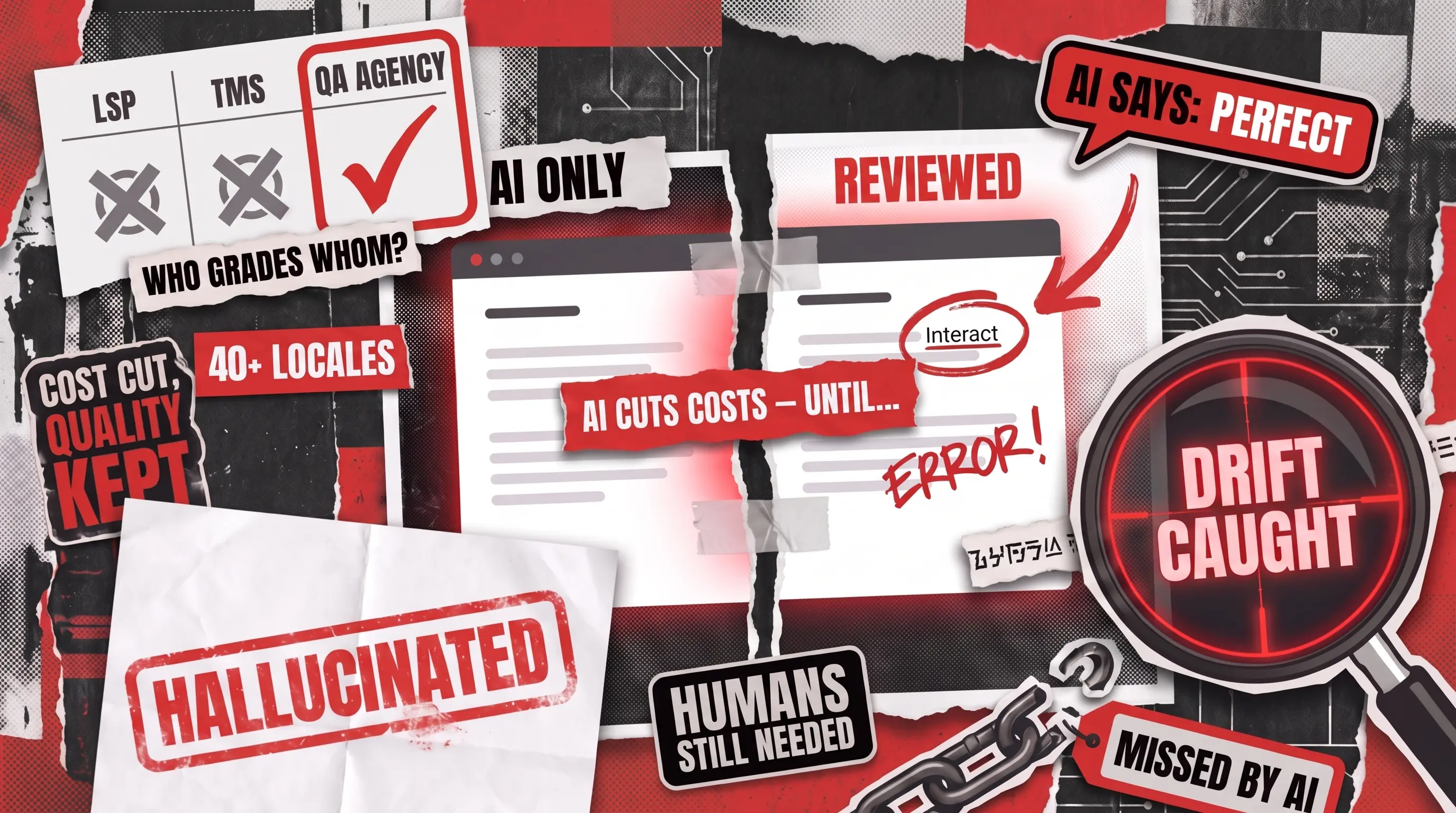
AI localization testing is reliable for mechanical, repeatable checks, but it becomes a liability the moment it is trusted to judge meaning without human review. The dangerous failures are not the obvious garbled ones; they are fluent, confident outputs that read as correct and slip past both users and automated scores. That is the core reason a QA agency treats an AI quality score as one signal inside a full localization testing process, not a verdict on its own. The three risks below are where unsupervised automation tends to cost more than it saves.
Hallucinated Meaning
Modern translation models produce output that reads naturally even when it says something the source never said. Peer-reviewed research confirms that even the best-performing multilingual translation systems still generate hallucinations, and detection methods remain substantially weaker for low-resource languages.
A hallucinated dosage instruction, contract clause, or safety warning is not a stylistic defect; it is a liability event. This is why AI-assisted localization QA needs the same adversarial rigor as any other AI system. Our LLM testing checklist details how we probe models for exactly these silent failure modes before trusting their output.
Terminology Drift
AI systems have no persistent commitment to your glossary. The same product feature can surface as three different terms across a knowledge base, a settings screen, and a legal disclaimer, with each individual instance scoring as a perfectly fluent translation. Automated quality scores miss this because drift is a cross-document consistency problem, not a sentence-level one.
Left unsupervised, drift compounds with every release until users file tickets about “features” that are actually one feature with four names, and untangling it retroactively costs far more than enforcing consistency would have.
Cultural Misreads
No quality score catches a color scheme that signals mourning in the target market, an idiom that lands as an insult, or imagery that violates local norms. These failures are contextual, not linguistic, and they are precisely the errors that damage brand trust fastest because local users read them as carelessness rather than as technical bugs.
Cultural review is the layer of localization QA where human judgment is not a cost to be optimized away but the entire point of the exercise. The honest framing for buyers is that AI narrows the surface humans must review; it never replaces the review itself.
Is AI Localization Testing Reliable?
AI localization testing is reliable for deterministic checks and unreliable as a sole authority on meaning. For regression runs, pseudolocalization, untranslated string detection, and layout validation, automated checks are consistent, fast, and cheaper than manual passes, and you can adopt them with confidence.
For semantic accuracy, terminology consistency, and cultural appropriateness, AI output must be treated as a draft signal for human confirmation, because the documented failure modes in these areas are sufficiently fluent to pass automated scoring.
The reliable configuration, and the one the strongest providers sell, is AI for volume plus humans for judgment, with a clear contract-level definition of which layer handles what.

How to Choose an AI-Driven Localization QA Provider
The top providers for AI-driven localization QA fall into three categories, and the category determines what the AI is actually optimized to do. Translation vendors and language service providers (LSPs) primarily use AI as a scoring engine to grade their own translation output. Translation management system (TMS) and localization platform vendors embed AI checks into their workflow tooling, which works well if you already live in their ecosystem. Independent QA agencies apply AI across the full testing surface, including functional, visual, and linguistic layers, and have no incentive to grade their own translations favorably.
Use this checklist when evaluating any provider:
- Separation of duties. Ask whether the party producing translations is the same party grading them. Independent verification is the norm in every other engineering discipline for a reason.
- Named AI and named limits. Credible providers specify which checks are automated, which models they use, and where human involvement remains mandatory. Vague “AI-powered” claims with no stated boundaries are a red flag.
- Human-in-the-loop for meaning and culture. Confirm that hallucination review, terminology governance, and cultural assessment are performed by qualified humans, not scored by another model.
- AI testing competence, not just AI usage. A provider that tests AI systems for a living understands failure modes a provider that merely uses AI does not. Evidence of dedicated AI testing services signals the difference.
- Cost transparency per layer. Request pricing that separates automated coverage from human review hours, so the savings are auditable rather than asserted.
- Regression proof. Ask for a sample multi-locale regression report from a real engagement. The artifact reveals more than any sales deck.
Why Partner with QAwerk for AI-Driven Localization QA
QAwerk approaches AI-driven localization QA from the testing side of the industry rather than the translation side, which changes the incentive structure in your favor. As a software testing agency, we do not sell translations, so our AI-assisted checks exist to find defects, not to validate our own linguistic output.
Our engineers automate the deterministic layers, including multi-locale regression, pseudolocalization, and string and layout detection. Because we also test AI systems professionally, from LLM evaluation to model behavior audits, we know how to catch the hallucinations and drift that scoring engines miss.
Proven Localization Testing Success
QAwerk’s testing history demonstrates how strategic quality assurance reduces overhead while elevating global user experiences. For instance, in our work with Keystone, a higher education search portal with 110 million annual visits, we had to ensure flawless operation across more than 40 localized versions. By implementing custom automated scripts to crawl eight different verticals, we successfully documented translation and layout issues without overwhelming manual resources.
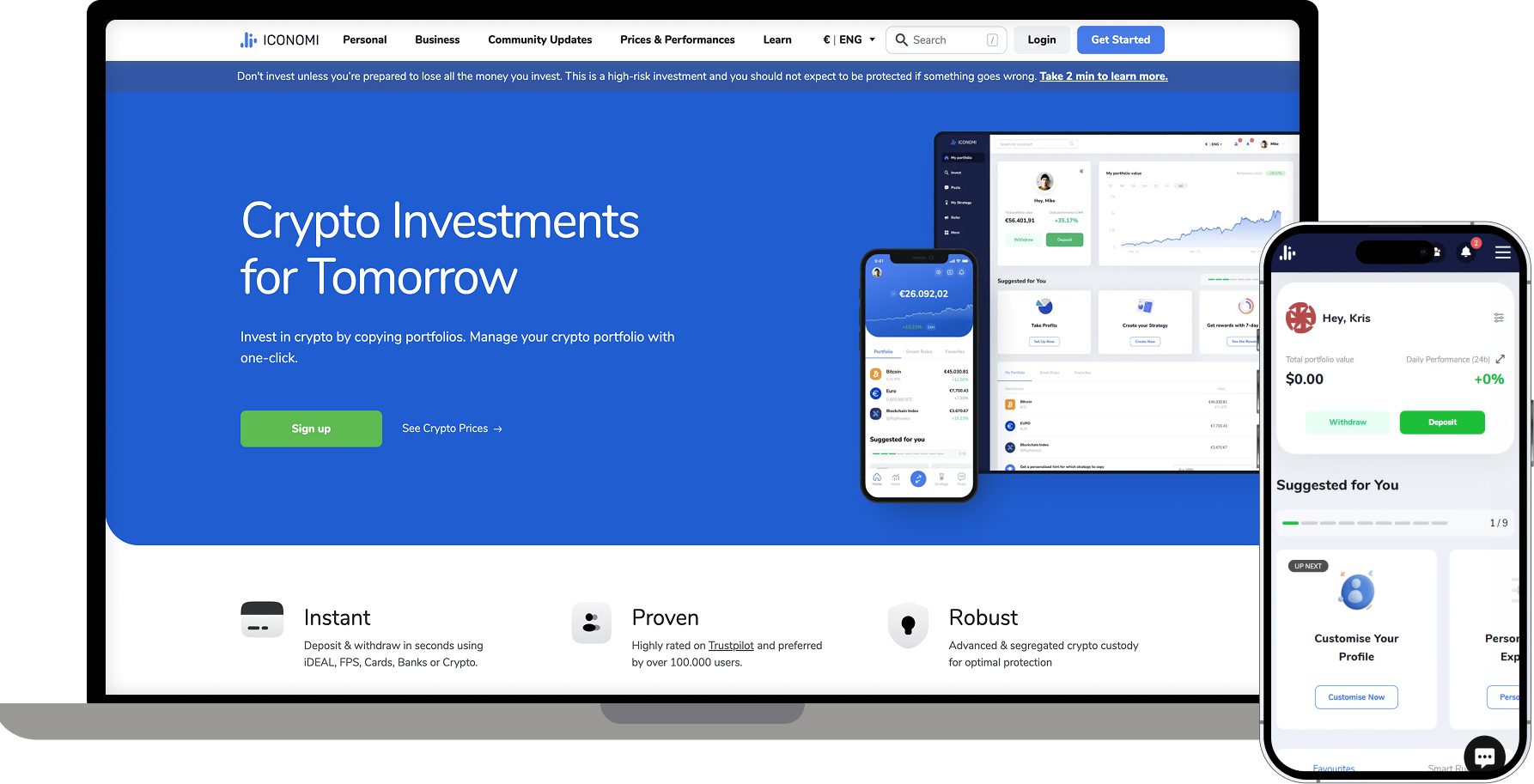
Similar rigor was applied to our projects with Escuela Coaching and ICONOMI, where localization testing was critical to user adoption in new markets.
In each case, a tailored mix of automated parsing and expert manual review ensured that the platforms scaled globally without sacrificing usability. If you are weighing AI-assisted localization QA as a cost lever, we can show you exactly which layers to automate, which to keep human, and what both will cost. Reach out for a scoped assessment of your localization QA pipeline.
See how our localization and onboarding testing helped ICONOMI cut user drop-off by 15% across a global crypto platform