
A test suite nobody trusts is a test suite nobody uses. When automated API testing fails, it’s rarely the tool’s fault. Instead, tests break for no obvious reason, someone removes them from the pipeline, and the team goes right back to checking things by hand.
Success depends far more on your strategy than your testing tools. The actual hurdles are finding the right starting point, prioritizing your next tests, and ensuring long-term reliability.
Automated API testing means running scripted checks against your API’s endpoints, contracts, and responses on every code change instead of by hand. Done well, it starts with a small set of high traffic, high risk endpoints, expands by test type in a deliberate order, and runs inside CI/CD so a failure surfaces within minutes of the commit that caused it.
This guide covers what to automate first, how to sequence the coverage, and how to keep the suite alive once it exists. None of it depends on a particular framework, and it is the same approach we take on client API testing projects.
What It Costs to Start, and What It Costs to Get Wrong
Plan the first phase in weeks, not quarters. A first suite covering the ten to fifteen endpoints that carry the most traffic and the most risk is realistic work for one engineer who knows the stack, pipeline integration included, inside two to four weeks.
Budgets rarely break on that first phase. They break in year two. A suite that grew without structure reaches the point where nobody can tell which failures are real, and the only way forward is a rewrite. You pay for that with engineering time already promised to something else.
Where Automated API Testing Pays Off First
Rank your endpoints before you write a single test. Two things decide the order: how much traffic an endpoint carries, and how much damage it does when it breaks. Authentication, payment, and anything that writes to a customer record sit at the top of both lists. An internal admin endpoint used twice a month sits at the bottom no matter how easy it is to test.
Then automate in this order:
- Happy paths on the top endpoints. The request everyone actually makes, with valid input and expected output. It is basic coverage, and it catches most of what a deploy breaks.
- Contract and schema checks. Status codes, required fields, types, and response shape validated against your OpenAPI specification or equivalent. These are cheap to generate from the spec, and they catch the changes that break things quietly. If a field that used to return a number starts returning text, the API still replies with a success code. Nothing looks wrong until an app that relies on that field falls over.
- Negative and edge cases on those same endpoints. Missing auth, malformed payloads, expired tokens, boundary values, unexpected nulls. Add these once the happy paths are green and stable, not before.
- Everything else, later or never. Breadth is not the goal. A suite covering twelve endpoints properly is worth more than one covering ninety shallowly.
The mistake worth naming here is trying to automate everything in the first sprint. Teams that do it end up with wide, shallow coverage that fails constantly for reasons unrelated to the code under test, and they lose the argument for automation before it has had a chance to pay anything back.
How to Sequence Unit, Integration, Load, and Security Tests
Not every test type belongs in the suite on day one. Some need a mature environment to say anything true, and running them early produces noise that teaches the team to ignore red builds. Sequencing them deliberately is the single practice that separates suites that survive from suites that get deleted.
Unit level API tests
During development, the sprint the endpoint is built
Broken logic, wrong status codes, schema drift
Low
Contract tests
As soon as a second consumer depends on the API
Breaking changes shipped to clients
Low
Integration and flow tests
Once staging carries real dependencies and real data states
Auth chaining, sequencing bugs, state that only appears across calls
Medium
Regression pack
Once you have a repeatable release cadence
Previously fixed bugs coming back
Medium
Load and performance tests
Once the environment genuinely resembles production
Throughput ceilings, timeouts, connection pool exhaustion
High
Security tests
Continuously from the start, deepened before each release
Authorization gaps, injection, data exposure
Medium
Load testing early is mostly theater. Run it against a staging box with a tenth of production’s data and a different connection pool configuration, and the number you get back is not about your API. Wait until the environment resembles production in data volume and topology, then treat the result as a real signal. At that point performance testing is its own job, not one more check inside the functional suite.
That is roughly how the Couple Up! project ran. The studio behind the mobile story game expected a jump in players and wanted to know where the backend would give way, so we load tested one GET and three POST endpoints in Apache JMeter, raising request volume step by step and watching response times. The instructive part was not the tool. Before we could describe the requests properly, the client had to fill gaps in their own API documentation. That is a normal starting position, not a reason to postpone testing.
Security testing is the exception to sequencing. It does not wait for a mature environment, because authorization logic is either right from the first commit or it is not. Run a baseline continuously and deepen it before release. The OWASP API Security Top 10 is a reasonable place to start on what that baseline should cover, and security testing picks up where automated checks stop.
The regression pack is where most suites quietly grow out of control, so decide up front what earns a permanent slot in it. Our guide to automated regression testing covers what to automate and what to leave alone.
How to Keep an API Test Suite Maintainable
Maintainability is not a phase after the tests are written. It is a set of decisions made while writing them, cheap at the start and expensive to retrofit.
- Build request logic once and reuse it. Shared request builders, one place where the base URL and auth live, no copy pasted payload blocks. When the auth header changes, and it will, you want one edit and not ninety.
- Own your test data. Tests that depend on a record someone seeded into a shared staging database six months ago will fail on a Tuesday for no reason anyone can reconstruct. Create what a test needs, then clean it up.
- Version test cases with the API code. Same repository, same pull request, same review. A contract change and the test that covers it should be impossible to merge separately.
- Diff the specification on every merge. Most silent breakages announce themselves in the spec file before they reach a consumer. Comparing it against the previous version in CI turns undetected schema drift into a failed build.
- Name tests for the behavior, not the endpoint.
rejects_expired_tokentells the next engineer whether a failure matters.test_auth_3does not.
Framework choice matters here more than anywhere else, because it decides how much structure you get for free. If you have not picked one yet, our API testing tools buyer’s guide compares the main options, and our comparison of Karate and REST-Assured goes deeper on two of them, backed by real Java automation work rather than feature tables.
One newer option is worth knowing about: tools that generate tests from real production traffic. They are genuinely useful for finding coverage gaps you did not know you had, especially on undocumented endpoints. They are not a substitute for reviewed test design, because a test generated from traffic copies whatever the system already did, including the parts that were wrong. Use them to find the gaps, then write the test yourself. The same discipline applies across automated functional testing more broadly.
How to Integrate API Tests Into CI/CD
API testing in CI/CD earns its keep through speed of feedback. A failure a developer sees four minutes after pushing gets fixed immediately. The same failure surfaced in a nightly report gets triaged next week, by which point three more commits sit on top of it.
Split the suite by stage:
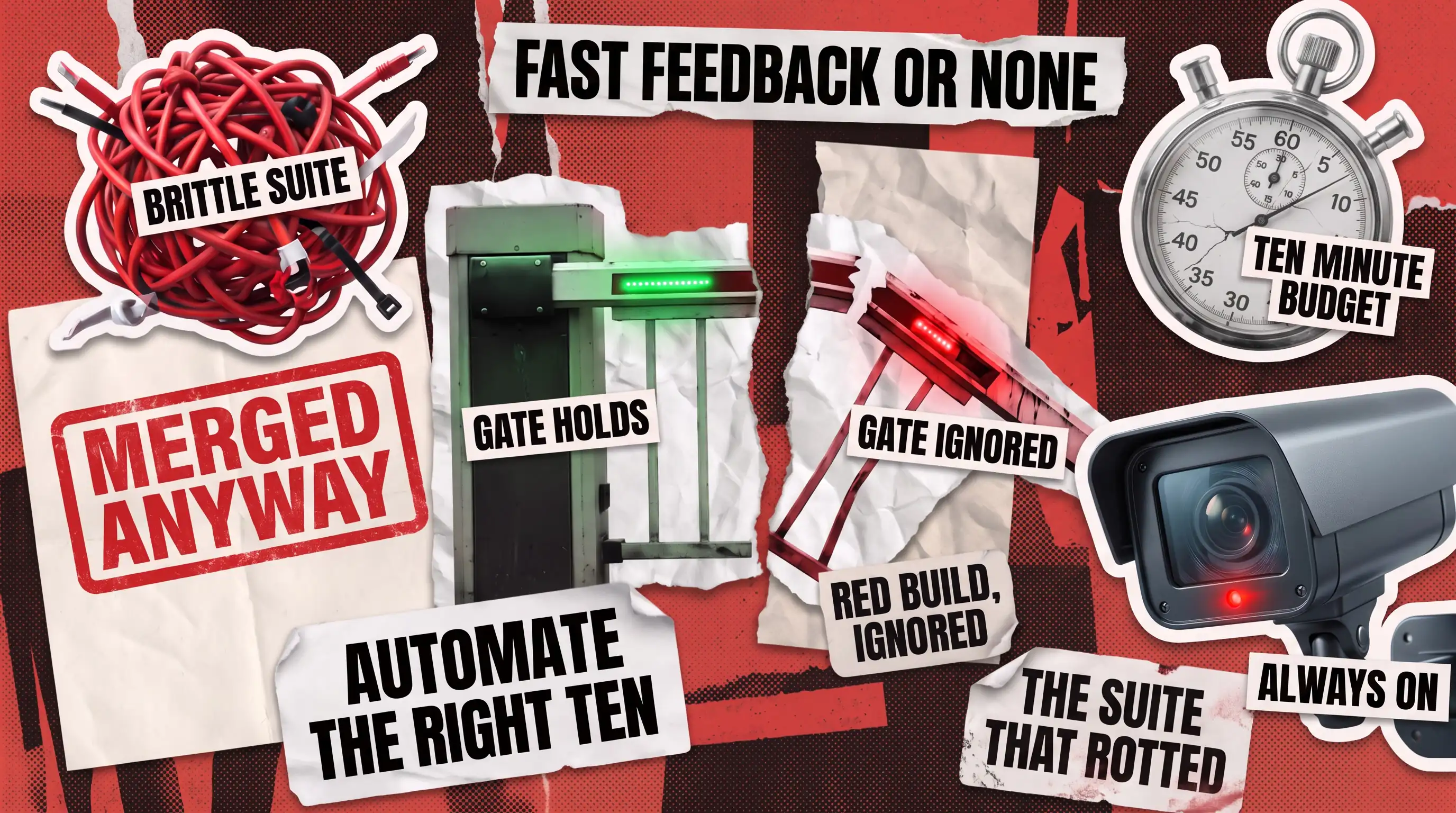
- On every pull request: the fast subset. Contract checks and happy paths on critical endpoints, under ten minutes total. This gate blocks the merge.
- On merge to main: the full functional and regression suite. Slower is acceptable here because nobody is waiting on it to keep working.
- Nightly or on a schedule: load tests and anything long running.
- Continuously: the security baseline.
Three rules keep it honest. Failures must block something, or the suite is documentation rather than a gate. Flaky tests get quarantined and fixed within a defined window rather than retried three times in the pipeline config, which is how a suite’s credibility drains away one silent retry at a time. And results go where developers already are, in the pull request itself, not to a dashboard someone has to remember to open.
Release cadence is what makes this urgent. On Granola, an AI notepad shipping new features roughly once a week, we built an automation framework from scratch with Playwright, Electron, and GitHub Actions, and automated 76% of the core regression suite across macOS and Windows. The team had no internal QA function before that, which is the common case rather than the exception. Weekly releases do not leave room for a manual pass, so the pipeline has to carry the regression load.
When Automation Is the Wrong Call
Automation is a poor fit while an API is still changing shape weekly. Pre product-market-fit, when endpoints are renamed and payloads restructured between sprints, the tests cost more to rewrite than the bugs cost to catch, and exploratory manual testing against the spec is the better spend until the contract settles.
It is also the wrong call when nobody owns it. An automated suite is a product with users, and without a named owner it degrades into noise inside two quarters. If you cannot name the person who is responsible when the build goes red, fix that before writing any tests.
How Qawerk Approaches API Test Automation
Most teams do not come to us with a blank slate. They come with an API already in production, partial coverage someone wrote two years ago, and a pipeline that has learned to ignore it. Qawerk plugs in at whatever stage a project is actually in rather than requiring a finished build handed over, which for API automation usually means auditing what exists, deciding what is worth keeping, and rebuilding the rest in a structure the team can maintain after we leave.
That work is hands on. We build the suites ourselves instead of handing over a strategy document, in Java with Karate and REST-Assured among other stacks, and our automated testing engagements cover functional, integration, performance, and security coverage across products from indie games to AI tools used in daily meetings. Qawerk’s QA engineers average nine years of experience each, which matters most on the maintainability decisions above, the ones that stay invisible for six months and then decide whether the suite survives.
If you would rather start with a team that has already worked through these decisions on other APIs, talk to us about automating your API tests.
Frequently Asked Questions
What should you automate first in API testing?
Start with happy path tests on the endpoints that carry the most traffic and cause the most damage when they break, usually authentication, payments, and any write to customer data. Add contract and schema validation next, then negative and edge cases on those same endpoints once the happy paths are stable.
How long does it take to set up automated API testing?
A first suite covering ten to fifteen critical endpoints, integrated into CI/CD, is realistically two to four weeks of work for one engineer familiar with the stack. Full coverage across a mature API takes longer and should be added incrementally rather than as a single project.
Should automated API tests run on every commit?
A fast subset should, ideally under ten minutes, covering contract checks and happy paths on critical endpoints. The full regression suite belongs on merge to main, and load tests belong on a nightly schedule where their runtime does not block anyone.
Can AI generate API tests automatically?
Tools that generate tests from real production traffic are useful for finding coverage gaps, particularly on undocumented endpoints. They are not a replacement for reviewed test design, because a generated test copies whatever the system already did, including existing bugs. Treat the output as a list of gaps to address, not as a finished suite.
What is the difference between automated API testing and API performance testing?
Automated API testing verifies that endpoints behave correctly: right status codes, right response shape, correct handling of bad input. Performance testing verifies that they keep behaving correctly under load. Both should be automated, but they answer different questions and belong at different stages of the pipeline.
See how we future-proofed Africa's first card-issuing API through test automation, resulting in $15M in seed funding.