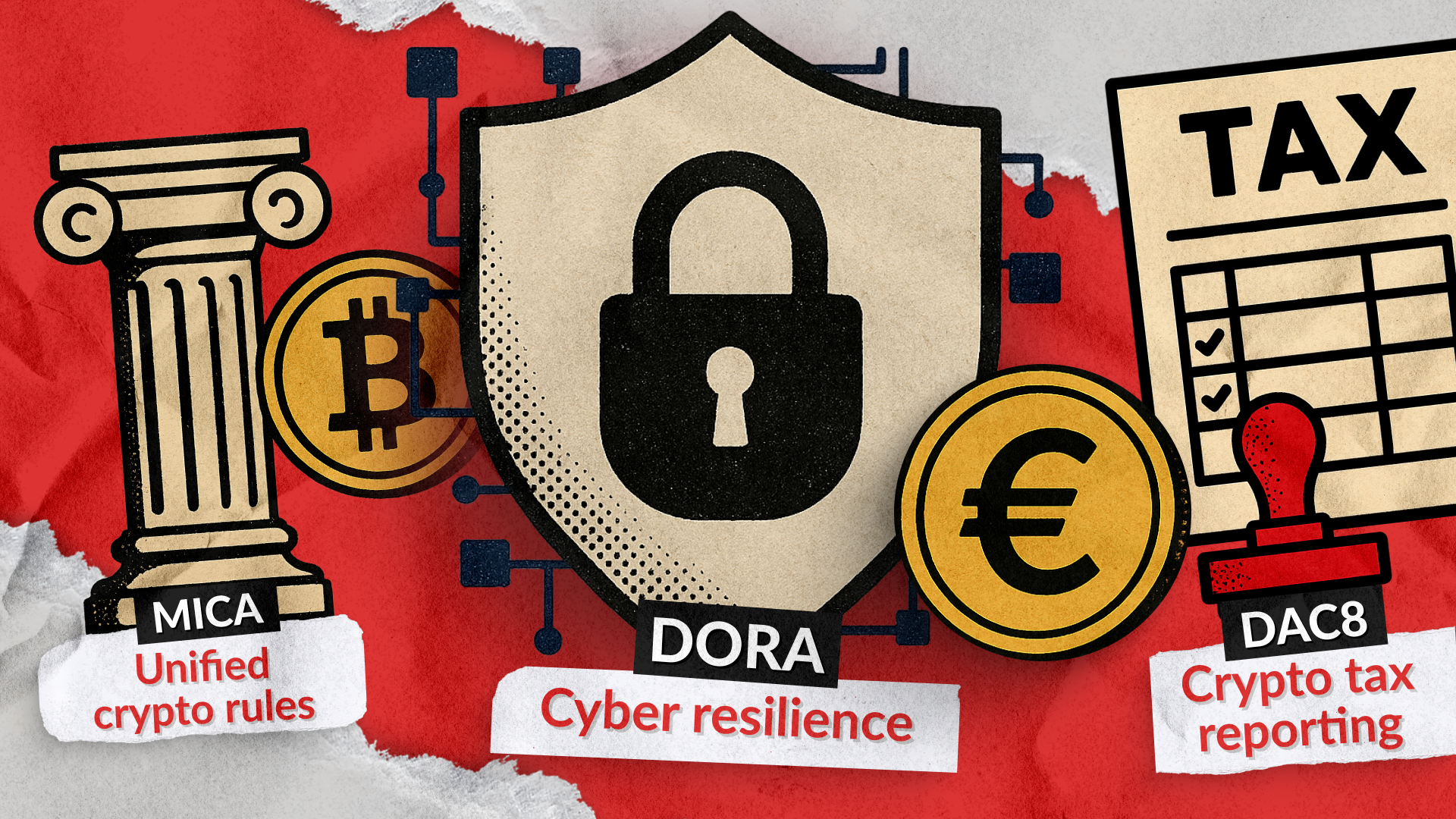
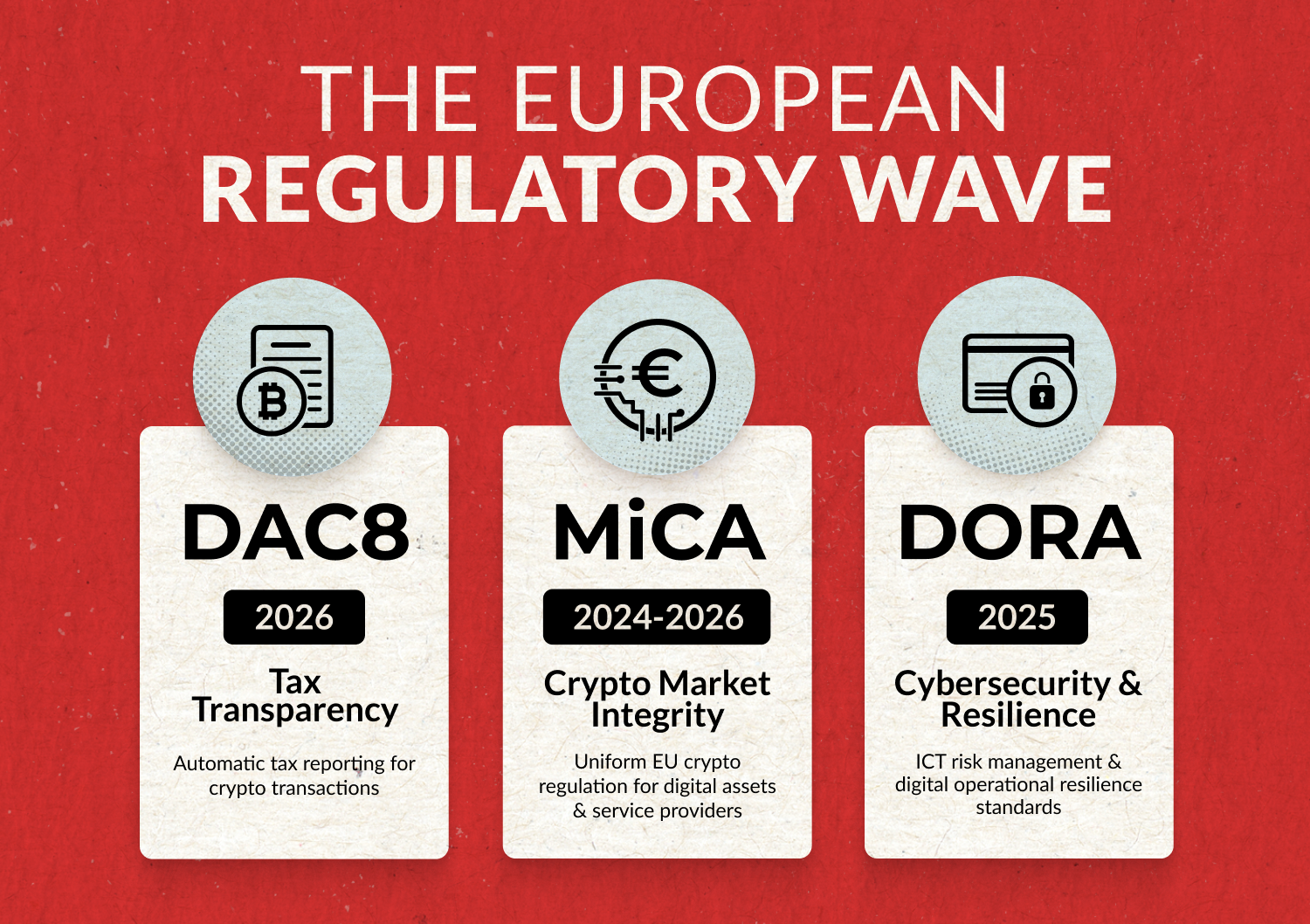
Europe stands at the forefront of the cryptocurrency regulation revolution, with three pivotal frameworks—MiCA, DAC8, and DORA—poised to reshape the way digital assets are governed across the continent. These new rules promise to deliver the world’s most comprehensive ecosystem for cryptocurrency laws, offering not just legal clarity but a competitive edge for compliant projects and businesses.
MiCA—Markets in Crypto-Assets Regulation
What is MiCA regulation? Markets in Crypto-Assets Regulation (MiCA, EU 2023/1114) marks the world’s first unified legal framework for crypto regulation, introducing harmonized, enforceable standards for cryptocurrency regulation and operations.
- Scope: All crypto assets (tokens, stablecoins, e-money tokens), and crypto-asset service providers (CASPs) throughout the EU.
- Phased rollout:
- June 2024: Regulates asset-referenced tokens (ARTs) and e-money tokens (EMTs).
- December 2024: All other crypto assets and service providers.
- Key requirements:
- Licensing for crypto asset service providers (CASPs): passporting across the EU.
- Enhanced anti-money laundering (AML), mandatory whitepapers, and extensive risk disclosures.
- Consumer protection and operational risk measures.
As a result, MiCA crypto regulation will standardize European crypto regulation, reduce fragmentation, and strengthen market integrity. This shift also raises new demands for QA and testing: Platforms must perform robust, continuous compliance and security testing, requiring not just functional QA but dedicated risk, accessibility, and resilience checks, especially given the interplay between financial regulation and digital product accessibility standards.
DAC8—Directive on Administrative Cooperation (Crypto Tax Reporting)
What is DAC8? The eighth amendment to the Directive on Administrative Cooperation (DAC8) is the EU’s answer to tax transparency on crypto. It mandates crypto-asset service providers—even those outside the EU with EU clients—to report all relevant transactions to tax authorities starting in 2026.
- Legal reach: Applies to all platforms that facilitate crypto-asset transactions of EU residents, such as crypto exchanges and trading platforms, certain DeFi platforms, custodial wallet providers, digital asset brokers and intermediaries, as well as traditional financial institutions that offer or deal in crypto-assets.
- Reporting obligations: Acquisition, disposal, crypto–fiat conversions, crypto–crypto exchanges, wallet transfers.
- Enforcement: Annual reports and mandatory data sharing between all EU tax authorities.
This level of scrutiny will drive greater demand for compliance and testing. Companies must invest in new QA validation routines to ensure their tax reporting engines and data pipelines meet DAC8’s rigorous standards.
DORA—Digital Operational Resilience Act
What is DORA regulation? DORA (Regulation (EU) 2022/2554) creates pan-EU rules compelling all financial entities (including crypto platforms) and critical ICT providers to manage cyber and digital risks actively.
- Effective from: January 2025.
- Coverage: Banks, investment firms, payment/e-money providers, insurers, and explicitly, crypto-asset service providers.
- Expected controls:
- Rigorous ICT/cyber risk management frameworks.
- Incident reporting and digital resilience testing.
- Mandatory board-level oversight of digital operational policies.
DORA’s arrival fundamentally raises the bar for QA and testing: Regular digital resilience and security testing becomes non-negotiable. Automated regression testing, penetration testing, and resilience drills across cloud services must become a core part of all crypto platform QA pipelines.
The Impact on Testing (QA)
The intersection of crypto regulation and software engineering is transforming quality assurance. Under MiCA, DAC8, and DORA, QA teams are compelled to:
- Go beyond functional testing: Validate regulatory reporting, licensing compliance, and digital operational resilience.
- Strengthen security and accessibility testing: Ensure that platforms meet both technical mandates (DORA) and usability/accessibility obligations.
- Automate compliance workflows: Integrate continuous compliance validation for transaction reporting (DAC8), operational risk, and consumer protection (MiCA/DORA).
- Document everything: Strict regulatory regimes demand exhaustive audit trails and transparent reporting of test results.
Why This Regulatory Wave Matters
Europe’s approach sets a global benchmark for cryptocurrency regulation. With harmonized and ambitious frameworks for legal compliance, operational resilience, and tax transparency, every crypto-asset service provider—from startups to multinational exchanges—must prioritize proactive QA and robust compliance engineering.
Penalties for Non-Compliance
Fines, suspension, loss of license, legal actions
Fines, restrictions, penalties for non-reporting or lack of resilience
Fines, back taxes, interest, penalties, reputational damage
Pitfalls
– Complexity in compliance for smaller firms
– Constant evolution in the crypto market
– Difficulty in managing third-party risks
– High cost of regular resilience testing
– Complex reporting for decentralized platforms
– Possible hindrance for P2P and small platforms
Compliance Complexity
Moderate to high (due to evolving nature of crypto regulation)
High (due to detailed resilience and third-party management requirements)
Moderate to high (due to global tax reporting requirements)
Global Reach
Primarily EU, but has global implications for non-EU crypto businesses
Primarily EU, but affects global financial institutions
Global reach, especially for platforms operating in the EU
Impact on Innovation
Balances regulation with the need for market growth
Focuses on resilience without stifling innovation
May stifle some decentralized platforms due to strict reporting
This is more than just a legal shift. It is a technological and operational inflection point: those who adapt rapidly will unlock new market opportunities, while laggards risk regulatory penalties or outright exclusion from the EU.
Key Takeaways
As MiCA, DAC8, and DORA re-define the landscape, the future of crypto in Europe now rests on operational resilience, transparency, and user protection:
- Comprehensive crypto regulation is not optional: It’s a market entry ticket, empowering compliant businesses while protecting consumers.
- Rigorous QA and security testing are essential: End-to-end validation ensures platforms meet both regulator and user expectations—a crucial element for trusted, inclusive growth. Integrating accessibility from day one is not just ethical, it’s a regulatory requirement for all digital finance providers in the EU.
- Continuous adaptation is a competitive advantage: The regulatory landscape will keep evolving as technologies and threats change. Proactive, agile organizations will always be one step ahead.
Ultimately, success in the new era of European crypto regulation means turning compliance into opportunity—where risk is managed, transparency is standard, and innovation is not just allowed but encouraged.
Why Choose QAwerk as Your Compliance Consultant
Navigating the evolving landscape of European crypto regulations, from MiCA to DAC8 and DORA, requires expert guidance. When considering a partner to help you through this complex environment, QAwerk stands out as an exceptional choice for several compelling reasons:
- Specialized Expertise and Experience: We possess in-depth knowledge of international tax law, specifically DAC8, CARF, and MiCA. Our understanding of the fintech and crypto domains is further solidified through our partnerships with companies like ChitChat and ICONOMI.
- Comprehensive Service Offering: We provide a full suite of services that span the entire compliance lifecycle, from initial assessment and gap analysis to thorough software audits, security reviews, and penetration testing.
- Advanced Technology Integration: We effectively blend manual expertise with automated software solutions to pinpoint cybersecurity vulnerabilities, accessibility issues, and to ensure the overall health and security of your codebase.
- Robust Data Security and Privacy Practices: Our commitment to enterprise-grade security is unwavering. We strictly adhere to critical data privacy regulations such as GDPR and SOC 2.
- Client-Centric Approach and Communication: Our compliance specialists excel at clearly communicating complex regulatory requirements and their potential impact. We embrace a collaborative approach that actively fosters cross-functional engagement within our clients’ organizations.
- Reputation and Credibility: Our dedication to providing excellent service has been recognized by the International Association of Outsourcing Professionals (IAOP), earning us a prestigious spot on their Global Outsourcing 100 list.
Ready to confidently navigate Europe’s new crypto regulation wave? Contact us today to discuss how QAwerk can become your trusted compliance partner.
Discover how we bug-proofed a crypto asset management platform, decreasing user drop-off by 15%