
Let us face the harsh reality of the modern digital landscape. If your application goes down during a peak traffic event, you are not just losing a few conversions. You are burning through money and customer trust by the second. According to ITIC’s 2024 Hourly Cost of Downtime Survey, 90% of mid-size and large enterprises now lose more than $300,000 per hour of downtime, and 41% lose between $1 million and $5 million per hour.
So if you’re a decision maker at a retail platform, a streaming service, a ride-sharing app, or a financial institution, microservices performance testing is no longer a nice-to-have post-launch checklist. To ensure your application survives Black Friday, a ticket drop, or a sudden news event, you need a resilient performance testing strategy for microservices.
This guide will explore the unique challenges of distributed systems, break down the testing types you need to adopt, and explain why investing in professional performance testing services is the best insurance policy your engineering team can buy.
Why Microservices Are Inherently Harder to Test
If you have ever been part of a legacy system migration, you know that monolithic architectures are bulky but straightforward. A monolith is a single deployable unit with one centralized codebase and one process. Performance testing a monolith is fundamentally simpler because all inter-module communication happens in-memory via direct function calls, taking roughly a microsecond. As Atlassian highlights, a monolithic application is highly unified, making end-to-end testing relatively fast.
So, how is microservices performance testing different? It all comes down to the physical landscape of the software. A microservices architecture breaks the application down into dozens or even thousands of independently deployed services communicating over a network. The network is the new function call, meaning every inter-service hop is suddenly exposed to physical network latency, TLS handshakes, packet loss, and timeouts. A simple data transfer that took one microsecond in a monolith can now take between 1,000 and 5,000 microseconds in a microservices environment.
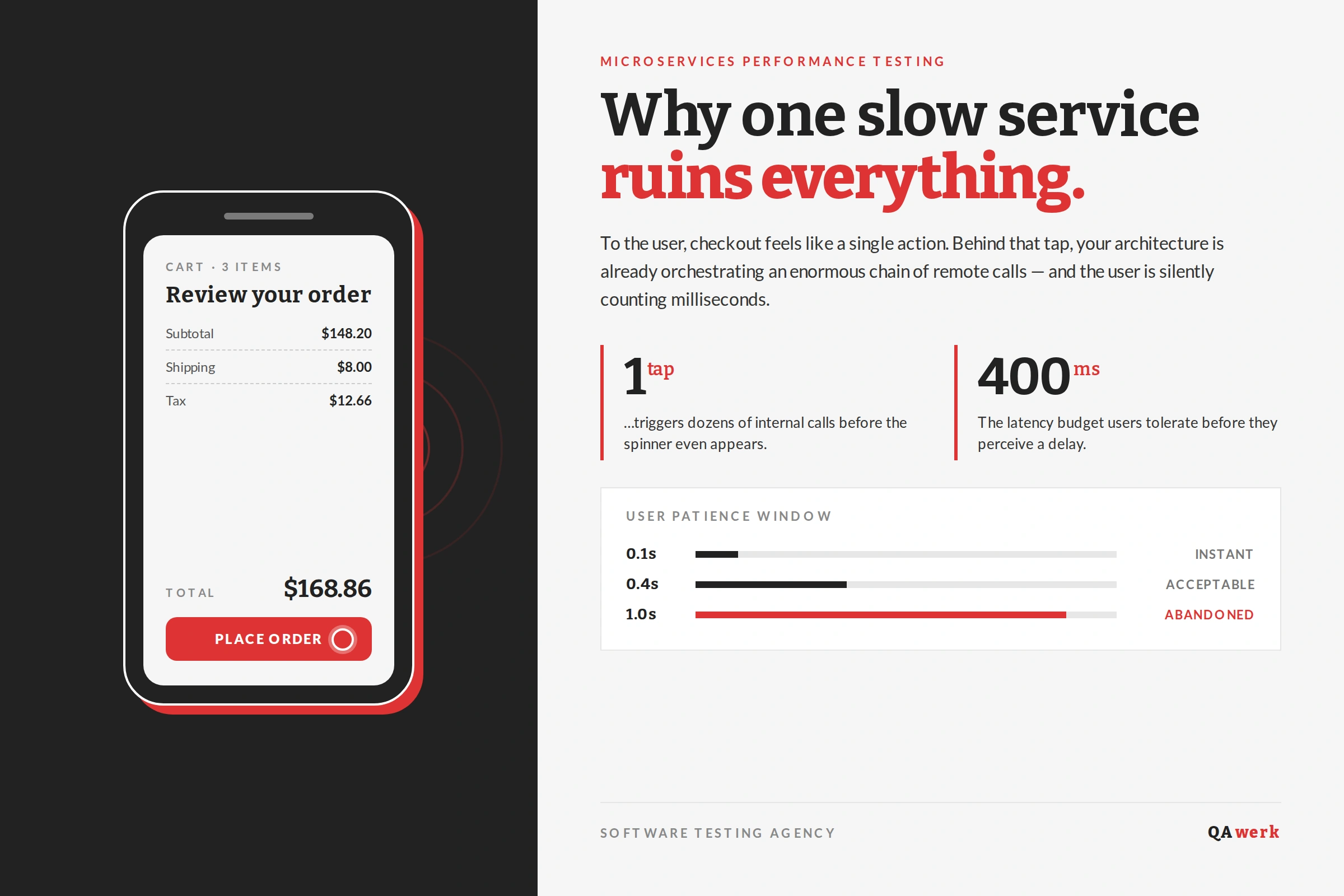
When evaluating how to test microservices, you have to stop looking at localized code execution speed. Instead, your microservices performance testing approach must account for data serialization, service dependency cascades, dynamic scaling thresholds, and the immense overhead introduced by API gateways. Without this mindset shift, your team will fall victim to performance blind spots that only reveal themselves during a catastrophic production failure.
Microservices Performance Testing Types and What Each One Catches
Think of these less as a checklist and more as a portfolio. Each test type answers a different question, and skipping any one of them creates a blind spot. A mature performance testing strategy for microservices runs all of them, on a schedule, with results piped into a dashboard your team actually looks at.
- Load Testing. Can your system handle the everyday hustle while meeting your promised speed targets, known as Service Level Agreements (SLAs)? Here, you simulate your expected peak traffic, hold it there, and watch how fast your system responds, how many errors pop up, and your total Requests Per Second (RPS). Microservices load testing is your baseline: everything else builds on this foundation.
- Stress Testing. Where exactly is your system’s breaking point, and what happens when it snaps? You intentionally push traffic far past your expected limits until something crashes. AWS Senior Principal Engineer David Yanacek captures this beautifully: “If engineers haven’t load tested a service to the point where it breaks, and far beyond that point, they should assume it will fail in the least desirable way possible.”
- Spike Testing. What happens when traffic jumps five or ten times higher in a matter of seconds? This is an absolute must-have test to prepare for flash sales, Black Friday, massive ticket drops, or unexpected breaking news.
- Endurance or Soak Testing. Can your system run a marathon, or does it slowly fall apart over time? You apply a moderate, steady amount of traffic for a long time (usually 8 to 72 hours) to check for sneaky issues like memory leaks or overloaded databases. A quick 30-minute test will almost never catch these slow-moving bugs, which is why endurance testing is so vital.
- Scalability and Volume Testing. Does throwing more server instances at the problem actually make things faster, or is there a hidden bottleneck holding everything back? This test also forces your system to process massive, realistic sets of data. Testing with tiny amounts of data easily hides inefficient database searches, whereas real-world data volumes expose them immediately.
- Chaos and Resilience Testing. How does your system react when things randomly break? In this test, you intentionally shut down servers, cut off network connections, or simulate full data center outages. Netflix pioneered this approach, proving that the only way to be completely confident in your system’s survival skills is to test its resilience in a live, real-world environment.
- Contract Testing for Performance. When one development team updates their service, will it unexpectedly slow down another team’s service that relies on it? This testing verifies that speed and RPS expectations remain intact between interconnected services.
Performance Testing Strategy for Microservices, Step by Step
Executing random, fragmented tests without a cohesive game plan will only give you disjointed and confusing data. A highly effective performance testing strategy for microservices requires a systematic approach that brilliantly layers metrics, continuous automation, and advanced observability.
Step 1: Define SLOs Anchored in User-Perceived Metrics
Before testing anything, decide what “good” looks like in concrete numbers. Service Level Objectives (SLOs) are the targets your tests will validate against, and they should reflect what real users experience.
For every critical user journey, set clear speed limits. Do not just focus on the average user experience. Instead, pay attention to your worst-case scenarios, often called the 99th percentile or P99. Setting a P99 target of 200 milliseconds for an e-commerce checkout means you guarantee that 99 percent of your customers will experience a load time of 200 milliseconds or faster. A video streaming platform might aim for a start-up time under two seconds, while a fintech app might require transactions to finish in under 500 milliseconds.
You also need to decide exactly how many simultaneous requests your system must handle and what percentage of errors you are willing to tolerate. Treat these final numbers as a strict, non-negotiable contract that your tests must enforce before any new code goes live.
Step 2: Map the Money Path and Identify Likely Bottlenecks
Not every service deserves the same testing budget. Start by mapping your “money path”, the user journeys that directly drive revenue:
- login, search, cart, checkout, payment for e-commerce
- signup, browse, play, bill for streaming
- request, match, ride, charge for ride-sharing
For each path, mark the shared resources multiple services touch (databases, queues, caches), the third-party dependencies that introduce rate limits (Stripe, Twilio, SendGrid), and the high-fan-out services where one slowdown cascades to many callers. This is where load testing microservices delivers the highest ROI per hour invested.
Step 3: Build Production-Shaped Test Environments
A test environment smaller than production hides exactly the bugs you most want to catch. Same container sizes, autoscaling policies, database flavor, network topology, and realistic data volumes.
Cloud-native teams typically spin up temporary, throwaway test environments on Kubernetes (created for a single test run, then deleted) or use AWS’s free Distributed Load Testing reference solution, which generates large-scale traffic from the cloud on demand. Robust cloud testing capability is non-negotiable here, because spinning up production-grade environments on demand is the only way to keep this practice affordable at speed.
Step 4: Manage Test Data Realistically and Mock External Dependencies
Testing with tiny, fake datasets will not expose the real database bottlenecks or memory hogs your system will face in the real world. Instead, use safe, anonymized copies of your actual production data. Also, make sure to warm up your system’s memory before the test begins, so you are measuring its normal running speed rather than the sluggishness of a cold start.
What about outside services you rely on, like Stripe or Twilio? You absolutely must fake them using a technique called service virtualization. Tools like WireMock or Mountebank create realistic “mock” versions of these partners. If you try blasting real third-party APIs during microservices load testing, they will instantly block your connection or hit you with a massive bill!
Finally, use contract testing tools like Pact. This automatically checks that your internal services are still speaking the exact same language whenever a developer updates the code. It catches broken connections immediately, rather than surprising your team with a total crash at 2 a.m. on launch night.
Step 5: Find the Right Balance Between Component and End-to-End Tests
It is incredibly common for teams to waste time building massive, slow, and unreliable end-to-end (E2E) tests while completely ignoring fast and focused component tests. The traditional “testing pyramid” is actually harmful when applied to microservices. Why? Because the hardest problems do not hide inside individual services. The real complexity lives in the network connections between those services.
Instead of a pyramid, Spotify uses a “testing honeycomb” model. Here is how you can adopt this microservices performance testing approach for your own team. Run quick, lightweight component tests every single time a developer updates the code. Next, focus the bulk of your effort on integration tests that check the boundaries and handshakes between different services. Finally, save your giant, full-system E2E tests for a weekly checkup. You will catch nasty bugs much faster this way, rather than waiting hours for an exhausting E2E marathon to finish.
Step 6: Integrate Tests Into CI/CD and Instrument Deeply
Performance tests run once a quarter become obsolete the second a new update goes live. Instead, automated load tests should act as strict quality gates for every single release.
Automating your tests is only half the battle, though. You must pair them with deep observability tools. Use distributed tracing (like Jaeger or OpenTelemetry) to track exactly how a request travels across different services, metrics dashboards (like Prometheus and Grafana) to watch server health, and Application Performance Monitoring tools (like Datadog or New Relic) for deeper insights. Without this essential stack, your tests will only tell you that your app is slow, but they will never tell you why it is struggling.
Step 7: Add Chaos Experiments and Improve Continuously
Once your basic load and stress tests pass, it is time to unleash some chaos. Intentionally shut down servers, slow down the network between services, or simulate entire data center outages. This proves that your safety nets, like circuit breakers and fallback plans, actually work, ensuring your system slows down safely instead of completely crashing.
After that, consistently monitor your tail latency (p99) trends. Your ultimate goal is to achieve stable “goodput”. This means that when your system hits its maximum capacity, the number of successful, fast responses simply levels off and stays steady, rather than buckling under the extra pressure.
What the Giants Actually Do
Looking at how the hyperscalers run performance testing for microservices is the fastest way to internalize the playbook. They treat performance as a continuous, aggressive engineering discipline.
Here is how the biggest tech companies handle their scaling challenges:
- Netflix: After a massive database outage in 2008, Netflix built the “Simian Army,” including Chaos Monkey, to randomly kill production instances and test resilience. Their Failure Injection Testing (FIT) platform ensures that a failure in a non-critical microservice does not result in a total system outage.
- Uber: Operating thousands of microservices, Uber utilizes an internal tool called Hailstorm. The capacity safety team runs weekly Hailstorm drills simulating extreme holiday peaks with auto-mitigating alerts.
- LinkedIn: To find their absolute breaking point, LinkedIn developed Dyno, a tool that gradually shifts live production traffic onto candidate instances to confidently identify saturation thresholds automatically.
The Best Microservices Performance Testing Tools
You cannot execute a modern testing strategy using outdated tools. Today, load generation must be paired with deep distributed tracing and observability. Finding the right microservices performance testing tools depends on your protocol diversity and your engineering culture.
Let us review the most popular and efficient performance testing tools for microservices:
- Grafana k6: A developer-first, Go-based framework. It boasts deep native integrations with modern CI/CD developer workflows and is incredibly efficient for cloud-native teams looking to write test scripts in JavaScript.
- Gatling: Known for extremely high throughput due to its asynchronous, non-blocking I/O. Gatling is a favorite among JVM-heavy engineering shops and provides highly polished out-of-the-box HTML reporting.
- Apache JMeter: The enterprise stalwart. It has unmatched protocol breadth supporting HTTP, JDBC, JMS, SOAP, and FTP natively. While it is a bit older, it is ideal for heterogeneous-protocol enterprises with existing investments in GUI-based test creation.
- Pact: The definitive tool for consumer-driven contract testing. Pact generates mock responses based entirely on agreed-upon contracts, allowing distinct teams to ensure structural compatibility in their local environments.
- Jaeger and Zipkin: Pushing load is useless if you cannot track the results. These distributed tracing tools monitor network requests by injecting unique correlation IDs through HTTP headers across every single microservice hop. This allows you to visualize a request’s exact journey and measure precise latency.
Choosing the right toolkit can make or break your product launch. It is often beneficial to evaluate your mobile footprint as well by reviewing the top mobile app performance testing tools before locking in your stack.
Why Partnering With QAwerk Makes Perfect Sense
Transitioning from monolithic load testing to a fully automated, distributed performance testing strategy requires an incredibly specialized skill mix. Building this framework internally often takes months and requires expensive engineering talent. This is exactly where a trusted QA partner steps in to fill the gap.
Since 2015, QAwerk has delivered comprehensive QA services to over 300 projects across North America, Europe, Australia, and beyond. We have successfully partnered with organizations navigating complex scaling challenges and architectural shifts.
For instance, we helped Native Games Studio optimize the backend for their interactive mobile game, Couple Up!. While a mobile game backend is different from a sprawling enterprise mesh, the principles of handling massive concurrent player spikes apply directly to microservices load testing. We used Apache JMeter to simulate tens of thousands of users, pinpointing exactly when server response times started to lag.
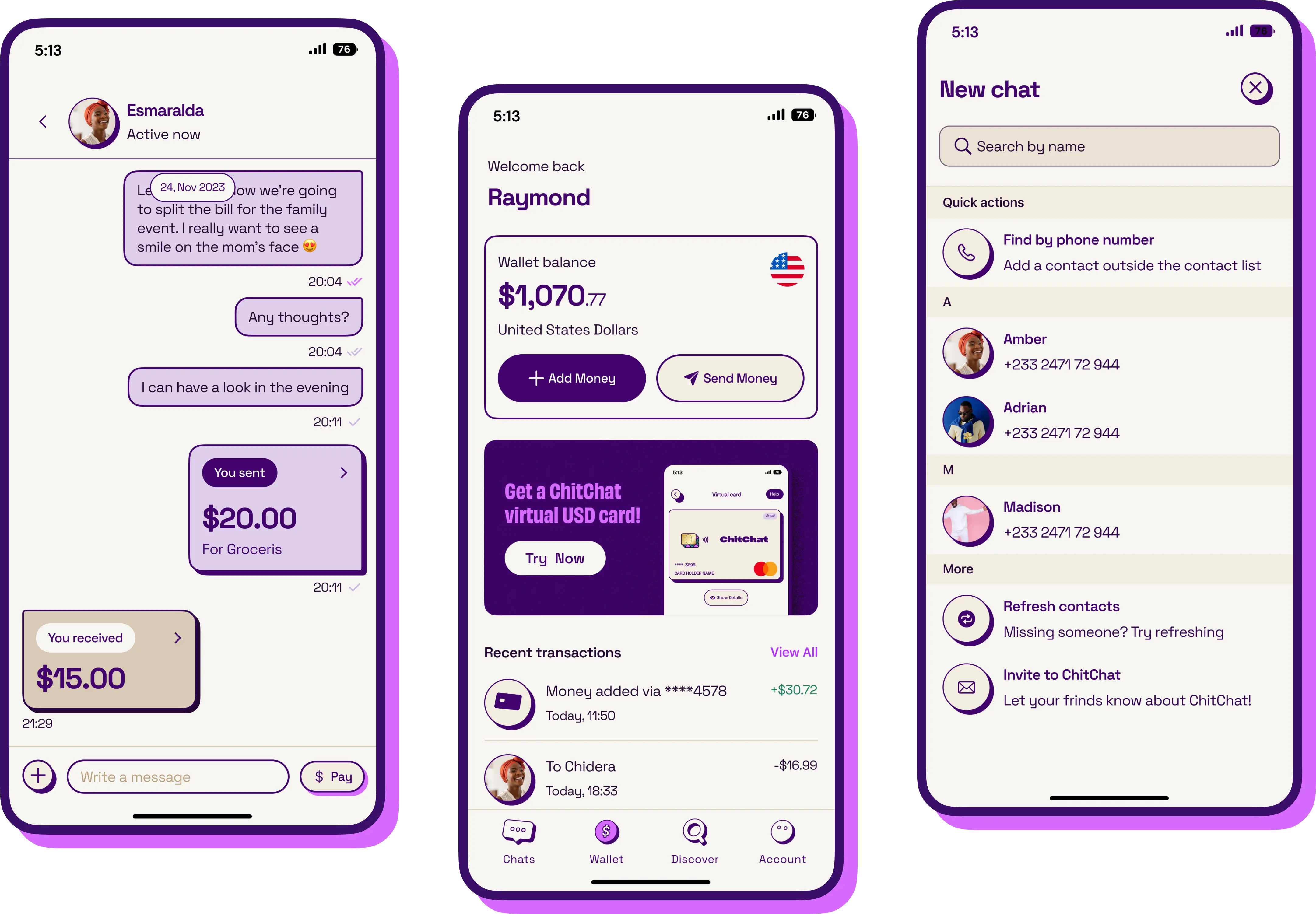
We also intimately understand the unique QA demands of building a distributed app from the ground up. Take ChitChat, a secure messaging and payment app designed for the African market. While our engagement here was not strictly focused on the performance testing of microservices, we established their entire QA process from scratch for this microservices-based application. We built robust automated testing frameworks for both the frontend and their backend APIs. By achieving a 70% automated to 30% manual testing ratio, we ensured their complex third-party payment integrations ran flawlessly, leading to a highly successful and secure MVP launch in just three and a half months.
Do not let invisible network bottlenecks ruin your next big peak event. You need independent, audit-grade validation. Whether you need a deep dive into cloud testing or comprehensive pre-release pressure testing, QAwerk provides the automated scripts and observability integrations required to turn your unpredictable system into a fault-tolerant engine of digital scale.
Reach out to QAwerk today, and let us ensure your microservices architecture performs flawlessly under any amount of pressure.
Check out how we automated 70% of test scenarios for this microservices-based payment app