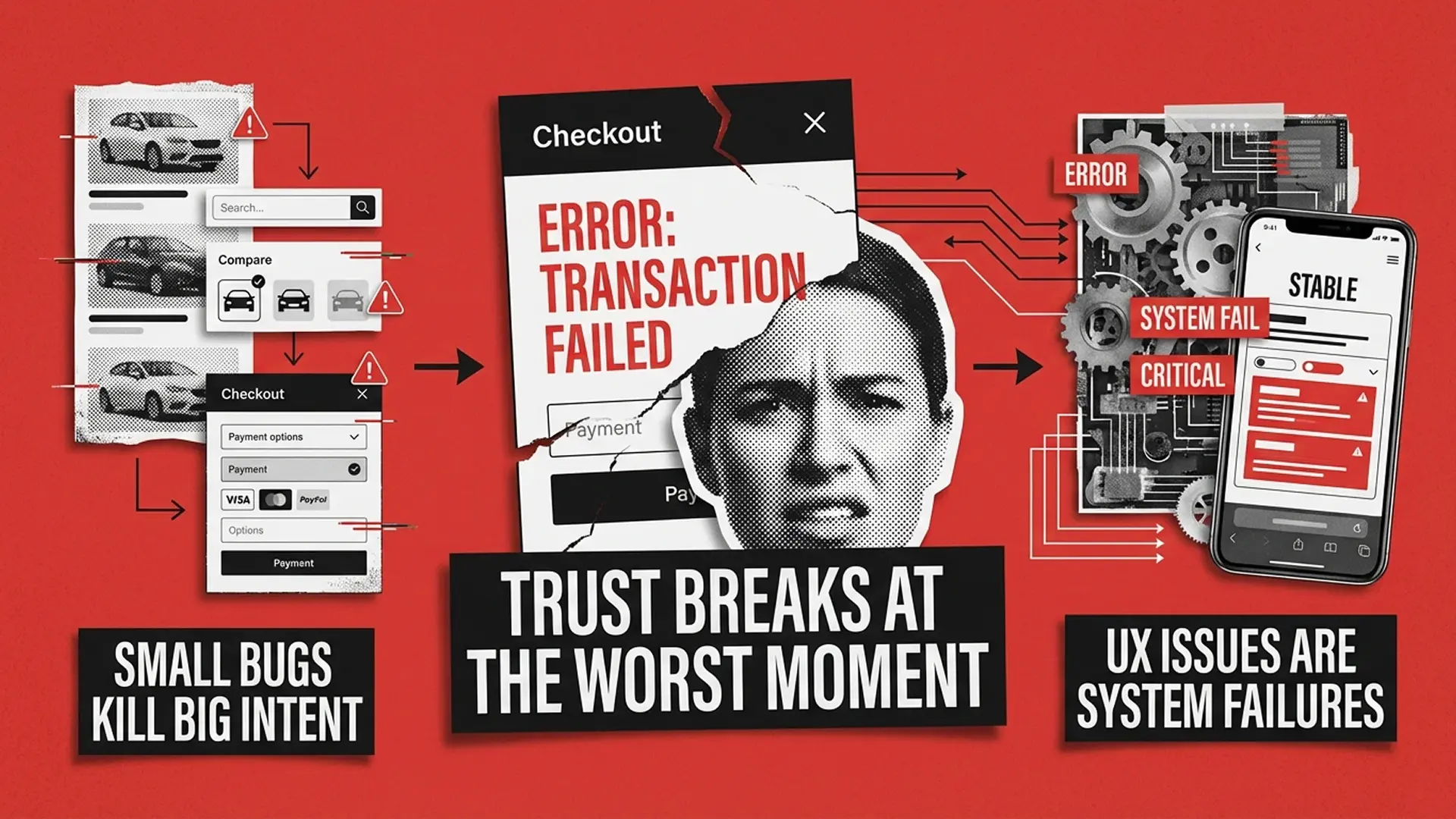
Buyers of any automotive products and services today go online to research models, compare trims, check financing scenarios, and read specs on their phones long before they commit to a purchase. It means that you might lose them at any stage of that research due to a minor bug. People want to have smooth experiences throughout the buyer’s journey and build trust in the brand along the way. You achieve this by ensuring they can do it by testing your systems from every angle.
Today, we’ll explain how exactly automotive software testing makes an impact on e-commerce conversions and your ultimate revenue. According to Cox Automotive’s 2023 Car Buyer Journey Study, most buyers prefer an omnichannel process: digital tools for research and pricing, human contact at key decision points. The majority do not complete the purchase entirely online.
That’s the context. The problem isn’t that buyers avoid automotive platforms. It’s what happens when the experience breaks at exactly the moment they’re ready to act.
Drop-offs happen at high-intent stages: vehicle discovery, inventory check, pricing comparison, finance form submission, and dealer handoff. These are the moments when your platform either earns trust or loses a buyer for good. According to JD Power’s 2024 U.S. Manufacturer Website Evaluation Study, website satisfaction rises when inventory is accurate, pricing is transparent, and navigation flows logically. Those aren’t aspirational goals. They’re baseline requirements that most automotive platforms still fail to meet consistently.
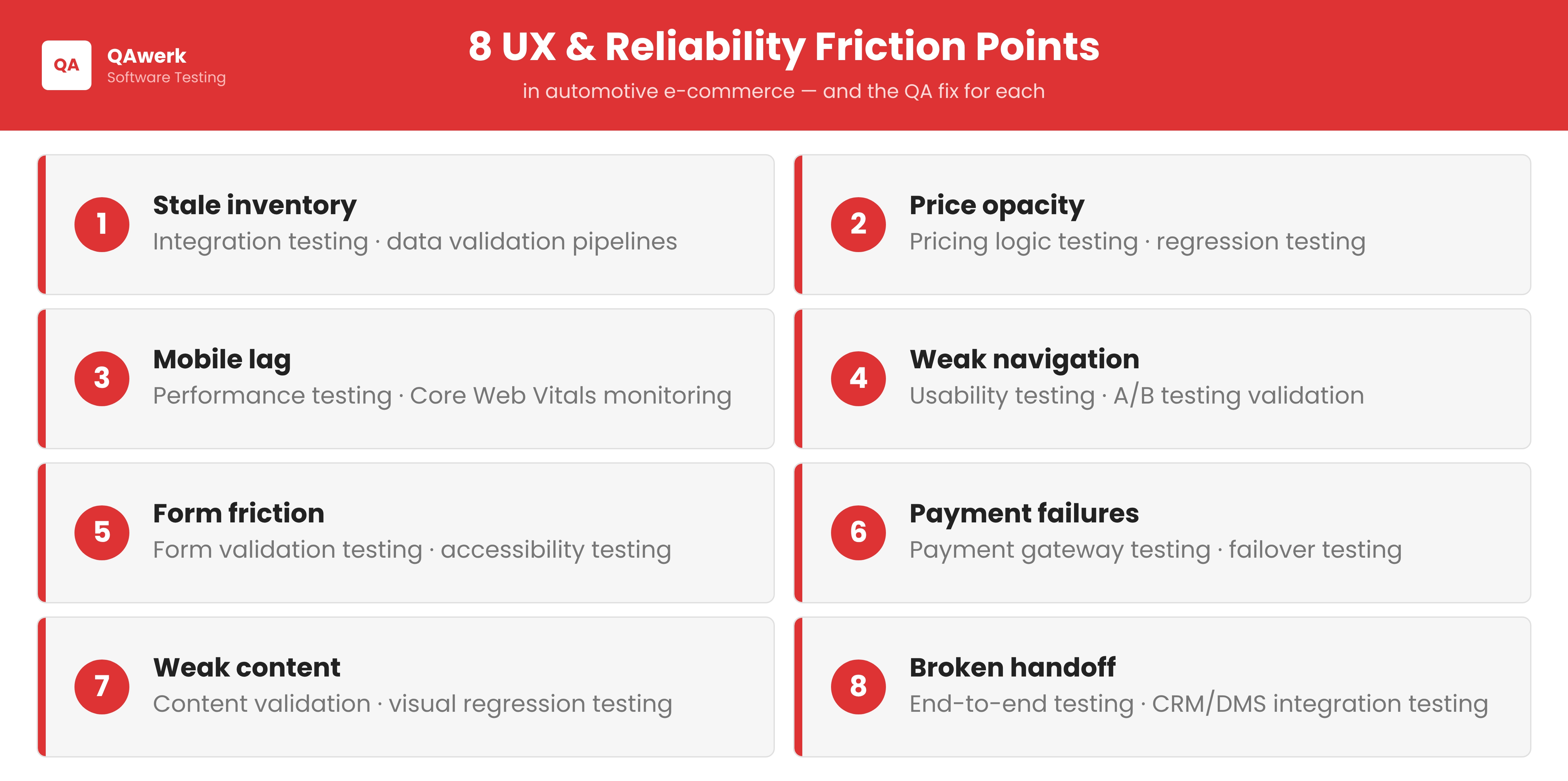
8 Automotive E-Commerce UX & Reliability Friction Points
Most of these don’t look like bugs. They look like a listing that seems slightly off, a form that’s one field too long, a payment step that times out once and never explains why. But each one lands at a high-intent moment, and a buyer who hesitates at those moments doesn’t try again.
Inaccurate or Outdated Vehicle Inventory
Few things destroy trust faster than clicking a vehicle listing that turns out to be sold, delayed, or inaccurately described. Stale data, caused by delayed syncs between the dealer management system (DMS), customer relationship management (CRM) platform, and website, doesn’t just frustrate buyers. It erodes confidence in everything else on the platform. Automotive inventory issues and dealership website problems stemming from data lag are among the most frequently reported friction points in automotive digital retail.
JD Power’s research identifies improved inventory accuracy as a key driver of rising manufacturer website satisfaction scores. Google’s vehicle listing documentation reinforces this: accurate availability data directly affects how dealership inventory surfaces in Search. So this is simultaneously a user experience (UX) problem and a discoverability problem.
From a QA standpoint, this is an integration testing issue. Inventory feeds need automated validation pipelines to catch discrepancies before they reach the buyer. Without that layer, stale data reaches production every time.
Price Opacity and Unexpected Changes
A buyer configures their vehicle, gets a quote, then submits a lead form, only to find the price has shifted. Or the manufacturer’s suggested retail price (MSRP) on the search results page (SRP) doesn’t match the vehicle detail page (VDP). Or incentives visible on the listing disappear during build-and-price. Each inconsistency reads as bait-and-switch.
Automotive pricing transparency UX is one of the clearest trust levers in digital retail. JD Power explicitly links pricing clarity to better satisfaction scores. Google’s auto UX guidance lists transparent, visible pricing as a baseline requirement. When backend pricing rules update, and the downstream effects go untested, buyer trust is the casualty.
Implementing automotive software QA through pricing logic and regression testing whenever a promo, incentive rule, or trim configuration changes can prevent most issues. Bear in mind that one untested backend update can silently break the trust built over months of marketing spend. Take a look at our full back-end testing checklist to understand exactly what you’ll need to cover.
Slow Mobile Experience and Performance Issues
Most buyers research on mobile devices, but many automotive platforms don’t meet their speed expectations. Google’s auto UX research is direct: the automotive mobile UX landscape still lags behind user expectations for fast, frictionless experiences. Homepage load time, build-and-price tools, forms, and overall page speed are the four key areas for improvement.
The stakes are concrete. Google and web.dev research shows that a 0.1-second improvement in mobile load speed measurably lifts progression rates through the purchase funnel. In automotive, where each conversion step carries real revenue value, automotive website performance issues compound fast. Mobile testing and Core Web Vitals monitoring are baseline hygiene for any platform taking mobile seriously.
Poor Navigation and Comparison Experience
Automotive buyers are high-consideration shoppers. They compare trims, financing options, incentives, and availability across multiple sessions and devices. When filters malfunction, comparison tools are buried three clicks deep, or calls to action (CTAs) don’t lead where they promise, users don’t dig deeper. They leave.
Google’s auto UX guidance recommends easy model comparison, clear above-the-fold CTAs, relevant landing pages, and simplified dealer-location actions. These are precisely the automotive website UX issues that usability testing surfaces before launch, not after conversion rate drops become visible in analytics. A/B testing validation can confirm which navigation changes actually hold improvements under real traffic.
Long, Confusing Lead and Finance Forms
This is where a meaningful share of high-intent buyers disappear. Baymard Institute research shows 39% of e-commerce sites require a phone number without explaining why. Users respond by entering fake data or abandoning the form entirely. The same research found 70% of major e-commerce sites perform poorly or only adequately on credit card form UX.
For automotive form UX, the impact is amplified. Finance applications ask for sensitive personal data. If the form is confusing, fields are poorly labeled, or validation throws cryptic errors, buyers associate that friction with the brand rather than the interface. Lead form abandonment in automotive e-commerce is rarely a marketing problem. It’s a testing problem: missing field validation, unclear error states, inaccessible form elements, and no submission confirmation. Together, usability and accessibility testing cover this surface thoroughly.
Payment and Financing Failures
Automotive funnels involve real financial transactions: reservation deposits, trade-in offers, finance pre-approvals, and service payments. When those steps fail, the damage goes well beyond the dropped transaction.
Stripe’s research quantifies this: 33% of consumers say they would not return to a business after a false payment decline. McKinsey adds that 40% of consumers already prefer to complete car financing online and want access with minimal friction. A payment failure UX moment at that stage doesn’t just cost the deposit. It costs a buyer who was committed to completing the purchase.
This is a payment gateway testing and failover assessment problem in e-commerce website testing. Third-party integrations, such as financing APIs, card processors, and trade-in valuation tools, need systematic testing under load, in failure scenarios, and across edge-case inputs before they handle real transactions.
Weak or Inconsistent Product Content
Salsify’s 2025 consumer research found that 54% of shoppers abandoned a purchase due to inconsistent product information, and 53% due to incomplete or poorly written descriptions. For automotive e-commerce, those figures translate directly: mismatched trim specs, missing equipment packages, outdated incentives, incomplete photo sets, and inconsistent availability status across SRP and VDP.
Any automotive product page UX depends on content reliability. 84% of shoppers rate pricing and availability as very or extremely important on product pages. When a model year update pushes new specs, but the VDP still shows old data, buyers notice, and their confidence drops. Content validation testing and visual regression testing catch these inconsistencies when updates are pushed to production, before they reach buyers.
Broken Online-to-Dealer Experience
This is the most automotive-specific failure point. Cox Automotive’s research shows that buyers overwhelmingly prefer an omnichannel automotive UX rather than a purely digital journey. They configure online and expect to arrive at the dealership with that groundwork intact. When saved vehicles disappear, deal details don’t transfer, or the salesperson has no record of the online inquiry, the buyer feels like they’re starting from scratch.
This failure sits at the intersection of the website, CRM, DMS, financing tool, and dealer portal. A break at any integration point can silently kill a lead that was ready to close. End-to-end journey testing and CRM/DMS integration testing are the only reliable ways to catch those breaks before real buyers encounter them.
You can see how this works in practice from our Keystone case study. We provided the client, who specializes in higher education marketing and runs a platform that helps students connect with over 5,500 universities, with comprehensive end-to-end testing. The result was a significant reduction in bugs in production, which enhanced the platform experience and attracted over 100M global visitors.
Why These Issues Are Automotive Software Testing Failures
Calling these issues ‘UX problems’ is accurate but incomplete. Design can’t fix an application programming interface (API) that returns stale inventory. A redesigned pricing page won’t stop a backend rule update from silently breaking the numbers. What looks like a UX failure is usually a systems failure, and systems failures are a quality assurance (QA) problem.
Every broken moment at a high-intent stage, be it inventory mismatch, form error, or payment failure, means a buyer who was ready to act walks away. In high-value automotive transactions, a single lost buyer represents real revenue. And automotive purchase decisions are high-consideration: a buyer who had a broken experience rarely gives the platform a second chance. They move to a marketplace or a competitor whose platform made the same journey feel reliable.

How Automotive Software Testing Prevents Customer Loss
Preventing customer loss in automotive e-commerce isn’t about catching every bug after launch, but about systematically testing the flows that matter before buyers encounter them. That means knowing exactly which surfaces pose the greatest risk and which testing disciplines address each.
What Should Be Tested in Automotive E-commerce Platforms
Automotive software testing covers more ground than most teams expect. The core surfaces that need systematic coverage:
- Inventory sync between DMS, CRM, and the customer-facing website
- Pricing logic across SRP, VDP, build-and-price tools, and lead forms
- Mobile performance under real-world conditions, including Core Web Vitals
- Checkout, deposit, and financing integrations under load and in failure scenarios
- Lead forms: field validation, error messaging, accessibility compliance
- End-to-end journeys across website, CRM, DMS, financing tools, and dealer systems
Key Testing Types That Matter Most
For automotive e-commerce conversion optimization, these testing services deliver the highest impact:
- Functional testing: verifies every feature, such as filters, forms, build tools, and calculators, works as specified
- Integration testing: validates data flow between your website and every connected system (DMS, CRM, payment gateway, financing API)
- Performance testing: ensures pages load fast enough to hold mobile buyers through each funnel step
- Usability testing: exposes navigation and flow breakdowns that analytics alone won’t surface
- Compatibility testing: confirms the platform works consistently across browsers, devices, and operating systems
What Fixing UX + Reliability Looks Like in Practice
The friction points covered above aren’t theoretical. They appear on any platform where high-intent users hit unreliable flows, and the fix always follows the same pattern: systematic testing at the moments that matter most.
How Resolving Flow Breakdowns Reduced Drop-Off by 15%
The same class of problem appears across high-stakes digital platforms, not just automotive. ICONOMI, a crypto asset management platform, approached QAwerk with a broken onboarding and verification flow. Unresponsive buttons, validation loopholes, and misleading error messages were silently killing conversions at the exact moment users were ready to commit. The same pattern that kills automotive lead submissions and checkout flows every day.
After systematic manual testing of registration flows, input validation, error states, and cross-browser behavior, ICONOMI achieved a 15% decrease in user drop-off rate, with over 100,000 users experiencing the improved platform.
The root causes weren’t exotic: broken form logic, dead-end error states, and user interface (UI) states that confused users into abandoning. The mechanism is identical in automotive e-commerce. A high-intent user hits a broken moment. They leave. Test the flow systematically; cut the drop-off.
Automotive E-Commerce Success Depends on Trust
Trust in automotive digital retail is built on accuracy, speed, and consistency. It is also destroyed the same way, one broken interaction at a time.
Inventory that says “available” when it isn’t. A price that shifts between pages. A form that throws a cryptic error on the last field. A lead that never reaches the dealer. Each of these is a lost sale, and in high-value automotive e-commerce transactions, a single lost buyer is real revenue. A buyer who had a broken experience rarely comes back.
Every one of these failures is testable and preventable. If your automotive e-commerce platform is losing leads between vehicle discovery and dealer handoff, the root cause usually isn’t marketing spend. It has untested UX and reliability gaps. Let’s fix that.
Check out how we provided web and mobile testing for Elsewhen, a digital consultancy working with Google and Spotify.