Multi-agent AI systems sell a tempting vision: autonomous agents collaborating like a seasoned human team. In theory, this setup allows a specialized researcher agent to gather data, a writer agent to draft a report, and an editor agent to finalize it, all seamlessly communicating in the background.
However, the reality of deploying these advanced networks is not always that bright. Without professional quality assurance, this dream of frictionless delegation often boils down to cascading errors, data loss between agents, and broken user experiences. This is exactly why specialized AI agent testing services are absolutely critical for any business trying to deploy these models into production.
This guide explains why multi AI agent systems are harder to test than single agents, where the bugs actually hide, and a practical strategy to catch AI agent handoff failures before a single user feels them.
The Chaos of Testing Multi-Agent AI Systems
Is testing multi-agent AI systems more challenging than testing single agents? The short answer is a resounding yes. Let us be clear: testing a single-agent system is not exactly a walk in the park. You still have to wrestle with inherent model randomness, hallucinations, prompt injections, and data retrieval failures. However, in a single-agent environment, the QA process is far more contained because you are typically debugging one conversation at a time. If something breaks, the root cause is usually traceable from a single execution trace, whether it stems from a bad tool call or a poorly retrieved document. You have one distinct set of decisions to inspect.
Multi-Agent AI Systems Don’t Follow a Fixed Path
When you transition to a multi-agent architecture, that single trace explodes into a tangled web of interactions. Multi-agent systems in AI behave more like a small team. Each agent reasons independently, picks its own tools, and adapts its plan as the task unfolds. You might run the exact same user query through the system three times and get three entirely different execution paths. Agent A might decide to ask Agent B for help on the first run, but on the second run, it might decide to query an external database directly. This unpredictability makes traditional regression testing almost impossible to apply without heavy modification.
Tool Use Blows Up the Testing Surface
Furthermore, the introduction of tool execution capabilities drastically expands the testing surface area. Agents are no longer just talking to each other; they are triggering workflows, generating reports, and sending emails. If an agent hallucinates a parameter while calling a secure internal API, the consequences can range from a broken UI to a massive data breach. As a result, comprehensive AI testing must now encompass behavioral monitoring, security validation, and boundary testing across an ever-changing web of agent interactions.
More Capability Means More Ways to Fail
Anthropic’s engineering team reported that its Research system, built around an orchestrator-worker pattern, outperforms single-agent baselines by 90.2% on internal evaluations while consuming roughly 15 times more tokens per task. More capability means more moving parts, longer traces, and more failure modes per request. Single-agent tests check whether the model returned a sensible answer. Multi-agent system testing has to check that several models, tools, and prompts converged on a sensible answer together, which is a fundamentally harder question.
Where the Bugs Hide in Agent-to-Agent Workflows
As appealing as agentic workflows are, they are heavily prone to specific categories of bugs that are rarely seen in traditional software. According to the Multi-Agent System Failure Taxonomy (MAST) study by UC Berkeley’s Sky Computing Lab, failures cluster roughly as:
- specification and system design issues (about 41.8%)
- inter-agent misalignment (about 36.9%)
- task verification or termination issues (about 21.3%)
In other words, more than a third of all failures happen specifically in the seams between agents. The numbers do not lie, and they prove that agent handoffs are a major headache. In the next three sections, we will break down exactly how these communication breakdowns happen so you know what red flags to watch out for.

Specification Gaps in Multi-Agent AI Systems
These are the failures you bake in before your agents even start working. Think of specification as the job description you hand each agent: who does what, when they’re done, and what counts as success. When that job description is fuzzy, agents fill in the blanks themselves, and they rarely fill them in the way you wanted.
Ambiguous role definitions, vague task boundaries, missing termination conditions, and disobeyed task constraints all live here. The MAST paper highlights “disobey task specification” as the single most frequent failure mode, accounting for roughly 15% of all observed errors.
Why are specification gaps so common? Because everyone assumes the prompt will somehow communicate intent across multiple agents. It rarely does. When a planner agent and a coder agent disagree about what “done” means, they will produce confident, well-formatted, completely wrong outputs. Robust LLM testing catches these specification gaps before they harden into production behavior.
Inter-Agent Misalignment
This is the second-largest failure category and the one this article is most concerned with. Inter-agent misalignment shows up as agents withholding information, ignoring each other’s outputs, repeating work, or speaking different “dialects” of the same data schema. Without clear protocols, standardized APIs, and reliable message-passing systems, agents can end up working against each other or duplicating efforts.
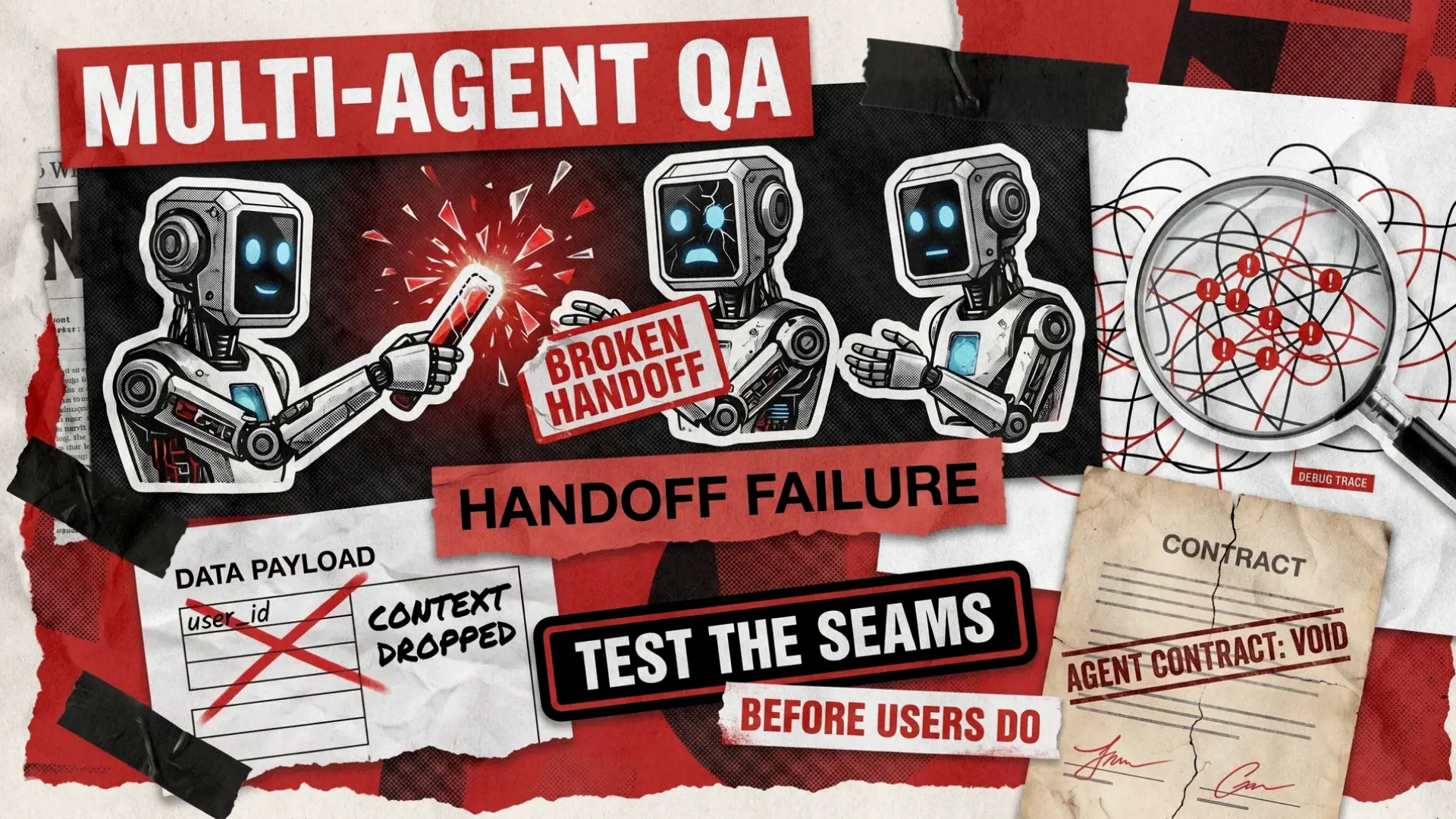
The classic agent handoff bug looks innocent. Agent A passes a payload to Agent B. Agent B accepts it, processes it, and returns a fluent answer. Nobody noticed that a critical field was dropped along the way, so Agent B helpfully made one up. Multiply that by a long chain of agents and you get the “telephone game” effect that Anthropic explicitly warns about in its guidance on when to use multi-agent systems.
Task Verification and Termination Failures
The last category is where the system is supposed to catch its own mistakes and stop, but doesn’t. Premature termination (the orchestrator declares victory too early), incomplete verification (the verifier checks the wrong thing), and incorrect verification (the verifier rubber-stamps a wrong answer) collectively account for roughly one in five failures. Defining the right AI agent evaluation metrics is what turns these silent failures into loud, actionable signals.
Most production reliability gains in multi AI agent systems do not come from a smarter model. They come from tighter specifications, cleaner handoffs, and verification you can actually trust.
How to Catch AI Agent Handoff Failures Early
For CTOs, QA leads, and product managers, the stakes could not be higher when introducing these autonomous networks to your users. When an AI agent handoff goes wrong, it does not just return a generic error message; it can generate wildly inaccurate actions, execute unauthorized API calls, or silently drop critical customer data. The complexity of these interactions requires a massive shift in how we approach software testing.
Treat Every Handoff as a Contract, Not a Vibe
If two agents share a payload, that payload deserves a schema and a written contract. Define required fields, types, valid ranges, the success criteria the receiving agent will check, and the failure modes the sender promises to flag. Without that contract, you cannot write a meaningful test, because there is no specification to test against.
This is the single highest-ROI step. It also dovetails with how Deloitte frames AI agent governance: roughly 80% of organizations surveyed for Deloitte’s 2026 State of AI in the Enterprise report lack mature capabilities like clear boundaries, real-time monitoring, and audit trails. Strong handoff contracts are the bottom layer of that governance.
Build Observability Before You Build Features
You cannot debug what you cannot see. Every agent call, tool invocation, and inter-agent message should emit a structured trace with a correlation ID, timestamps, token counts, and the full prompt-and-response payload. Without distributed tracing, you are stuck guessing why your AI acted up. With it, you know perfectly well that Agent C handed over messy data on step four, which sent Agent D into a frantic retry loop that drained your API budget.
Trajectories matter as much as outputs. You evaluate the path the agents took, not just the final answer, because two agents can return the same correct response while one quietly burned through 40 tool calls, leaked extra customer data, or got there by accident.
Test the Seams, Not Just the Agents
Most teams test each agent in isolation and call it a day. That catches the easy bugs, but it misses the place where users actually get hurt: the handoff between agents. In practice, that means building four kinds of tests aimed at the handoff itself:
- Schema checks confirm the data passed between agents has the right shape and required fields, so nothing gets silently dropped.
- Context-loss tests deliberately overload the system’s memory to see which details get forgotten when things get crowded.
- Conflicting-state tests set up situations where two agents believe different things (for example, one thinks the user is logged in, the other thinks they aren’t) and check how the system reconciles them.
- Replay tests run the same handoff multiple times with small variations to expose flakiness, since agents don’t always behave the same way twice.
For systems with retrieval components, this is also where RAG testing becomes essential, since retrieved context is one of the most common handoff payloads and one of the most error-prone. A multi-agent system that hands off the wrong document is not a search problem. It is a coordination problem dressed up as a search problem.
Mix Automated and Human-in-the-Loop Evaluation
LLM-as-a-judge approaches scale well, but they share blind spots with the models they evaluate. Berkeley’s MAST team built an automated annotator that matches expert humans about 94% of the time, which is excellent and still not enough on its own. Human reviewers catch tone, emotional nuance, regulatory gotchas, and the “technically correct but wildly inappropriate” answers that automated judges miss.
Our perspective on this trade-off lives in manual vs. automated testing of AI agents. Short version: scale your regressions with automation, sharpen your edge cases with humans, and never trust a single evaluator for high-stakes decisions.
Perform Stress, Chaos, and Adversarial Testing
Real users will break your system in numerous, unexpected ways. Once your system meets actual production traffic, it will encounter combinations of inputs, timing, and edge cases that your happy-path tests never imagined. The fix is to break the system on purpose, in a controlled way, before users do it for you. There are three flavors of this kind of testing, and you want all three:
- Load testing sends realistic volumes of concurrent traffic at your system to see how it behaves when many users hit it at once. Does latency stay reasonable? Do agents start timing out? Does anything quietly drop?
- Chaos testing deliberately injects failures into individual agents: timeouts, malformed responses, half-finished tool outputs. The goal is to see whether the rest of the system handles the failure gracefully or collapses in a heap.
- Adversarial testing sends prompts specifically designed to break things, like attempts to jailbreak the orchestrator, bypass safety rules, or trick the verifier into approving an unsafe action.
This is also where the hidden risks of AI agents surface, since many of them only show up under pressure. A few common ones to watch for:
- Prompt injection through retrieved content, where malicious instructions hide inside a document the agent fetches and end up being treated as a command.
- Cascading retries, where one failed call triggers another, which triggers another, until your token budget is gone and your bill is enormous.
- Quiet permission escalations, where an agent slowly gains access to tools or data it shouldn’t have, one tool call at a time, without anyone noticing.
Verify the Verifier
The verification agent is your last line of defense, which means it is also a single point of failure. Build an adversarial test suite specifically for the verifier: feed it answers that look correct but aren’t, answers that are correct but poorly formatted, and answers that test edge cases of the success criteria. If the verifier waves all of them through, your last line of defense isn’t actually defending anything.
Monitor Continuously in Production
Pre-release testing finds the bugs you can imagine. Production monitoring finds the ones you cannot. Track handoff success rates, agent-level latency, token budgets, retry counts, and verifier disagreement rates. Set alerts on drift, not just outages. A handoff success rate that quietly slides from 99% to 96% over a month is the kind of thing your users will notice before your dashboards do, unless you instrumented for it.
Why Smart Teams Bring In QAwerk
Most engineering teams building multi-agent AI systems are already drowning. You’re shipping features, tuning prompts, chasing token costs, and trying to ensure the project is on track. Setting up handoff contracts, building adversarial test suites, and instrumenting every agent for production observability is a full-time job on its own, and you probably don’t have enough time or expertise for it.
That’s the part we can handle. QAwerk has spent over a decade testing complex software (300+ projects across North America, Australia, Europe, South Korea, and Africa), and we’ve translated that experience into the specific work multi-agent system testing actually demands: writing the handoff contracts your agents need to agree on, building automated regressions that survive non-deterministic behavior, running adversarial evaluations against your orchestrator and verifier, and pressure-testing the whole system under realistic load before users do it for you.
For example, our rigorous QA protocols delivered tangible results for the Sitch AI matchmaking app, ensuring flawless performance and scalability during a massive period of nationwide growth. Your multi-agent project deserves nothing less than the most experienced hands in the industry. If you’re tired of finding out about handoff failures from angry customers, let’s talk.
Frequently Asked Questions
How to monitor multi-agent handoffs in AI systems?
Monitoring requires dedicated AI observability tools that track the metadata of every interaction. You must log the token usage, the exact prompt passed between agents, the latency of the response, and the specific tool calls made during the transition. By recording the payload at each transition node, teams can reconstruct the exact conversational path and identify where context was lost or altered.
Which platforms can manage multi-agent AI systems?
Several robust frameworks and platforms exist to orchestrate these networks. Open-source solutions like LangChain, LangGraph, and Microsoft’s AutoGen are widely used for building and managing the underlying logic. For enterprise-grade deployments, platforms like IBM watsonx Orchestrate and various managed cloud services from Google Cloud and AWS provide governed environments with built-in observability and access controls.
How do you secure multi-agent AI systems?
Security must be implemented at both the model and the architectural level. This includes applying strict role-based access controls to the APIs the agents can call, ensuring sensitive data is redacted before it enters the context window, and utilizing specialized security agents to evaluate the safety of the outputs. Additionally, continuous penetration testing is necessary to prevent prompt injection attacks that could trick an agent into executing harmful actions.
What are the main differences between single and multi-agent system testing?
Testing a single agent is generally more contained, focusing heavily on prompt-to-output validation. In contrast, multi-agent system testing requires evaluating the dynamic, unscripted negotiations between multiple models. QA teams must test for infinite loops, context degradation during data transfers, and unpredictable execution paths that emerge when multiple autonomous entities collaborate.
How can RAG testing improve AI agent performance?
Retrieval-Augmented Generation provides the factual foundation for enterprise agents. If the retrieved data is inaccurate, the agents will confidently share false information. By systematically testing the vector embeddings, the chunking strategies, and the semantic search accuracy, you ensure that the agents are always operating on the most relevant, high-quality data available, drastically reducing the risk of confident hallucinations.
See how we helped Sitch stabilize their AI matchmaking app and scale to new cities while growing the active user base