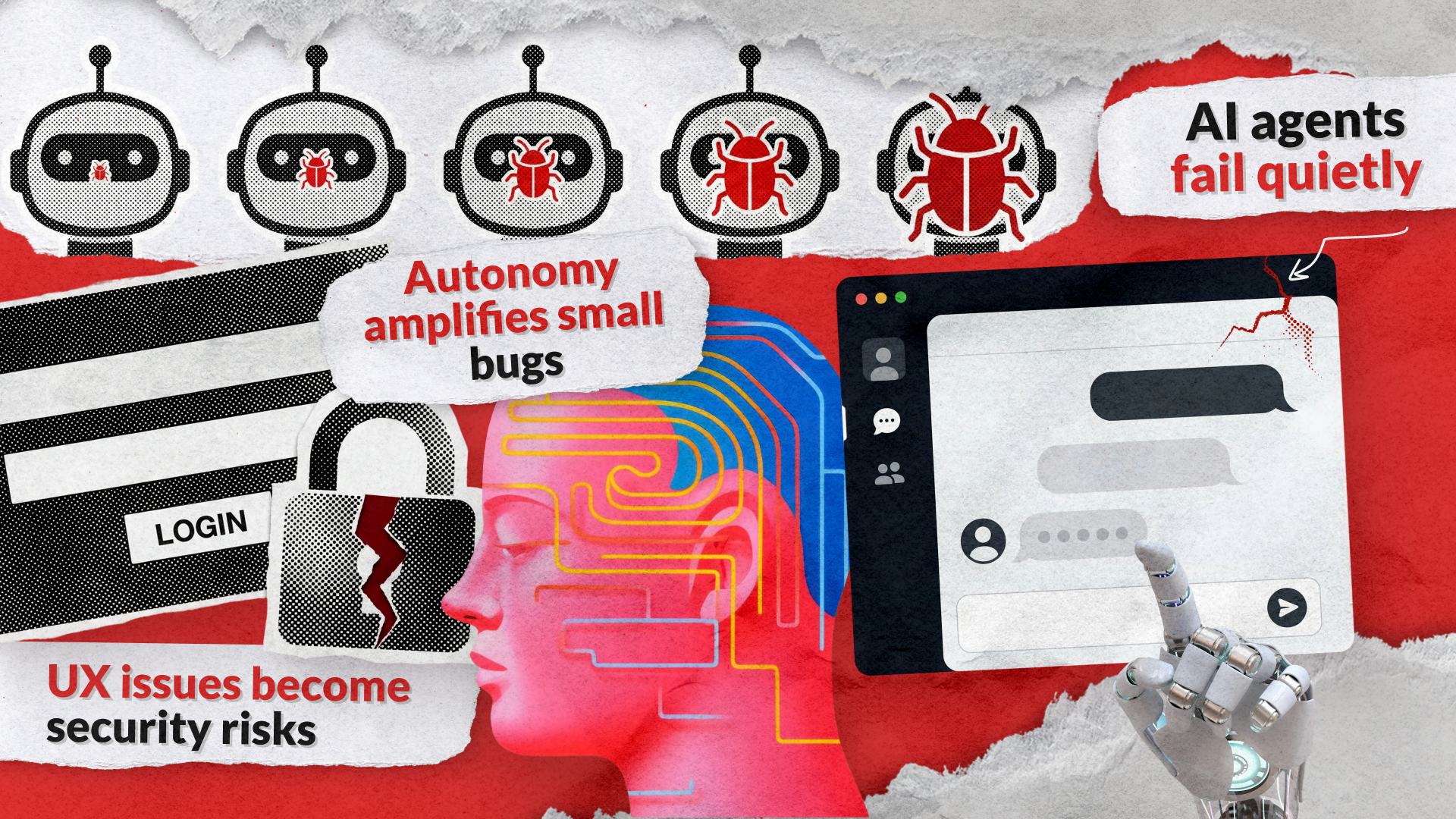
Have you considered that, with the exceptionally fast growth of this tech, the hidden risks of AI agents can have just as much impact on our lives as AI technology itself? In 2025, about 25% of businesses that use generative AI launch their own agentic AI pilots. Therefore, the number of such ‘autonomous’ AI-powered tools increases exponentially.
However, is technology already advanced enough to power such bursts? Some of these solutions will inevitably fail due to bugs, weaknesses, and poor planning. What will happen to the business that uses such tools, then?
Today, we’ll discuss all these topics and offer some real-life examples of hidden failures in AI agents identified by the QAwerk team during our bug crawls and AI agent testing.
Understanding Agentic AI: Why It Matters
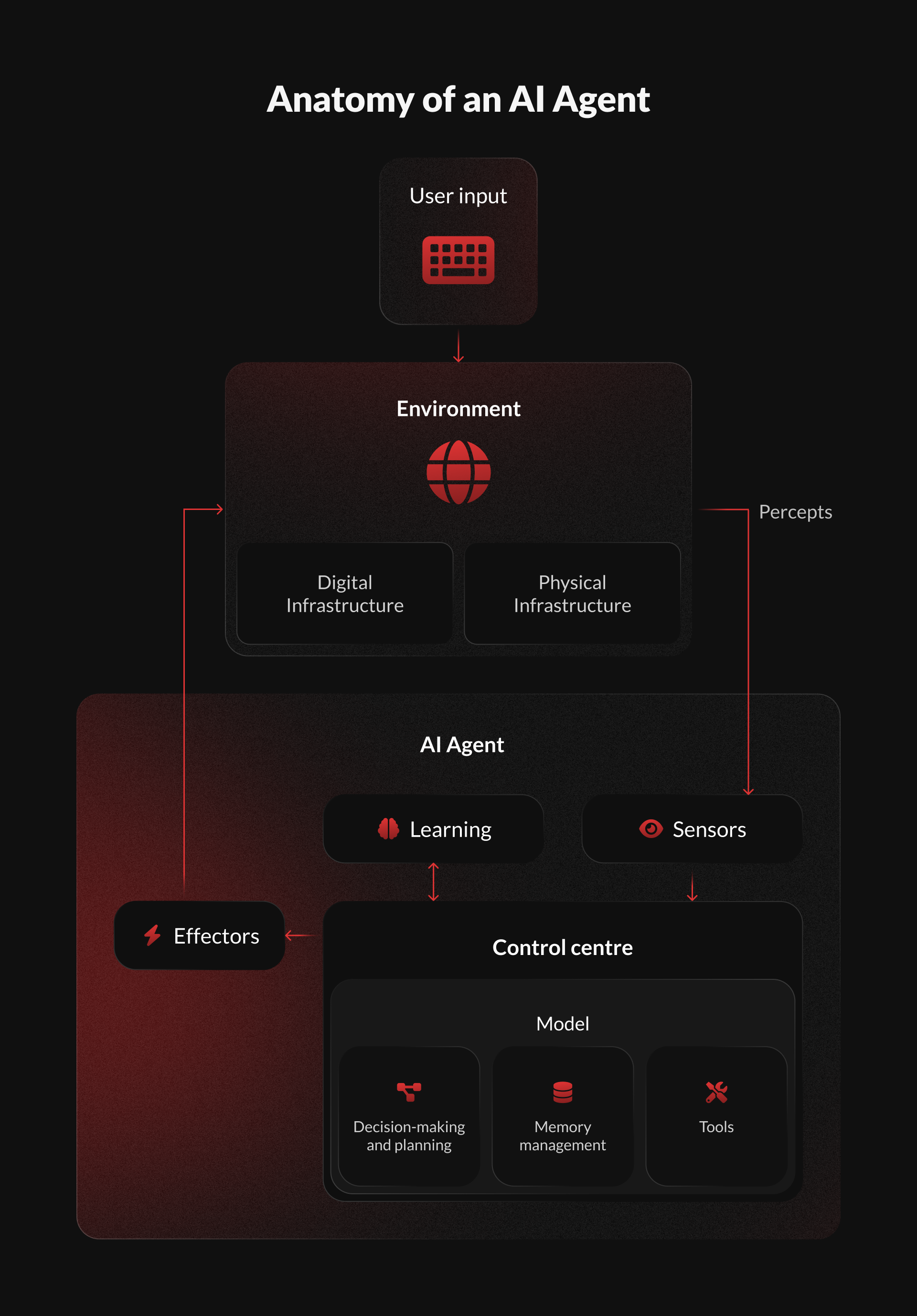
Let’s start by defining exactly what agentic AI is and how it’s used today. In essence, AI agents are autonomous systems that perceive their environment and make decisions or take actions to achieve a specific goal. In theory, they should only require minimal human input, such as making an inquiry or giving a specific command.
The demand for such tools is great. People today can create basic variations of those with minimal effort using large language models (LLMs) like ChatGPT or Gemini. According to a Deloitte report, businesses have invested over $2 billion in agentic AI during the last two years, and they keep going. It’s easy to understand the popularity of these systems when you consider the benefits they offer, such as:
- Boosting productivity through automation
- Streamlining workflows
- Offering 24/7 multi-lingual support
- Increasing response speed
- Improving personalization
- Cost savings through optimizations and automation
- Delivering valuable insights based on data analytics
However, there is also the very important matter of limitations of AI agents, as well as issues like AI hallucinations, data bias, and lack of transparency.
5 Hidden Failures in AI Agents Found in Real-Life Apps
As testing experts, our teams conducted multiple QA checks of popular apps using specific AI agent evaluation metrics and assessing the solutions from a technical standpoint. Below, we offer some examples of critical and major technological issues these tools have. These hidden failures in AI agents affect performance but could also have broader implications by creating vulnerabilities for attacks.
PocketPal AI (Android)
One critical issue we discovered during the bug crawl of PocketPal, an AI-powered team workflow helper for Android, is that the app enters an endless loading state when changing the model in Benchmark.

Now, the direct impact is that the user is frustrated by the buggy UX flow. This deals reputational damage to the developer’s brand and reduces the app’s download count. However, the situation becomes much more complicated when we consider the hidden risks of autonomous AI agents in this case:
- Under the hood, this bug is likely caused by issues in the benchmark/agent pipeline, an unresolved async call, or a backend/API edge case. Note that the agent itself might be fine, but the unseen ‘AI failures’ are the orchestration or UI state problems.
- This specific bug can create a loophole for resource leaks and lead to a direct lack of observability. Therefore, a seemingly UX issue creates several AI agent security vulnerabilities.
- This specific issue will be hard to solve because it may go unreported, as users believe it is a temporary glitch and drop the app out of frustration. It can also interfere with AI agent debugging techniques because the logs do not accurately reflect it.
Fiscal.ai (SaaS)
Our bug crawl for Fiscal.ai showcased several issues QAwerk’s testers managed to identify. It’s an AI-powered SaaS product that’s designed to help businesses speed up decision-making through automating financial data analysis and forecasting. One of the major issues we discovered is that the Copilot chat you delete remains accessible and active for sending messages.
This may not seem like much of a problem for the user. In fact, many won’t even notice it. However, it has some serious implications in the context of hidden failures in AI agents.
- Essentially, the bug means that you have a ‘ghost chat’ that’s not listed anywhere but exists and remains active within a system that has access to institutional-grade financial data, dashboards, and analytics.
- This creates a host of compliance and security risks, making the organization using the AI platform vulnerable to both penalties and adversarial attacks on AI agents.
- The chat might contain sensitive info the user wanted deleted, but it still remains accessible. This is a direct threat to data privacy and breaks multiple regulations.
- The fact that the chat is hard to detect makes it both hard to identify the bug and can interfere with financial audits, which are mandatory for many of the platform’s users.
Flexi AI Tutor (SaaS)
Flexi AI Tutor is an AI agent that helps students and teachers by offering assistance in sharing knowledge on multiple subjects. We conducted a thorough evaluation of Flexi AI Tutor and discovered a few bugs, some of them critical. One major issue was that the photo-size error in the profile was displayed in the browser rather than the app interface.
A bug like this affects the user experience by introducing interface inconsistencies. It’s annoying but doesn’t seem essential. However, as hidden failures of AI agents go, this one indicates a break somewhere within the user flow and tool integration. Depending on its exact cause, the implications of this bug could be:
- The client validation step might be bypassed or not performed early enough in the UI. Therefore, it’s handled by the browser. If the issue is that the front-end doesn’t intercept large file uploads, the back-end might reject them, but this will affect performance and cause delays. Such issues affect memory usage and page upload speed.
- Large failed uploads can result in partial state changes and create corrupted profile picture references. This will cause image glitches and compromise the system’s integrity. Admittedly, this risk is lower if the solution has a modern ‘upload → validate → save metadata’ architecture.
TwinMind (SaaS)
During our bug crawl of TwinMind, an AI assistant designed to enhance your learning and productivity through real-time transcription and intelligent suggestions, we found a critical issue. The app uses your microphone as its primary data source, and it won’t stop capturing even if the microphone permission is denied. The user must restart the browser because the app doesn’t handle rejection.
From a user experience standpoint, this makes the app appear not actually ‘intelligent’. Permission denials are common, so frequent occurrences can lead to a dead-end state that the app can’t recover from. However, there is also a deeper layer to it, connected to AI agents’ security risks:
- Some places (for example, schools or corporate offices) require blocking microphones for privacy reasons. Therefore, the app creates a system breach that might go undetected.
- From the tech side, this is a classic example of hidden failures in AI agents as an unmanaged state transition issue. It impacts the AI subsystems in real time and sets up WebRTC streams and audio graph nodes, but worker threads never stop properly. This is a source of potential leaks.
Answer.AI (iOS)
We conducted a bug crawl of Answer.ai, an iOS app that basically acts as a simple AI tutor helping you with research. This led us to discover a peculiar bug, when the user is unable to ask a multi-sentence question while chatting with the ‘tutor’ because the app clears the data and answers only to the last sentence.
It’s definitely one of the most annoying issues such a tool might have, and users are likely to drop the app out of frustration. However, there is more to consider with similar AI agent risks:
- The solution may produce incorrect outputs, which can affect the user’s choices.
- The user may assume that incomplete answers are due to miscommunication rather than truncation.
- As there is no error signal, the quality of performance degrades gradually.
- AI provides wrong or low-value answers.
Additional Hidden Risks of AI Agents
We could separate AI agent risks into two categories: technical issues and the socio-economic impact of autonomous AI systems. The latter includes:
- AI Governance and Compliance: If we make AI autonomous, we must also ensure that it does not become a chaotic power that fuels anarchy. Therefore, self-managed systems require strict governance and regulations. However, we don’t have such systems and legislation yet. There is the EU Artificial Intelligence Act, but it’s just the first step toward proper legal regulatory frameworks that could govern the use and impact of AI agents.
- Lack of Transparency: The main issue here is that we sometimes don’t understand exactly how AI arrives at specific conclusions. This makes the user vulnerable to accepting AI hallucinations as truth or to becoming misled by unseen AI issues. The solution could be introducing the ‘human-in-the-loop’ oversight. However, the issue of the machine’s autonomous ‘thinking’ and its ability to limit the information provided to the human overseer remains. Already, studies show AI’s ability to fake alignment and outright deceive users.
- Ethical Guidelines: The societal implications of AI agent risks stem from the lack of ethical guidelines for machines. We mustn’t forget that they are largely like children, who have no understanding of morals and ethics from birth. Therefore, mitigating this risk requires establishing clear ethical guidelines that AI agents must adhere to. These guidelines must include prioritizing human rights, privacy, and accountability.
- Societal Backlash: One of the major hidden risks of AI agents actually comes from people, not the AI. Widespread implementation of this tech can lead to both overreliance and rejection due to disempowerment. The latter is where the ‘AI will take your job’ comes from, while the former causes concern that humans might become lazy and less intellectually capable due to reliance on AI. Both of these are largely unrealistic extremes. However, their existence shows that we must implement a public education program on Artificial Intelligence and, most importantly, the limitations of AI agents, so that people have a better understanding of this technological innovation.
Bottom Line: How to Mitigate AI Agent Risks and Limitations
It’s hard to predict the future of AI agents and autonomous systems, but one thing is sure: we will see more of them. As demand for them grows, users’ expectations increase as well. Therefore, in order to launch a competitive tool, you’ll need to ensure it’s free of any issues, including unseen AI failures. To achieve this, you’ll require manual or automated AI agent testing performed by experienced pros.
Contact QAwerk today to uncover all your app’s potential weaknesses!
Frequently Asked Questions
What are the risks and failures of AI agents?
Most common hidden risks of AI agents have to do with:
- Security: compromised via prompt injection; poor security of the app’s design; disclosure of sensitive information; supply chain risks.
- Reliability: wrong objectives; poor termination checks; incorrect tool use; coordination failures in multi-agent systems.
- Safety and ethics: sycophancy; over-compliance; deceptive behaviors.
- Operational level: context rot and compounding errors; overreliance by human users.
How to secure an AI agent?
Treat these solutions as high-risk code-execution surfaces and implement robust AI agent testing strategies from the start. You also need to protect the system from prompt injection by implementing strict AIM and least privilege policies and isolating external content. Use human-in-the-loop as a final defense to minimize risks.
You can also reduce AI agent security vulnerabilities by segmentation, which means using smaller, specialized sub-agents with narrow permissions.
What are the disadvantages of AI agents?
Main disadvantages and limitations of AI agents include:
- They require constant monitoring due to the difficulties in reproducibility of the results.
- There are complex and hidden failures in AI agents that may result in cascading errors across the whole system.
- AI agent debugging techniques can be expensive due to complexity.
- AI agents’ security risks are hard to overcome with the current level of technology.
- Sycophancy and overconfidence may mislead users and prompt them to make poor decisions.
What is the impact of AI agent failures?
The impact of hidden failures in AI agents may vary from the erosion of trust in the brand and lower app downloads to serious security and privacy breaches that cause millions of damage. Some of the common risks to watch out for include:
- User harm due to wrong actions or content
- Data leaks due to insecure tools or prompt injection
- Operational losses due to loops and wrong goals
How to detect hidden AI agent failures?
Thorough AI agent testing and continuous output monitoring are essential. You can use the AI models’ testing guidelines to get a better idea of how to audit AI agents or contact QAwerk experts directly so they can help you select the most effective AI agent testing strategies.
Get your AI agent tested for free!