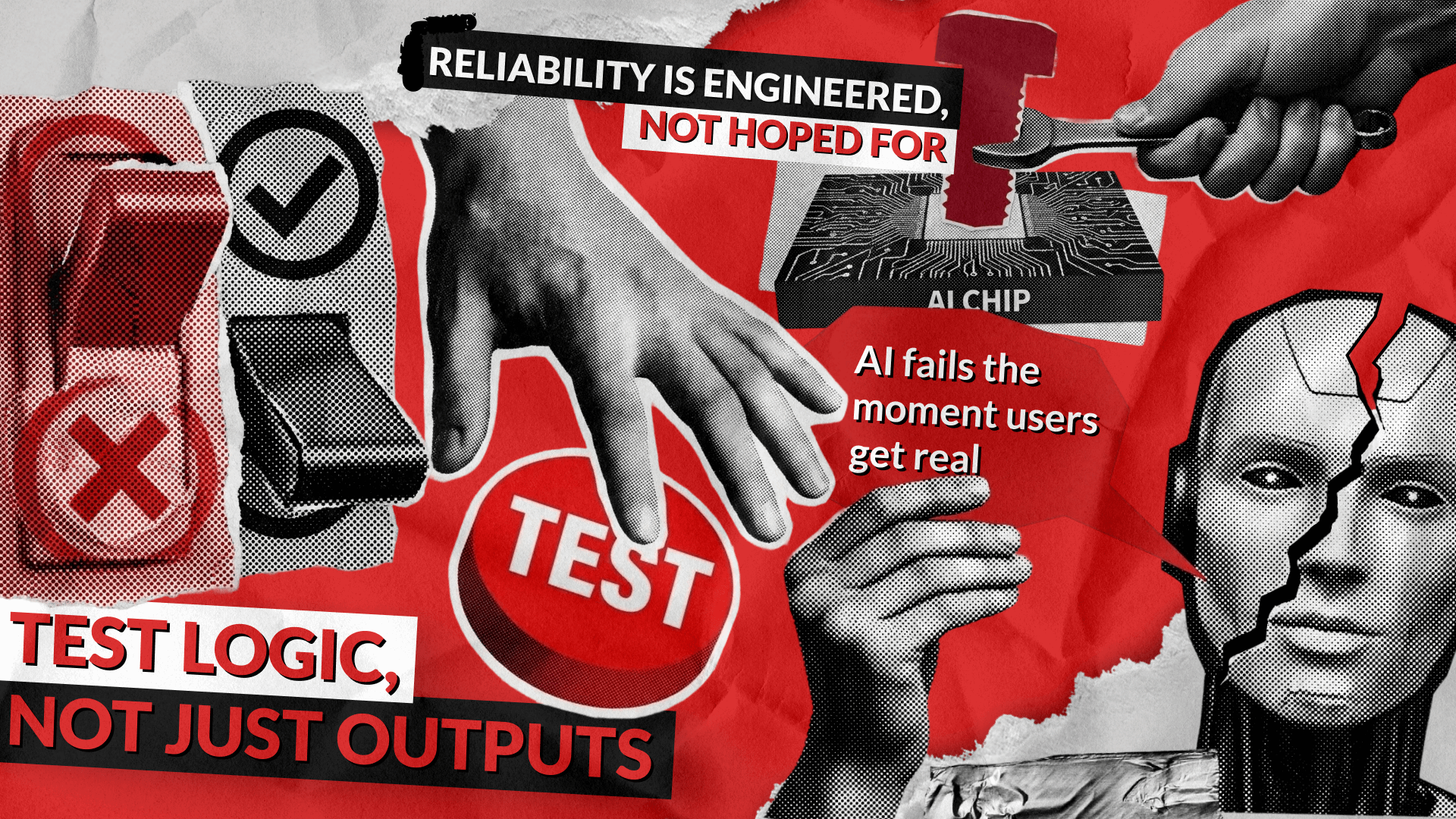
AI systems slip in the exact moments users lean on them most. A chatbot loses track mid-conversation, a copilot edits the wrong code block, a recommender pushes products no one would ever click. You’ve likely seen these glitches firsthand, usually when your team can least afford them.
This playbook shows how QAwerk keeps those failures out of production and illustrates how to test AI models in environments that reflect real user behavior. We test chatbots, copilots, and recommender systems with the same framework we use in high-stakes projects. We recreate real behavior, stress the decision paths, and expose blind spots early. What do you get in the end? AI that stays reliable even under pressure.
Inside QAwerk’s AI Testing Framework
After two decades in QA, one pattern emerges in nearly every AI failure we investigate: models behave differently the moment real users, real data, and operational pressure come into play. The Stanford HAI AI Index Report 2025 underscores the same reality, noting that rapid AI deployment is outpacing organizations’ ability to validate behavior at scale, especially in high-impact use cases.
In our chatbot testing, these cracks show up as subtle intent drift, while in Copilot testing, they emerge as overconfident code or command suggestions. That’s why our playbook comes in handy. Every method here comes from reinforcing systems under real load, uncovering failure points that surface only through deliberate stress scenarios. We approach testing chatbots, Copilots, and recommenders with the same disciplined, production-first methodology.
1. Intent & Goal Interpretation Testing
Intent slip-ups are the most frequent reasons AI systems derail. We stress-test how well a model interprets what users actually say, going beyond training data. That means pushing the system with paraphrased requests, multi-intent phrasing, typos, slang, and inverted logic that forces it to choose the right priority.
Where things typically go sideways:
- A chatbot interprets “refund only the shipping fee” as a full refund. We can expose such a failure through conversational AI testing.
- A Copilot asked to “optimize this block” quietly rewrites it, removing business-critical conditions instead of improving performance.
- A recommender sees “running late for a meeting” and pushes running shoes — a signal-processing error surfaced during recommender system testing.
Our approach is simple: recreate the messy inputs real users provide, then trace how each system resolves intent conflicts. If the reasoning chain wobbles, the entire experience wobbles with it.
2. Multi-Step Reasoning & Context Retention
We see AI systems struggle in areas that involve memory, sequencing, and dependency tracking. A bot that books a flight can confirm the destination, yet lose the passenger count two prompts later. The reason is not the model’s weakness, but proper testing with the reasoning chain end-to-end.
We stress-test multi-turn logic by making the system:
- apply earlier facts in later decisions
- update answers when context changes mid-session
- preserve constraints after diversions or clarifications
This approach to LLM chatbot evaluation exposes gaps in reasoning that surface only when workflows span several steps. Our QA team builds prompts that stack dependencies, delay critical details, and reshuffle priorities to see whether the algorithm can keep the entire thread intact.
During testing for Sitch, an AI-powered dating app, users occasionally had their onboarding answers overridden or repeated after later profile edits — a flaw that cannot be caught with linear testing. By applying our multi-step reasoning checks, we traced the failure to missing context handoffs between quiz stages and helped the team fix the logic so every response stayed consistent throughout the entire flow.
3. Safety & Guardrail Testing
Once an AI system can act, a single error can cascade into reputational, legal, or financial damage. The UK Government’s 2025 assessment notes that generative AI sharply increases digital risks by enabling unsafe outputs and expanding the scope of misuse. It’s in this area that most AI projects underestimate exposure.
We test guardrails by simulating harm rather than happy paths. In automated chatbot testing, we probe for misinformation and privacy leaks using adversarial prompts. In the Copilot performance evaluation, we feed ambiguous requests into real code flows to see whether the system proposes unsafe operations. For example, one flawed suggestion can behave like cutting the wrong circuit in a live control panel. If we work with recommenders, we trigger profile edge cases to expose ranking failures that surface restricted or risky items.
These failures can damage trust and drain revenue. During our testing of Caktus AI, we uncovered a critical flaw that let users bypass subscription paywalls through simple DevTools tweaks, granting full access to paid content for free. Issues like this turn AI from a profit engine into an unmonitored leak.
4. Hallucination, Fabrication & Invention Testing
LLM-driven AI behaves like an overconfident intern: when it lacks facts, it fills the silence. When it happens, we start having areas where the most damage begins. In our practice, instead of questioning hallucinations, we map the exact points where the system drifts away from truth and track how those lies propagate through workflows.
To expose failure zones, we test knowledge boundaries through:
- truth-source comparisons against canonical documentation
- validation prompts that reference deprecated or removed features
- forced hallucination triggers that mimic real ambiguity
- contradiction loops that pressure logic paths
This approach matters far beyond chat. For example, in recommender system testing, fabricated signals distort personalization, pushing products that users never wanted. It looks like an AI equivalent of a GPS that calmly guides you into a lake. By pinpointing where invention starts, we prevent minor inaccuracies from snowballing into costly customer-facing failures.
5. Real-World Performance & Load Testing
AI behaves perfectly when it’s alone in the lab, but it can fall apart the moment thousands of users show up at once. Most breakdowns come from concurrency, latency, and resource contention. That’s why our AI assistant testing framework simulates real traffic patterns.
We recreate the pressure scenarios that cripple production systems:
- latency spikes during peak shopping hours
- cold-start delays when models scale up
- burst traffic during promo campaigns
- oversized embeddings and multi-MB prompts
- long input chains that choke memory allocation
This isn’t theoretical. McKinsey (2025) reports that companies routinely skip performance testing because distributed architectures are hard to simulate, even though consumers expect “lightning-fast, glitch-free performance” and punish apps that miss the mark. When an enterprise banking chatbot performs well at 20 users but introduces a 4-second lag at 600 concurrent sessions, users don’t judge the model; they assume the bank is unreliable.
We’ve seen similar collapse patterns elsewhere: a logistics Copilot timing out on large manifests, freezing an entire task queue, or a retail engine delaying computations long enough for buyers to abandon their carts. And when no one tests cold starts at scale, Black Friday traffic turns your AI from a competitive differentiator into a blocker.

Skipping this kind of performance automation cascades into SLA violations, abandoned sessions, and revenue loss. Real-world AI systems win only if they don’t break under pressure. Performance testing ensures exactly that.
6. Personalization Consistency & Bias Drift
Personalization acts like a garden — thriving with pruning, overgrown and useless when left alone. Over time, AI systems subtly shift tone, repeat narrow choices, or treat identical users differently. We detect decay early by testing how personalization changes over time, across contexts, and across personas.
Where it breaks:
- Tone drift: a chatbot becomes more formal with one dialect and casual with another
- Instruction bias: two identical prompts trigger different outputs because the model inferred a hidden persona
- Echo chambers: recommender loops repeat the same category, starving users of discovery
That’s why AI agent testing serves as the control mechanism to safeguard user trust. Sometimes the issue isn’t in the model’s logic but in the surrounding functionality, where a single mismatch between user input and system response instantly breaks immersion and undermines trust in the entire experience.
We go further with recommendation engine testing to expose when product, content, or suggestion diversity collapses. Without this layer, personalization misguides. Continuous bias monitoring ensures your systems adapt intelligently instead of trapping users in patterns they never chose.
How We Turn the Playbook Into Repeatable QA Systems
A playbook only matters if it survives real deployments. AI products demonstrate their resilience through model updates, dataset shifts, and UX tweaks. That’s why it’s important to embed quality assurance throughout the lifecycle, not just at the final stage. This approach turns unpredictable behavior into predictable, testable patterns.
Our Testing Methodology Stack
AI products break because they can’t sustain decisions over time. That’s why our tests validate the system’s continuity, integrity, and resilience.
We design testing environments that mimic real usage instead of isolated prompts. We achieve this through structured layers:
- Scenario-Centric Test Design: We treat AI interactions as chained objectives, rather than isolated tasks.
- Behavior and Drift Detection: Continuous checks in testing recommender systems catch logic drift before it reaches production.
- Human-Led Validation Layer: Machines flag anomalies, but only human testers judge which ones matter, especially when tonal shifts, unsafe logic, or biased reasoning surface during dialog.
- Cross-Model Consistency: Identical prompts must behave the same way across environments; mismatches signal hidden instability that can explode under real user traffic.
This scaffolding lets us evaluate Copilots, chatbots, and personalization engines as one adaptive organism. While models differ, the failure patterns remain the same.
Evolving QA Assets
Our assets also evolve. We maintain libraries of behavioral triggers, synthetic personas, and domain-specific traps that sharpen with every engagement. They’re reusable across industries yet tailored enough to expose mistakes specific to finance, healthcare, retail, or public sector deployments.
Deployment-Based Best Practices
Shipping AI without stress-testing adaptability is like shipping a bridge without testing weight limits. We combine automated load harnesses with expert scrutiny – not only “manual vs. automated testing,” but the right blend of both.
By validating decisions over time, we ensure AI systems remain stable long after launch and long after the first thousand users push them into unpredictable corners.
Why Professional Chatbot Testing Matters
Most teams still validate AI at the surface level, focusing instead on flows or measuring uptime. That’s not enough. Modern testing demands deeper inspection: ensuring copilots don’t inject logic errors, recommenders don’t distort customer journeys, and search flows respond consistently even as user intent shifts. These systems evolve silently, and without structured model-level checks and best engineering practices, teams only notice failures when customers do.
QAwerk closes that gap. We fuse real-world scenario design, behavioral profiling, and long-context evaluations into one testing discipline that catches AI regressions long before they reach production. While testing AI search pipelines or validating personalization, our QA engineers apply almost two decades of experience to ensure your AI behaves predictably, safely, and profitably at scale.
The Bottom Line
AI systems may run on code, but start having challenges with patterns and decision paths. If you treat them like static software, you’ll miss the collapses that only appear under real users and absolute pressure. Our unified approach works because it evaluates behavior, exposing fractures long before they turn into customer-visible failures. If you’re ready to prevent those failures instead of reacting to them, get in touch — we can show you where your AI will break before your customers do.
See how we helped an AI matchmaking app achieve app stability, expand nationwide, and double monthly user growth