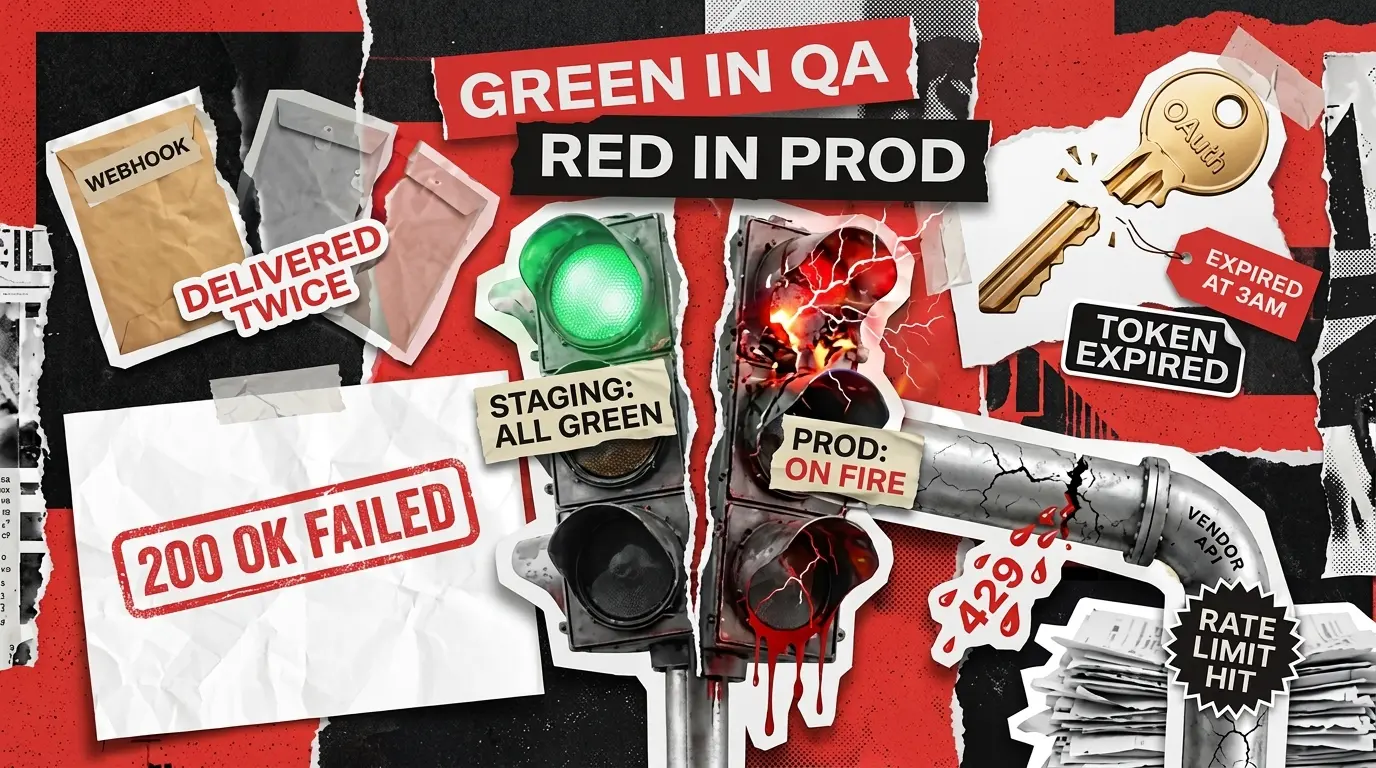
Every test passes in staging. The release ships on Friday. By Monday, a payment webhook has silently dropped a chunk of orders, the OAuth refresh broke for sessions that stayed open over the weekend, and the partner API is returning HTTP 200 with "status":"failed" buried in the body. The QA report still says green.
This pattern repeats across stacks and industries. Functional checks pass in isolation, and production tells a different story. The Splunk and Cisco Hidden Costs of Downtime 2026 report puts the average annual loss per Global 2000 company at $300 million, with application and infrastructure failures driving roughly a quarter of all downtime events.
Web application functional testing for integrated systems is its own discipline. Treating it like a checklist of UI clicks misses where the real failures live. The five patterns described here are the ones that surface most often across audits, with the test cases that catch each.
Why Integration Bugs Slip Through QA
Integrations break in production for reasons that have nothing to do with sloppy testing. They break because the test environment is structurally different from production, and most QA processes are not designed to expose that gap.
Staging tells a comforting lie. Sandbox APIs respond in 100 to 200 ms; production webhooks under peak load can take two to five seconds. Sandbox tokens never expire mid-flow. Mock servers always return the schema the test was written against. Rate limits do not collide because no other feature is running. Every one of these gaps is the seed of a future production incident.
Then there is the definition of done. Most features ship the moment unit tests and the happy-path UI flow pass. The connected workflow, where the feature talks to a vendor whose behavior nobody controls, is rarely part of the acceptance criteria. The Postman’s 2025 State of the API Report, based on a survey of more than 5,700 developers, found that 93% of API teams still hit collaboration and documentation blockers, and only 24% design APIs with non-human consumers in mind. That gap translates directly into production bugs that the test plan was never built to catch. A disciplined functional testing process closes the gap by treating integration boundaries as test surfaces in their own right.
The Five Integration Failure Patterns We See in Audits
The same patterns recur across audits regardless of stack or industry. Each one is invisible to standard test plans and very visible to end users. Here is how each one looks and what catches it through functional testing for web applications.

Webhook Misfires
Webhooks fail in ways that mock tests never reproduce. They get delivered twice, out of order, or not at all. Sometimes the receiving endpoint returns 200, the queue marks the event processed, and the business logic silently never ran. ShipEngine, for example, allows only 10 seconds for acknowledgment and two retry attempts at 30-minute intervals before the event is dropped from dispatch entirely. If the handler is slow once, the event vanishes.
Functional test cases to add at the webhook boundary:
- Signature verification with valid, invalid, and missing HMAC headers.
- Replay and duplicate delivery handling with the same idempotency key.
- Out-of-order delivery: process event B before event A and assert correct state.
- Retry-storm tolerance under simulated endpoint slowness.
- Silent-failure detection by asserting on the resulting business state, not just on the 200 response.
Token Expiry Mid-Session
OAuth tokens expire. Refresh logic exists. Both are obvious. What is less obvious is what happens when the access token expires during a long-running user flow, when two background jobs try to refresh the same token concurrently, or when the vendor silently rotates refresh tokens and the application keeps using the old one. Google revokes refresh tokens after seven days for apps in testing mode, after six months of inactivity, and immediately when a user changes their password if Gmail scopes are involved. None of this surfaces in a 30-minute QA pass.
The fix is to force token expiry as a test condition. Stub a 401 mid-session, run concurrent refreshes against the same connection, and assert that the application either succeeds with the new token or surfaces a clean re-auth prompt. Clock-skew tests catch the silent class of failures where the server believes the token is valid and the vendor disagrees by 30 seconds.
Success Responses That Hide Failures
This is the failure mode that catches naive test suites most often. Slack’s API, several payment gateways, and most messaging platforms return HTTP 200 with the failure encoded in the JSON body: "ok":false, "status":"failed", or an errors array. A test that asserts on status code passes. The user-facing workflow breaks downstream because the application treated the response as success.
The remedy is to assert on payload semantics rather than transport status. Functional API testing at this boundary means schema validation on every response, business-state assertions that verify the action actually happened, and a normalization layer that converts vendor-specific error shapes into a consistent internal error contract. This is also where API contract testing earns its place: contracts catch the moment a vendor’s response shape changes, before that change reaches users. A mature integration testing process builds these contracts into the release pipeline rather than treating them as a one-off exercise.
Rate-Limit and Quota Collisions
In a feature’s isolated test suite, the integration uses 5% of the vendor’s rate-limit budget. In production, the webhook handler, the background sync job, the export feature, and the new dashboard all share the same pool. The integration that passed every test starts returning 429s under combined load.
Rate-limit collisions sit on the seam between functional and performance testing. The same audits where these collisions appear also surface other API bottlenecks that pass every isolated test but break under combined production load. At minimum, functional QA should:
- Run concurrent feature tests against the same vendor sandbox to expose pool contention.
- Assert correct 429 handling: respect Retry-After, apply jitter, avoid stampedes on recovery.
- Verify the application’s fail-open versus fail-closed decision is intentional rather than accidental.
Schema and Contract Drift
Vendors change their APIs. They add fields, deprecate others, tighten validation, or quietly switch a string to an enum. Tests that run against mocks built six months ago will keep passing while production breaks on the first real call after the vendor’s deploy. This is the pattern behind silent integration failures that take days to diagnose because nothing in the codebase changed.
The defense is contract testing scheduled against the live vendor sandbox, beyond just CI. A daily contract check that hits the real endpoint and validates the response shape against a stored schema is enough to catch most drift before users do. Pair it with strict schema validation on every production response so an unexpected field type fails loudly instead of corrupting state silently.
How to Functionally Test Third-Party Integrations
The reflex when integrations break is to write more tests. The better move is to write different tests, organized around how integrations actually fail. Three principles separate teams that catch these issues from teams that ship and hope.
Test the failure modes alongside the happy path. Force timeouts. Inject 5xx responses. Return malformed payloads. Expire tokens mid-flow. Most integration bugs live in error paths the test suite never exercises, because the suite was built to confirm the feature works rather than to confirm the feature degrades safely.
Combine mocks with live contract checks. Mocks are fast, deterministic, and necessary for unit-level coverage. They are also the reason schema drift goes unnoticed. A short table makes the trade-off concrete:
Mocked responses
Application logic against a known shape
Vendor-side changes, real latency, real errors
Unit and CI runs
Sandbox testing
Authentication flows, payload shape, retry behavior
Production load, pool contention, real-world latency
Pre-release validation
Live contract checks
Schema drift, deprecated fields, behavior changes
Application logic
Scheduled monitoring against the real vendor
Treat production telemetry as part of QA. Functional testing for integrated web apps continues past release. Track integration-specific signals: 401 spike rate, webhook delivery success percentage, retry-storm frequency, p95 latency per vendor. These are the metrics that confirm what staging promised. Integration testing for web applications only earns its name when it includes this feedback loop, and it is exactly the loop that strong API integration testing builds in by default.
A Test-Case Checklist for Integrated Web Apps
A starting checklist for integration-layer QA, organized by integration type. Every item on it is something that has missed in production at least once across recent audits.
Payment integrations
- Card declined on the vendor side: does the order roll back cleanly?
- 200 OK with status:failed body: does the application surface the failure?
- Webhook signature invalid: rejected and logged?
- Duplicate webhook delivery: idempotency key respected?
OAuth and identity providers
- Access token expired mid-request: refresh happens transparently?
- Two concurrent refreshes: only one fires, both succeed?
- Refresh token rotated by vendor: new token stored?
- User revokes access: application detects and prompts re-auth?
Webhooks generally
- Out-of-order delivery handled?
- Retry within a valid window: deduplicated?
- Endpoint slow: vendor’s retry policy honored without data loss?
Third-party APIs
- Schema validation on every response, beyond status code.
- 429 with Retry-After: respected with jitter?
- Vendor returns deprecated field: logged for action?
- Network partition: circuit breaker opens cleanly?
This is the coverage that strong web application testing builds into release pipelines from the integration layer up.
The Functional QA Cost of Getting Integrations Wrong
The cost of an integration failure in production rarely shows up as a single line in a report. It shows up as a Monday-morning incident channel, a CFO asking why payments dropped over the weekend, customer screenshots circulating on social media, and an engineering sprint lost to the post-mortem. The pattern is consistent across audits: the bug that surfaces in production was not in the code that changed, it was at the seam between in-house code and a vendor whose behavior nobody owns.
Catching these failures earlier comes down to testing those seams with the same rigor as the features around them. Contact us and we will walk through where the gaps are likely hiding.
FAQ
Why do third-party integration bugs slip through QA?
Staging and production are structurally different environments. Sandbox APIs respond faster, tokens do not expire mid-flow, mocks always match the expected schema, and rate limits never collide because no other feature is competing for the same pool. A test plan built around staging passes everything staging can fail, and misses everything only production can break.
What's the difference between functional testing and integration testing for web apps?
Functional testing verifies that a feature does what its specification says it should do. Integration testing verifies that two or more components work correctly when connected. Strong QA for integrated systems uses both, with functional assertions written at the integration boundary rather than only at the UI.
What's the difference between sandbox and production for third-party integrations?
Sandboxes are simplified clones built for development. They omit production-grade load, real-world latency, true rate-limit behavior, and the vendor’s full error surface. Plaid, Stripe, and most shipping carriers document this gap publicly, with sandbox webhook latency typically at 100 to 200 ms while production averages 2 to 5 seconds.
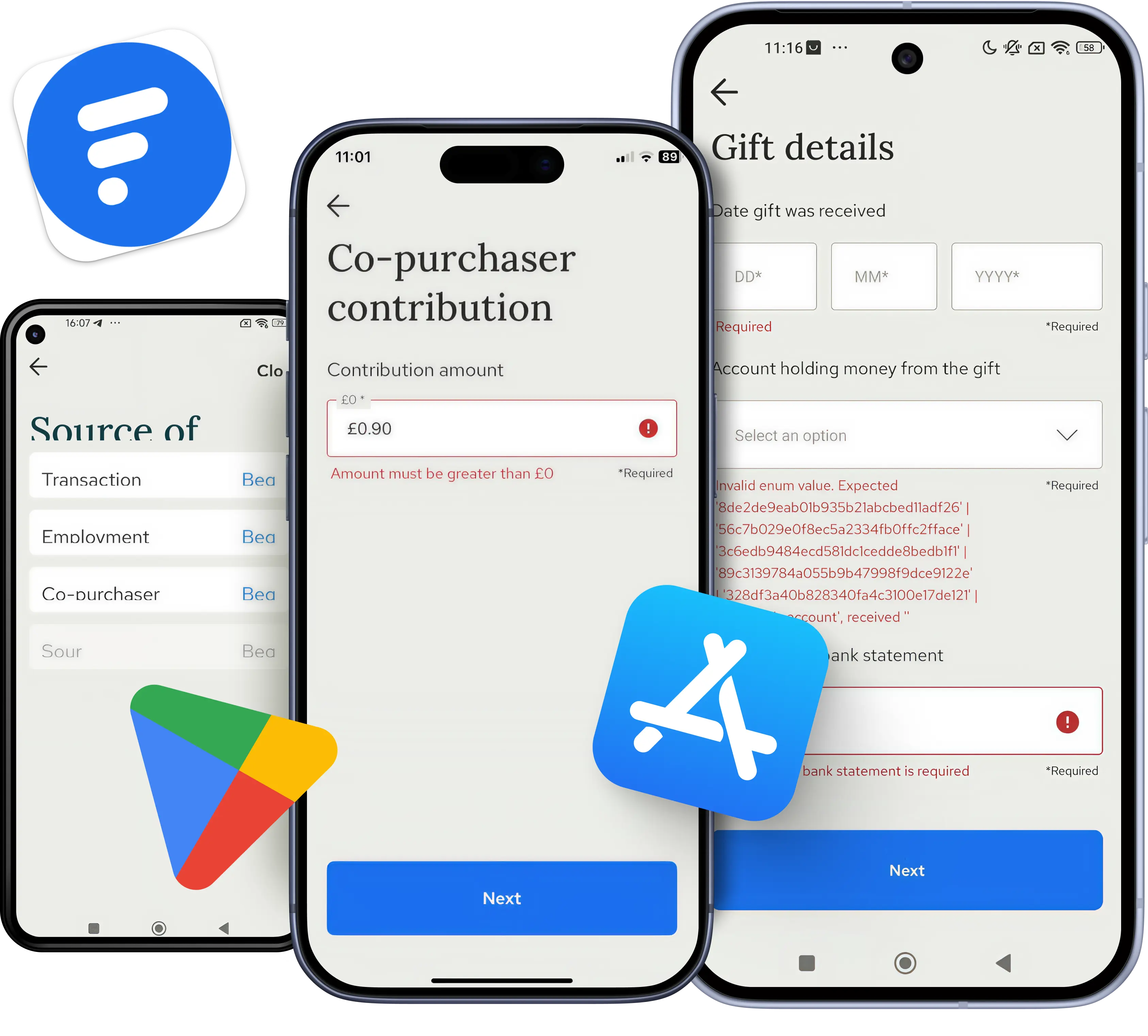
See how we delivered stable onboarding, identity checks, and Source of Funds workflows for a UK fintech built on deep third-party integrations.