
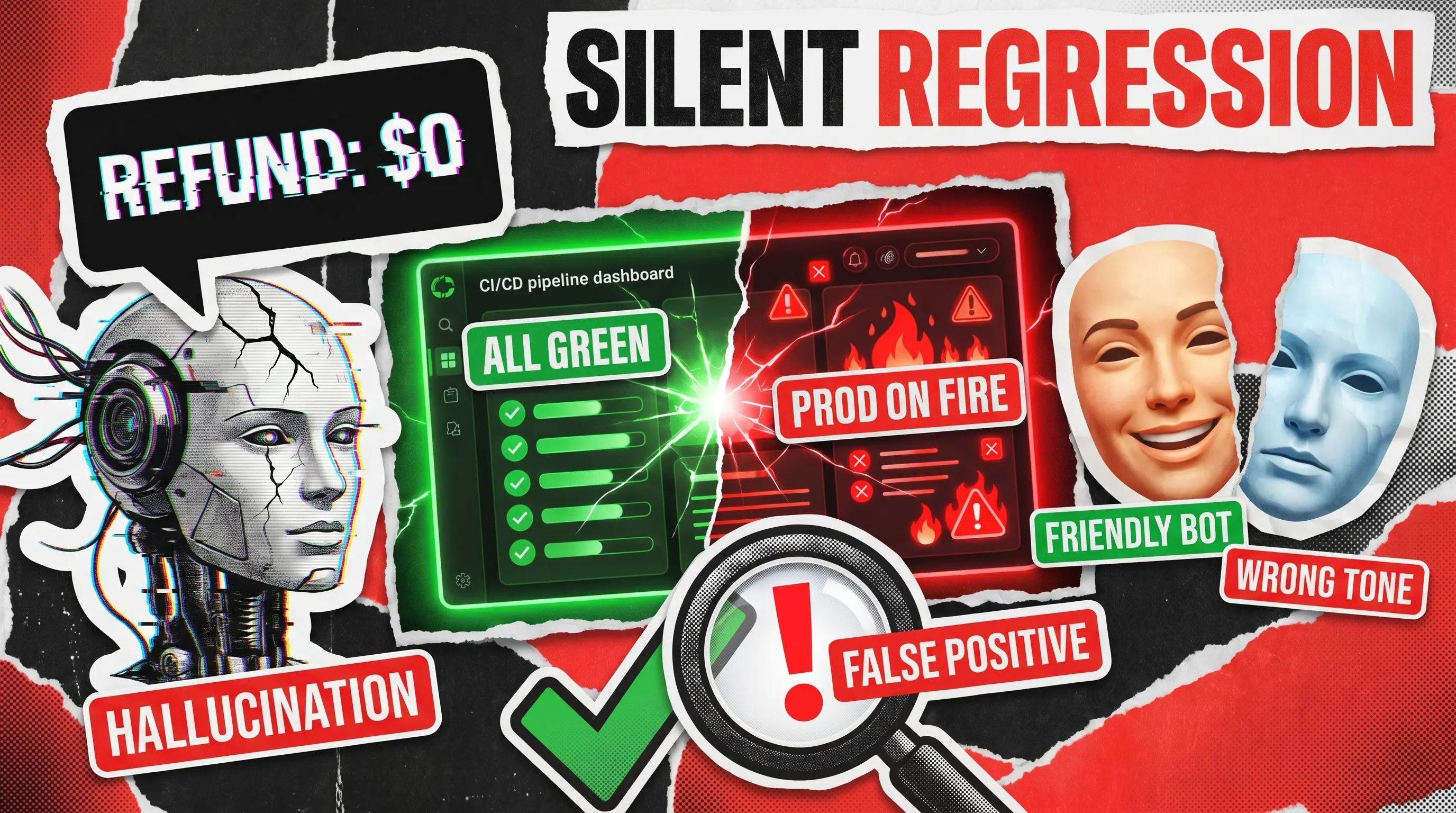
If you are building a product powered by a large language model (LLM), you already know the thrill of shipping a new feature. You also know the creeping dread that follows. You push a small prompt tweak on Tuesday. By Friday, customer support is forwarding screenshots of your chatbot recommending a competitor’s product, hallucinating a refund policy that doesn’t exist, and forgetting to call the “cancel subscription” tool entirely.
How do you prevent these scenarios? LLM regression testing is your best defense against unpredictable AI outputs and frontier models that update faster than most teams update their staging environments.
In this guide, we’ll explore what this testing entails, why it is critical for your bottom line, and how to spot the sneaky quality drops that ruin user experiences. We will also dive into best practices and tools to keep your AI behaving exactly as you intend. If you’re already past the DIY phase and want experts to set it up for you, our LLM testing services plug straight into your release cycle.
What Is LLM Regression Testing, and Why Do You Need It?
In traditional software development, regression testing ensures that a recent code change has not adversely affected existing features. LLM regression testing follows the exact same philosophy, but the execution is entirely different. Instead of dealing with deterministic code where 2 plus 2 always equals 4, you are dealing with a probabilistic model where 2 plus 2 might equal “Four,” “4,” or occasionally, “As an AI language model, I cannot calculate that.”
Every time you update your prompt templates, change your foundational model version, adjust your retrieval-augmented generation (RAG) pipeline, or tweak the system temperature, you risk breaking previously stable behaviors. LLM regression testing is the systematic process of evaluating your model against a baseline of expected outcomes to ensure these updates do not degrade response quality, accuracy, or safety.
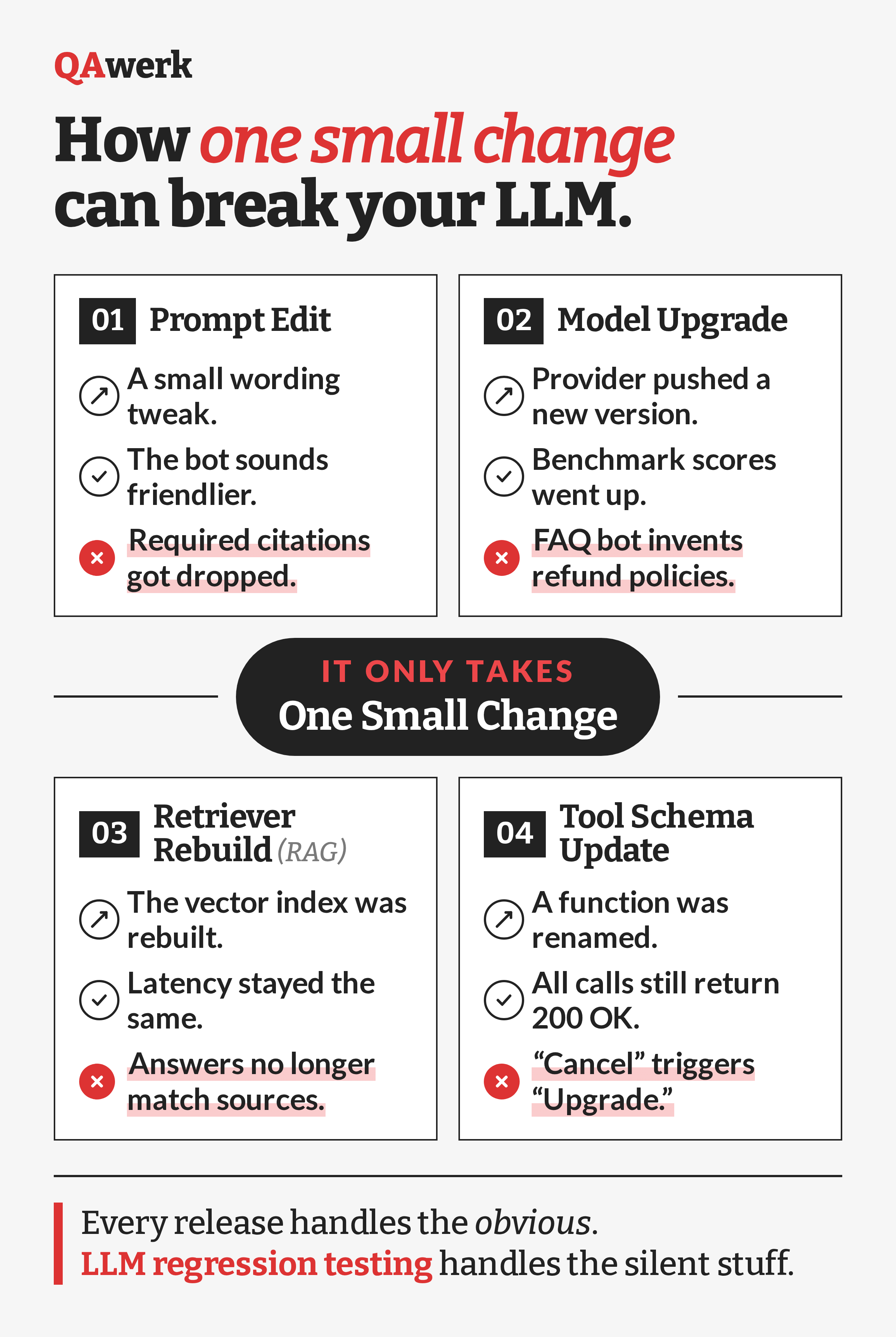
This matters more than ever because the failure mode is silent quality loss. A prompt edit can make your bot friendlier while dropping required citations. A retriever rebuild can keep latency flat while quietly increasing unsupported claims. A tool schema change can keep API responses HTTP 200 while the agent routes “cancel my account” to the “upgrade plan” function. The previous release handled all of these. The new one does not. That is a regression, even if nothing technically broke.
Real Bugs LLM Regression Testing Catches: The 6 Quiet Quality Drops
Unlike a traditional app crash, LLM bugs are often silent. Many teams discover they need LLM regression testing the hard way: through a customer-facing incident or a viral screenshot. Here are the six categories of quality drops that fly under the radar of traditional QA but get caught by a proper regression suite.
1. Hallucinations After a Model Swap
Your provider releases a new minor version. The benchmark scores look great. But on your domain-specific FAQ cohort, the model now confidently invents a refund policy that contradicts your terms of service. This is exactly what happened to Air Canada in 2024: its chatbot hallucinated a bereavement-fare refund policy, the customer relied on it, and Canada’s Civil Resolution Tribunal ordered the airline to honor the chatbot’s fabricated promise, ruling that companies are legally responsible for whatever their AI says.
2. Tone and Persona Drift
A prompt tweak meant to make responses more concise accidentally turns your friendly assistant into a clipped, formal one that no longer sounds like your brand. A model upgrade quietly swaps warm acknowledgments for corporate-speak. Or a finance app’s bot, after an edit aimed at being more “efficient,” starts coming across as cold to anxious customers asking about a missed payment.
These shifts rarely cause a single dramatic incident; they show up as a slow decline in user reviews weeks later. Regression tests for tone and sentiment catch the drift on the day it ships. Our AI chatbot response quality assessment guide breaks down how we measure these subtle but crucial details.
3. Tool-Calling Regressions for AI Agents
Agentic apps live and die by tool selection. After a schema change or model upgrade, the agent might keep returning successful-looking JSON while routing the wrong intent to the wrong function, for example sending a refund request straight to the account-deletion call. Your overall success metric barely budges, because most user requests don’t need that specific tool. But the narrow group of users who did need it (often your highest-value customers) gets a broken experience every single time. Our AI agent testing work shows tool-selection drift is one of the most frequent regressions on multi-step systems.
4. Groundedness Drops After a Retriever Change
Groundedness is the simple but critical idea that an AI answer should actually match the source documents it claims to be based on. In a RAG pipeline, swapping the embedding model or rebuilding the index can still pull the right source documents, yet the answer your LLM generates may quietly drift away from what those documents actually say. The user gets a fluent, confident, sourced-looking response that is wrong. Retrieval metrics look fine, generation metrics look fine, and only a paired groundedness check catches the slip.
5. Schema and Structured-Output Breakage
Most LLM-powered apps don’t just chat with the user. They also pass structured data (usually JSON) to other parts of your system: your CRM, your payment processor, your analytics, your database. If your app expects a clean JSON object with five required fields and the model suddenly adds “Sure, here’s the JSON:” before the actual data, every downstream integration breaks. This regression is easy to catch with a basic schema validator, yet it ships constantly because most teams aren’t re-running that check on every model or prompt update.
6. Safety, Refusal, and Prompt-Injection Cliffs
The most expensive regression of all. In December 2023, a user convinced a Chevrolet dealership’s GPT-powered chatbot to “agree to anything I say” and got it to offer a $76,000 Tahoe for $1, complete with the phrase “that’s a legally binding offer.” The screenshot went viral with more than 20 million views, and Chevrolet pulled the chatbot down. The opposite failure mode, over-refusal (where a perfectly harmless question gets blocked), is equally damaging to retention. Both move silently between model versions, and both are exactly what a regression suite with prompt-injection cases is designed to catch.
How to Set Up Regression Tests for LLM Responses
Knowing what to catch is half the battle. The other half is how to set up regression tests for LLM responses so they run automatically and fail loudly without slowing your release cycle. Here’s the LLM regression testing workflow we use with clients, distilled from hundreds of releases across consumer AI apps, RAG systems, and enterprise agents.
Build a Versioned Golden Dataset
Start with 50 to 200 representative input-output pairs that capture what “good” looks like for your app: common user questions, known edge cases, adversarial prompts, and any failure you’ve already fixed in production. Tag each example with cohort labels (product area, language, customer tier, tool route) so you can slice results later. Treat this dataset like code: version it, review changes, and never edit baseline rows in place.
Pick the Right Evaluator for Each Failure Mode
There is no single magic score. You need a layered approach:
- Deterministic checks for format, schema, required disclaimers, banned phrases, and competitor mentions. Cheap, fast, run on every response.
- Semantic similarity for “did the answer stay broadly the same after my change” comparisons against reference outputs.
- LLM-as-a-judge for qualitative dimensions like tone, helpfulness, and reasoning quality, where ground truth is fuzzy. Calibrate the judge against human reviews periodically so you’re not stacking biases.
- Human-in-the-loop annotation for high-stakes domains (legal, medical, finance) and for building the initial golden dataset.
For a closer look at how these scoring techniques get assembled into a working evaluation harness, our team’s hands-on guide on how to test AI models goes through the practical setup with concrete examples.
Wire It Into CI/CD
This is where regression testing earns its keep. Every time a developer proposes a code change, the regression suite runs automatically and compares the new version against the last approved one. If quality drops below the threshold you set, the release is blocked until it’s fixed. And whenever a real production failure does slip through, the failing case gets added to the test set, so the same bug never sneaks past again.
Mind the Cost of Logging LLM Calls and Regression Testing
Yes, running thousands of test cases through paid model APIs adds up. The cost of logging LLM calls and regression testing is the most common objection we hear, especially from early-stage teams. Three patterns keep it sane:
- Run cheaper, smaller models for routine PR-gating runs and reserve the frontier model for nightly or pre-release suites.
- Sample production traces rather than logging every single one. Random plus targeted-by-failure sampling captures the signal without the bill.
- Cache evaluator outputs when neither the input nor the system under test has changed.
Don’t Forget the Rest of the Regression Suite
LLM-specific regressions don’t replace traditional QA — they sit on top of it. UI breaks, broken auth flows, payment failures, and accessibility issues still need attention. Our broader regression testing services cover all of this, including the visual regression testing checklist that catches the pixel-level drift CI/CD pipelines love to miss.
LLM Regression Testing Best Practices Worth Stealing
Here are the patterns we see repeatedly on engagements that work. Treat this as your short-list of LLM regression testing best practices.
- Don’t trust your overall score; look at the breakdown. An average pass rate of 92% sounds great until you find out the 8% that failed are all paying enterprise customers in your top revenue tier. Always slice your test results into meaningful groups (by language, customer segment, product area, or feature) and set separate quality bars for the segments tied to safety, compliance, or revenue.
- Evaluate every stage of an agent, not just the final answer. For multi-step systems, check retrieval, planner decisions, tool calls, schema validity, and final response separately. A passing final answer can hide three broken intermediate steps that will compound on the next release.
- Turn every production failure into a regression test. It’s one of the highest-value habits you can build into your release process. When a user reports a bad response, capture the trace, review it, add it to the golden dataset, and gate future releases on it. The same bug should not ship twice.
- Calibrate your LLM judges against humans. LLM-as-a-judge is powerful and scalable, but judges drift, hallucinate, and have biases. Re-run a small human-graded control set periodically and compare. If alignment slips, retune the judge prompt before trusting its verdicts.
- Treat benchmarks as orientation, not as regression tests. Public benchmarks like MMLU (a broad knowledge and reasoning test across 57 academic subjects) or BFCL (the Berkeley Function Calling Leaderboard, which scores how reliably a model picks the right tool to call) tell you which model is generally smarter. They tell you nothing about your product’s policy answers, your refund flow, or your tone of voice. Build your own golden dataset and let public benchmarks inform model selection only.
How These Best Practices Hold Up in Real Projects
These best practices show up everywhere our team has shipped AI quality work. With Granola, the AI notepad for back-to-back meetings, we built a regression suite that runs across macOS and Windows, automated 76% of the core regression cycle, and used AI inside our own testing scripts to verify that generated meeting summaries captured the right context and action items. The result: 200+ bugs caught before reaching users, a stable foundation for the team’s pivot to enterprise, and the platform-level reliability that helped Granola hit a $1.5B valuation.
For Sitch, the AI matchmaking startup founded by Bumble and Snap veterans, we layered AI testing, regression testing, and pre-launch validation into the release cycle. Among the issues we caught before they reached users: a quiz-flow regression that left users staring at the message “OH NO! Something went wrong. We’re immediately going to feed an engineer to a tank of sharks…” instead of receiving their AI-generated profile summary. With the bugs out of the way, Sitch expanded confidently from NYC into LA, San Francisco, Chicago, and Austin, now handling more than 20,000 AI-powered introductions a day. That’s what well-run regression testing buys you: the confidence to move fast.
Essential Tools for Conducting LLM Regression Testing
To successfully deploy your strategy, you need the right infrastructure. Relying purely on ad-hoc manual testing or basic Python scripts will quickly become a bottleneck. You need dedicated tools for regression testing LLM prompts in CI/CD to ensure every code commit is automatically validated. Here are some of the most popular and efficient tools available today.
DeepEval. An open-source pytest plugin with 50+ built-in metrics, including faithfulness, answer relevancy, hallucination detection, and tool-selection accuracy. The pytest integration makes it a natural fit for engineering teams that already gate releases on a green test suite.
Promptfoo. A CLI-first tool that excels at side-by-side prompt and model comparison, red teaming, and adversarial testing. Its 500+ attack vectors make it the strongest open-source option for prompt-injection regression checks.
Langfuse. Open-source LLM observability and experiment runner with strong CI/CD support. Lets you store remote datasets, run experiments via SDK, and configure LLM-as-a-judge evaluators that aggregate results across runs.
LangSmith. LangChain’s evaluation platform. Especially powerful for converting production failures into regression datasets with a single click, which closes the feedback loop most teams struggle to build manually.
Braintrust. A clean, developer-friendly platform that combines a prompt playground with regression tracking, autoevals, and CI/CD eval gates. Strong choice for teams that want a polished UI without sacrificing programmability.
Evidently. Open-source library with built-in descriptors for semantic similarity, toxicity, sentiment, neutrality, and competitor-mention checks. Useful when you need quick test suites that don’t require reference outputs for every input.
Ragas. The de facto standard for RAG-specific regression testing, with retrieval-aware metrics like context precision and faithfulness baked in. If your application is RAG-heavy, this belongs in your stack. We’ve covered the full landscape in our breakdown of the best RAG evaluation tools.
The pattern we recommend: pick one CI-friendly framework (DeepEval, Promptfoo, or Ragas), pair it with one observability platform (Langfuse, LangSmith, or Braintrust), and resist the urge to chase every shiny new tool. The goal is to automate regression testing for LLM applications end-to-end, not to collect dashboards.
Ship LLM Updates Without Holding Your Breath
The best time to set up LLM regression testing is before your viral screenshot moment, not after. Since 2015, QAwerk has delivered QA across 300+ projects worldwide and built the regression suites that keep AI products like Granola and Sitch stable through rapid scale-up. As one of IAOP’s Global Outsourcing 100, we bring deep technical expertise across manual and automated testing, with specialists in LLM evaluation, AI agent testing, and the full CI/CD integration around them.
If you want a regression suite running against your application this quarter, get in touch with QAwerk. We’ll show you what to test, how to test it, and where the quiet quality drops are most likely hiding in your stack.
See how we helped Sitch stabilize their
AI matchmaking app and scale to new cities while growing the active user base