If you are wondering why LLM red teaming tools are something you must know about today, consider this: cybercrime costs are forecast to exceed $10.5 trillion in 2025, with LLM vulnerabilities now part of that trajectory. A 2025 study analyzing 214,271 attack attempts found that automated red teaming achieved a 69.5% success rate, compared with 47.6% for manual testing. Yet most teams still ship AI-powered products after a handful of manual prompt tests and call it a red team exercise. That’s a risk you, frankly, can’t afford to take now.
LLM testing has become a necessity today, so the red teaming tools market has grown fast. Some frameworks are built for deep offensive security research, others are runtime defenses (mislabeled as red teaming tools), and a few are academic benchmarks with no relevance to testing your product. Picking the wrong one, or relying on a single tool, leaves real gaps in your attack surface.
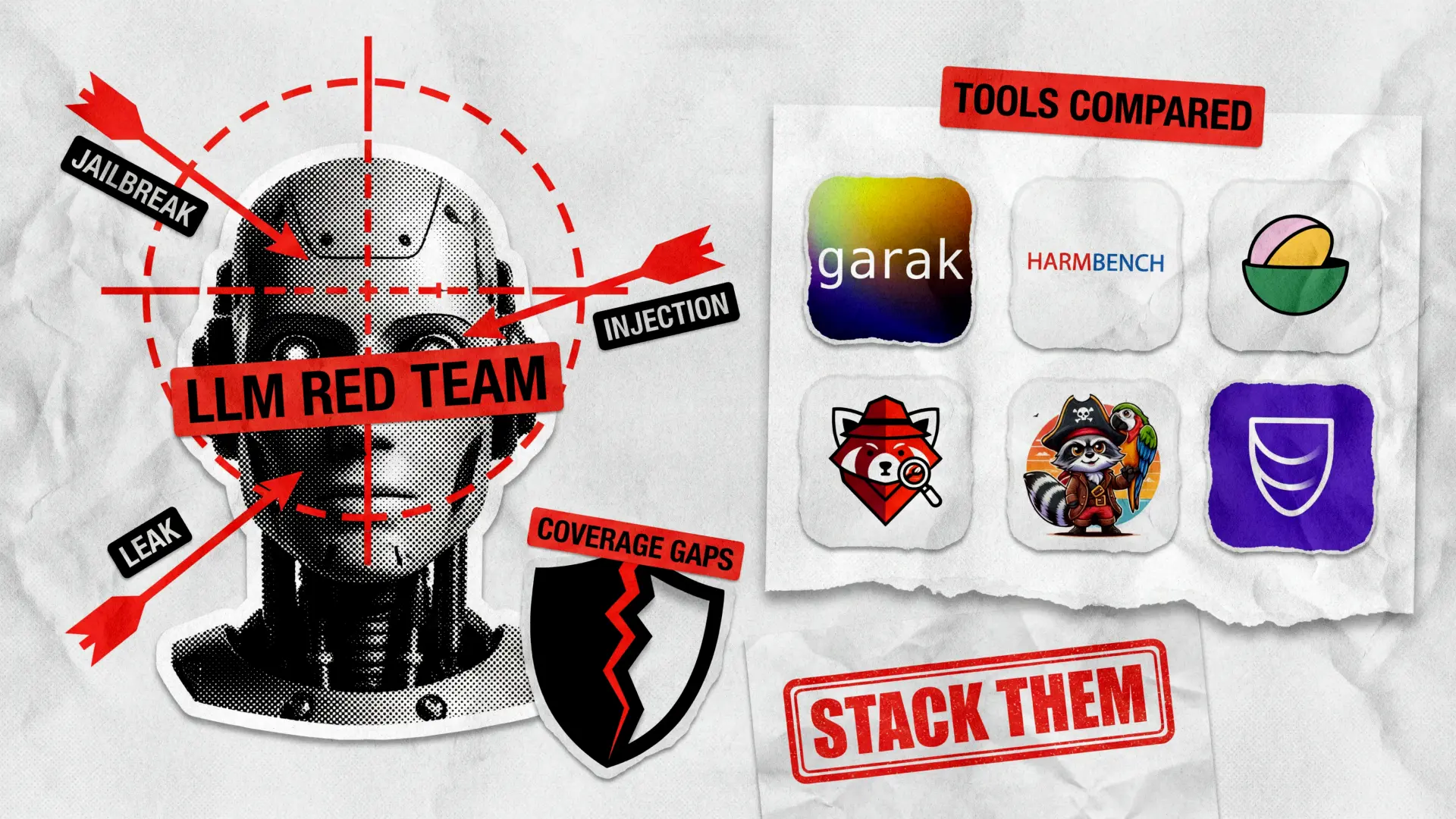
In this article, we break down six widely used LLM red teaming tools: what each genuinely catches, where each falls short, and how to combine them into a workflow that actually closes the loop.
What LLM Red Teaming Actually Tests
Red teaming LLM applications is fundamentally different from testing traditional software. There is no deterministic output to assert against, because failure modes are probabilistic, context-dependent, and often invisible until a real user triggers them. OWASP’s LLM Top 10 maps the threat landscape into six categories that any mature red-teaming program should cover.
- Prompt Injection and Jailbreaks.
Attacker-crafted input that overrides system instructions, either directly or indirectly through content embedded in retrieved documents. OWASP ranks this as the number one LLM vulnerability class. - Harmful Content Generation.
Toxic, violent, or harmful responses produced under adversarially framed prompts, including jailbreaks disguised as fiction or roleplay. - Data Leakage and PII Exposure.
System prompt contents, training data memorization, user data from prior sessions, or sensitive material embedded in the context window. - Hallucination and Factual Drift.
Confidently stating false information is embarrassing in a chatbot and a genuine liability issue in healthcare or legal applications. - Bias and Fairness Failures. Inconsistent or discriminatory outputs across semantically identical prompts with different demographic framing, visible at scale.
- Agentic and Tool-Use Attacks.
When an LLM controls tools, APIs, or code execution, attackers redirect it into harmful actions rather than harmful statements. Our article on the hidden risks of AI agents covers this in more depth.
The hardest part is that none of these failure modes is static. For example, a jailbreak that works today may stop working after a model update, and an attack vector invisible to English-only probing may be wide open in another language. That is why a single tool, or a single testing pass, is never enough.
LLM Red Teaming Tools at a Glance
If you are in a hurry, a quick glance at the table below will give you a general idea of which LLM red teaming tools are top right now and what they can do. To gain a deeper understanding of each tool’s strengths and weaknesses, please review its individual description.
And if you want to know how we perform assessments, check out our guide to testing AI-powered chatbots, copilots, and recommender systems.
Garak
Offensive framework
Yes
Pre-deployment audits, security engineering
Partial
PyRIT
Offensive framework
Yes
Multi-turn attacks, conversational AI testing
Partial
Promptfoo
Eval + red team
Yes
Regression testing in release pipelines
Strong
LLM Guard
Runtime defense
Yes
Production scanning, PII protection
Strong
Guardrails AI
Output validation
Yes
Policy enforcement, output schema validation
Strong
HarmBench
Research benchmark
Yes
Comparing attack methods (research only)
N/A
LLM Red Teaming Tools Compared Honestly
We’ve organized this list by priority, from what QAwerk’s experts consider the most effective and comprehensive tool today to the more specialized solutions with fewer capabilities. Please bear in mind that all these tools are outstanding in some areas and weaker in others. Therefore, a comprehensive automated testing strategy always requires implementing several solutions to cover as much ground as possible.
Garak
Garak, short for Generative AI Red-teaming and Assessment Kit, is NVIDIA’s open-source LLM vulnerability scanner. Garak LLM red teaming tool is currently the most widely cited in security research. Think of it as a penetration testing framework purpose-built for language models, with three core components: generators (interface with the target), probes (craft and send adversarial prompts), and detectors (evaluate whether responses are failures).
Garak covers DAN-style jailbreaks, prompt injection, encoding-based attacks (base64, ROT13, Unicode homoglyphs, invisible characters), GCG adversarial suffix attacks, glitch tokens, and multiple harmful content categories. Its Buffs system layers transformations onto any probe, including paraphrasing, encoding, and translation, thereby multiplying coverage without writing new probes. It also supports local models via Hugging Face and Ollama, not just cloud APIs.
That said, remember that probes are static, so novel attack techniques that postdate the library won’t be caught unless you write them yourself. Most probes are single-turn, leaving multi-turn and crescendo attacks uncovered. Output is detailed JSONL: thorough, but hard to parse without a security engineering background.
- Widest probe library of any open-source LLM red teaming tool
- Encoding and obfuscation attack coverage that most tools skip entirely
- Extensible probe architecture for custom threat models
- Works against local and API-hosted models alike
- Free and open-source
- Static probes miss novel attack patterns
- Single-turn focus leaves multi-turn vectors uncovered
- No built-in dashboard or triage workflow
- Requires Python proficiency and real setup investment
PyRIT (Python Risk Identification Toolkit)

PyRIT is Microsoft’s open-source framework for red teaming AI systems, released by their AI Red Team in early 2024. While Garak uses a static probe library, PyRIT uses an orchestrator LLM that acts as an attacker, dynamically generating and refining adversarial prompts based on the target model’s live responses.
PyRIT’s signature capability is multi-turn conversational attack simulation: crescendo attacks that gradually escalate toward harmful territory across several exchanges, adapting to each response. Microsoft’s own research demonstrated it surfacing novel attack patterns across major commercial models that standard evaluation had not found. Converter chains add obfuscation and evasion testing on top.
However, running two models per session makes comprehensive campaigns expensive fast. Bias and fairness testing are minimal, and output is less structured than Garak, so results take real effort to turn into actionable findings.
- Best-in-class multi-turn and crescendo attack simulation
- Dynamically generated prompts discover patterns that no static library finds
- Converter chains for obfuscation and evasion testing
- Strong for RAG and conversational application architectures
- Actively maintained by Microsoft’s AI Red Team
- API costs scale with attack depth and get expensive for comprehensive campaigns
- Minimal bias and fairness coverage
- Less structured output than garak
- Requires LLM API access for the attacker model
Promptfoo (Red Team Mode)

Promptfoo started as a prompt evaluation framework and has grown into a credible option for CI/CD-integrated red teaming, oriented around developer workflow integration rather than deep security research.
Its YAML-based configuration means developers, not just security engineers, can run red team checks as part of pull request workflows. It supports jailbreak testing, PII leakage detection, prompt injection, and hallucination scoring against custom output policies. An OWASP Agentic preset (ASI01-ASI10) adds compliance-oriented reporting.
However, the coverage stays shallow compared to dedicated offensive tools. It functions more as a safety regression harness than as a deep adversarial platform. Encoding attacks, sophisticated multi-step jailbreaks, and agentic tool-use scenarios are largely outside its scope.
- Native CI/CD integration with red teaming built into pull request workflows
- Low barrier to entry for non-security engineers
- Policy-driven test generation that maps to real product requirements
- OWASP preset for structured compliance reporting
- Open-source and actively maintained
- Shallow coverage across most individual threat categories
- No multi-turn attack simulation
- Limited encoding and obfuscation probe support
- Not designed for deep adversarial research
LLM Guard
LLM Guard, maintained by Protect AI, is a real-time input and output scanning library. It is a defensive layer, not an offensive red teaming tool. It appears on enough LLM red teaming tools lists that it is worth placing accurately, so teams do not mistake it for a substitute for offensive testing.
It’s great at catching PII detection and redaction, prompt injection pattern matching against known signatures, and toxicity scoring on both inputs and outputs. Output scanners, including relevance checks, factual-consistency scoring, and anomaly detection, help catch hallucinations as they occur in production.
Bear in mind that LLM Guard is defensive by design. Therefore, novel jailbreaks that bypass its classifiers pass through undetected until the library updates. Without prior offensive red teaming, you are defending against threats you have not mapped yet.
- Strong PII detection and redaction out of the box
- Real-time prompt injection pattern matching
- Output quality and consistency scanning
- Easy integration via Python wrapping
- Open-source
- Purely defensive with no attack generation capability
- Classifier-dependent coverage misses novel patterns
- Adds API call latency in production
- Not designed for bulk pre-deployment test runs
Guardrails AI

Guardrails AI adds structured validators and output contracts to LLM responses. Like LLM Guard, it is defensive, but the focus is on semantic and structural validation rather than security-specific scanning.
It’s good for catching output schema enforcement, factual grounding checks, and custom validation logic. The validator library covers toxic language, competitor mentions, off-topic responses, reading level, and more. It is extensible, so teams can write validators that reflect their actual product requirements.
It enforces rules you have already defined, but teams that rely on it without prior offensive red teaming are building guardrails around a threat surface they have not fully explored. No mechanism exists to surface novel attack vectors.
- Strong output schema and custom policy enforcement
- Extensible validator architecture
- Composable, developer-friendly API
- Effective production enforcement layer after red teaming
- Open-source with an active validator library
- No offensive capability, enforces known rules, and does not discover unknown risks
- Complements red teaming findings but does not replace them
- Coverage is only as good as what you define upfront
A Note on HarmBench
HarmBench is a standardized evaluation benchmark from UC Santa Barbara for comparing red teaming methods against each other, not a tool for testing your own application. If you are a researcher measuring how attack strategies perform across models, it is invaluable. However, if you are a product team preparing for deployment, it does not affect your workflow. Simply put, it’s a measuring tape, not a screwdriver.
Coverage Comparison: What Each Tool Catches
In the table below, ‘Strong’ means purpose-built for that category and performs reliably. ‘Partial’ means the category is addressed with known limitations. ‘Weak’ means the tool does not meaningfully cover this area.
Single-turn jailbreaks
Strong
Strong
Partial
Partial
Weak
Multi-turn / crescendo attacks
Weak
Strong
Weak
Weak
Weak
Direct prompt injection
Strong
Strong
Strong
Strong
Weak
Indirect prompt injection (RAG)
Weak
Partial
Weak
Weak
Weak
PII leakage detection
Partial
Partial
Partial
Strong
Partial
Harmful content/toxicity
Strong
Strong
Partial
Strong
Partial
Encoding/obfuscation attacks
Strong
Partial
Weak
Weak
Weak
Glitch tokens / adversarial suffixes
Strong
Weak
Weak
Weak
Weak
Hallucination / factual grounding
Weak
Weak
Partial
Partial
Strong
Bias and fairness testing
Partial
Weak
Weak
Weak
Weak
Agentic / tool-use attacks
Weak
Partial
Partial
Weak
Weak
CI/CD pipeline integration
Partial
Partial
Strong
Strong
Strong
Custom policy enforcement
Strong
Partial
Strong
Partial
Strong
As you can see, no single tool covers the full surface. Every ‘Weak’ in the table is a gap an attacker can walk through. The combination that comes closest to comprehensive coverage is Garak plus PyRIT for offensive testing, Promptfoo for ongoing regression in CI/CD, and LLM Guard or Guardrails AI as the production defense layer.
The Gaps No Current LLM Red Teaming Tool Covers Well
It’s crucial to understand that some gaps in the table reflect tool immaturity, while others reflect attack surfaces that the entire ecosystem is still catching up to.
- Multi-Turn Context Manipulation at Scale.
PyRIT handles it, but comprehensive crescendo campaigns are expensive and slow. Most red teaming of LLM applications still happens in single-turn mode, which is not how real attackers operate. - Agentic System Attacks.
The OWASP Top 10 for Agentic Applications, published in December 2025, codifies this threat landscape. None of the LLM red teaming tools above were designed with agentic threat models as the primary use case, which is the largest current gap. - Indirect Prompt Injection via RAG Retrieval.
Instructions embedded inside retrieved documents bypass the system prompt entirely. If your product uses retrieval-augmented generation, this gap is worth taking seriously and worth pairing with RAG evaluation tools that test the retrieval layer separately. - Multilingual and Cross-Lingual Attacks.
Safety training skews heavily toward English. Attacks in low-resource languages and code-switching prompts consistently outperform English jailbreaks. Most tools default to English only. - Long-Context Attacks.
As context windows reach 128K tokens and beyond, attacks buried deep in long documents become harder for both models and tooling to catch. Static probe libraries built around short prompts do not replicate this vector.
In addition, you should get some fundamental understanding of output quality evaluation. To help with that, check out our breakdown of LLM evaluation metrics, which covers the ten measures that matter before release.
How to Build a Red Teaming Stack That Works
The right approach is not to pick one tool. Layer them by threat surface and cadence. Here’s the structure that QAwerk’s experts advocate:
- Layer 1: Broad scan (nightly or per release).
Garak, with its full probe suite, covers jailbreaks, encoding attacks, prompt injection, and harmful content categories. It is fast, systematic, and archives results in JSONL for regression comparison. - Layer 2: Compliance and regression scan (per PR or weekly).
Promptfoo with defined output policies and the OWASP preset catches known-bad behaviors and generates reports that non-technical stakeholders can read. - Layer 3: Deep exploitation (bi-weekly or during security sprints).
PyRIT multi-turn campaigns target crescendo attacks and context manipulation, reaching the vulnerabilities that static probes cannot. - Layer 4: Production defense.
LLM Guard handles runtime PII scanning and prompt injection filtering. Guardrails AI enforces output policies. These tools enforce what offensive testing discovered, not the other way around. - Layer 5: Expert manual testing (quarterly or before major releases).
Automated LLM red teaming tools hit roughly 69.5% success in controlled studies. The remaining 30%, covering business-logic attacks, social engineering chains, and novel vectors, requires human red teamers with domain expertise.
The teams that ship reliable LLM applications treat red teaming as a continuous practice, not a launch checkbox. Every bad production response is a candidate test case. The loop from ‘that response was wrong’ to ‘that failure is now a test case’ is what separates teams that improve from teams that patch.
When Do You Need More Than LLM Red Teaming Tools?
Tools are half the equation, but knowing which probes fit your threat model, how to interpret Garak’s output, and how to design PyRIT campaigns for your specific architecture is the other half.
If your team is shipping an LLM-powered product without a structured red team exercise, QAwerk’s AI testing service covers adversarial testing, safety evaluation, and structured red teaming for LLM applications. We have helped teams build testing frameworks for chatbots, copilots, and RAG-based products. We are ready to help ensure your product is ready to ship and wow your customers.
You know where to find us, so let’s talk today.
FAQ
What is LLM red teaming?
LLM red teaming is the practice of systematically probing a large language model or LLM-powered application for vulnerabilities before and during deployment. It covers prompt injection, jailbreaks, harmful content, data leakage, bias, and agentic attack vectors. Unlike traditional software testing, red teaming LLM applications deals with probabilistic, non-deterministic outputs and a threat surface that evolves as models update.
What is the best open-source LLM red teaming tool?
For offensive security coverage, Garak is the most comprehensive open-source option, with the widest probe library, strong coverage of encoding attacks, and a fully extensible architecture. For multi-turn and conversational attack simulation, PyRIT is stronger. Most mature red teaming programs use both.
What is the Garak LLM red teaming tool?
Garak (Generative AI Red-teaming and Assessment Kit) is NVIDIA’s open-source framework for probing and assessing the security of language models. Its generator-probe-detector architecture supports dozens of vulnerability categories: DAN jailbreaks, encoding attacks, prompt injection, glitch tokens, and harmful content. It is the LLM equivalent of a penetration testing framework.
Can you use multiple LLM red teaming tools together?
Yes, and you should. Garak handles static, broad-coverage probing, while PyRIT handles dynamic, multi-turn exploitation. Promptfoo adds CI/CD regression testing. LLM Guard and Guardrails AI complete the production defense layer. No single tool covers the full attack surface.
What attacks do current LLM red teaming tools miss?
The main gaps are multi-turn context manipulation at scale, agentic tool-use attacks, indirect prompt injection via RAG retrieval, multilingual and cross-lingual attacks, and long-context attacks buried in large documents. Closing these requires specialized tooling, non-standard testing approaches, or expert manual red teaming.
How often should you red team an LLM application?
Before initial deployment, after any major model update or fine-tuning change, and after architectural changes like adding tools or retrieval systems. Automated regression testing with Garak and Promptfoo should run continuously in the CI/CD pipeline. Manual expert testing is worth scheduling quarterly for high-stakes applications.
See how we helped an AI matchmaking app stabilize every flow and scale nationwide