Let’s imagine that you ship an AI product that nails every demo. Your team runs it through its paces before launch, and the outputs look sharp, so you ship with confidence. However, two weeks later, a customer sends you a screenshot of a response that is factually wrong, confidently stated, and completely at odds with what the same product said the day before. That could be a serious blow to your reputation, and you absolutely cannot afford to lose customer trust.
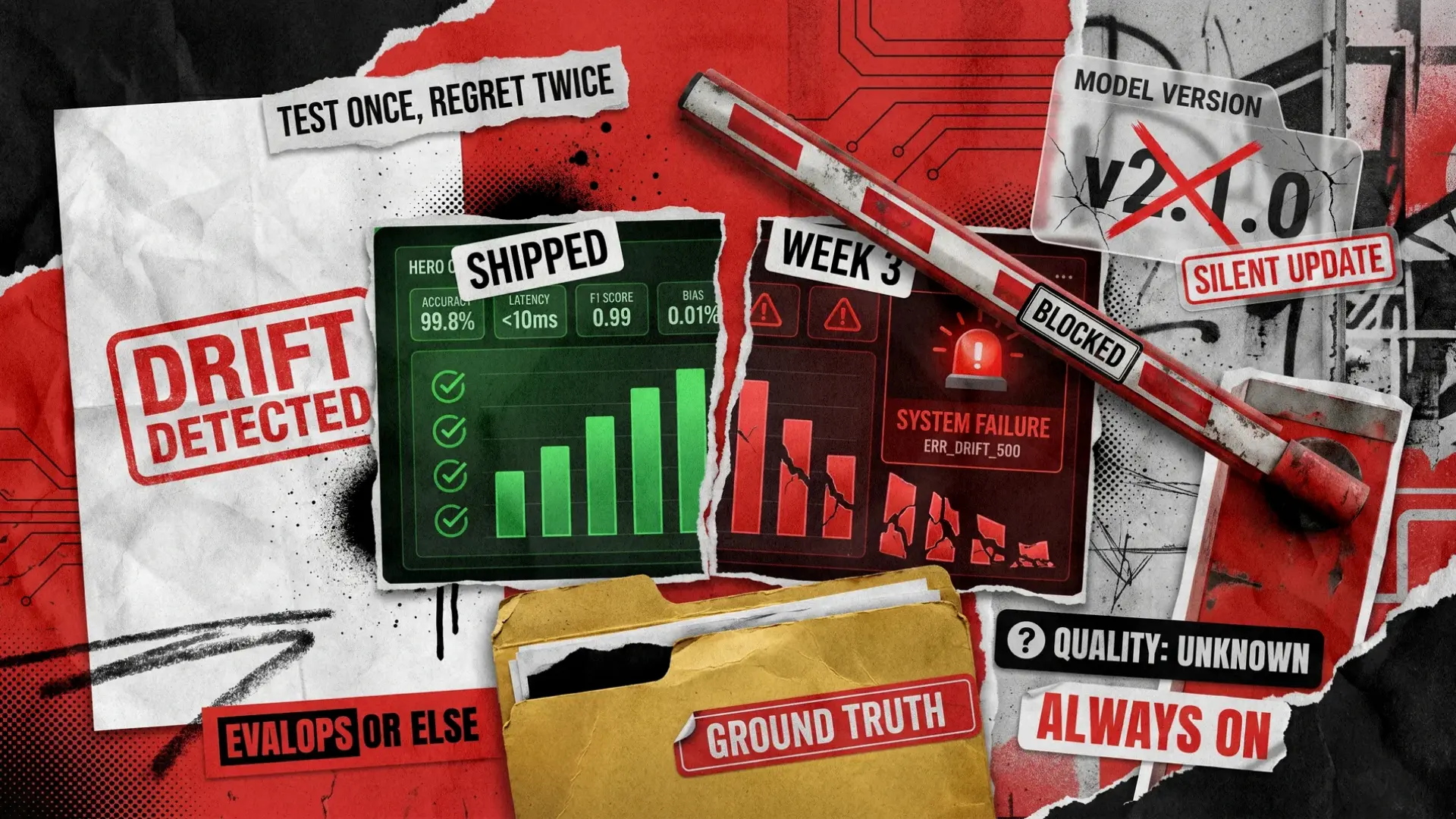
Now, your engineers dig into the codebase and find nothing wrong. The code did not change at all, but the model did, quietly, on the provider’s side. The worst of all is that there is no changelog entry that anyone would have known to look for.
This scenario plays out across AI product teams every day in 2025, and even thorough AI testing only takes you so far in preventing it. This is precisely why a new operational discipline called EvalOps is emerging fast among the teams building serious AI products.
In this article, QAwerk’s testing experts will explain what EvalOps is, why it has emerged now, and what it looks like when a team puts it into practice. If you have heard the term in a conference talk or a vendor pitch and wanted a plain-language explanation that does not assume you have a machine learning background, you are in the right place.
What Is EvalOps?
First, let’s define exactly what we’re talking about. To put it simply, EvalOps is the practice of treating AI output evaluation as a continuous, production-grade operational discipline rather than a pre-launch quality check you run once before go-live.
You could notice that the name follows a familiar pattern used by the software industry. DevOps transformed software deployment from a quarterly release event into a continuous, automated practice. MLOps did the same for machine learning model lifecycle management. EvalOps does the same for evaluating AI deployment and operations, turning something that used to be a one-time gate into an ongoing system that keeps running long after launch.
However, there’s one important clarification we should make early. You will encounter the term ‘EvalOps’ used both as a vendor product name and as the name of this broader operational discipline. This article is about a discipline that any team can adopt, regardless of the tools they choose to use.
The simplest way to understand EvalOps is by comparing it with traditional software quality assurance (QA). Conventional QA operates on a reassuring assumption: write the code, define the expected outputs, run the tests, and ship when the tests pass. It means that the same input will always produce the same output, so you can write a test suite once and trust it indefinitely. However, this assumption simply does not hold for AI products, and EvalOps is the discipline that fills the gap.
Why Traditional AI Testing Falls Short: The Case for EvalOps
EvalOps exists as a concept in 2025, not because AI products are new, but because traditional testing fundamentally breaks down when your product is built on a large language model (LLM). Also, this industry has only recently reached the scale at which that breakdown carries real business consequences.
According to McKinsey’s 2025 State of AI report, 88% of organizations now use AI in at least one business function. However, only 39% of them report enterprise-level financial impact from doing it. It means the gap between adoption and value is huge and it’s not primarily a problem of model quality. Instead, it’s often caused by inadequate operations and measurement, with evaluation right at the center.
The reason is that LLMs are non-deterministic by design. It means that the same prompt, submitted twice to the same model with the same configuration, can return two meaningfully different answers. That is not a bug but an architectural feature of how these systems generate text. However, it creates a testing problem that has no real precedent in conventional software development, because the rules your test suite was built on no longer apply.
Three specific failure modes make traditional QA insufficient for AI products, and each one is worth understanding on its own terms.
- Hallucinations
AI hallucinations are the most widely discussed failure mode. A model generates a confident, fluent, grammatically correct response that is factually wrong. It does not flag uncertainty or throw an error. The output looks perfectly fine and is wrong, and without a scoring system actively checking factual accuracy, that output reaches your users with nothing to stop it. - Drift
Model drift is quieter and often more damaging over time. LLM providers continually update their infrastructure, so your prompt that scored well in March may score quite differently in July because the underlying model has been updated, retrained on new data, or otherwise changed. Without a system actively monitoring output quality over time, you will not know this is happening until a user tells you. - Context Sensitivity
This one means output quality is deeply dependent on factors your pre-launch test suite never covered. These could include the specific phrasing a real user chooses, the conversation history that precedes the query, the documents retrieved from your database, or the edge cases that only appear at full production traffic volume. A test suite that passes 200 carefully curated examples before launch gives you very limited confidence about the behavior your actual users will encounter in the wild.
For teams building autonomous or multi-step AI workflows, the hidden risks of deploying AI agents deserve particular attention, because in such architectures, failures tend to cascade rather than fail cleanly and visibly.
The analogy that captures this most clearly is the one that gave us DevOps in the first place. DevOps emerged because ‘deploy once and maintain’ did not work for software at scale. EvalOps emerges for exactly the same reason: because ‘test once and ship’ does not work for AI at scale either.

EvalOps vs LLMOps: What Is the Difference?
You will often see EvalOps discussed alongside LLMOps, and the two are genuinely related, but they are not the same thing, and the difference matters.
- What is LLMOps?
LLMOps is the evaluation process that covers the entire operational lifecycle of an LLM-based product, including model selection, prompt engineering and versioning, deployment infrastructure, cost management, latency optimization, and production monitoring. You can think of it as the full operating system for running an AI product in production. - How is EvalOps different from LLMOps?
EvalOps is a discipline within LLMOps that specifically owns the evaluation layer. Therefore, if LLMOps is the factory, then EvalOps is the quality-control floor. LLMOps asks whether the system is running. Meanwhile, EvalOps asks whether what the system produces is actually any good.
If you need a more tangible way to make the distinctions, consider this:
- LLMOps covers: deployment, infrastructure, versioning, cost, and system health.
- EvalOps covers: output quality scoring, hallucination detection, drift tracking, quality gates in the release pipeline, and the ongoing measurement of whether your AI product is doing what it is supposed to do.
Most teams that have invested seriously in LLMOps have strong deployment and monitoring infrastructure in place. A surprising number of them have a significant gap in the evaluation layer, because evaluation requires the most domain judgment and has the least obvious off-the-shelf solution. EvalOps is the discipline that addresses that gap.
How to Implement EvalOps: Four Components of a Production Evaluation Pipeline
Once you understand the EvalOps concept, the practical question becomes what a team actually needs to build and run day-to-day. There are four operational components that together make up a functional EvalOps practice, and each one builds on the last.
LLM Evaluation Pipelines
Again, let’s start by defining that an evaluation pipeline is an automated, repeatable test harness that:
- Runs your AI product against a curated dataset of prompts and expected outputs
- Scores the results against defined quality rubrics
- Flags regressions before they ever reach production
To put it simply, this is the foundation on which everything else rests. The word ‘automated’ is doing a lot of work in that description. Manual review simply does not scale once you are shipping updates regularly. In fact, any evaluation practice that depends on human review for every output will collapse under its own weight.
In addition, teams building on retrieval-augmented architectures (RAGs) face an extra layer of complexity. It’s because both the quality of what is retrieved and the quality of what is generated must be evaluated, often independently. You can explore the tooling landscape for this kind of setup through our overview of RAG evaluation tools. Remember that a well-structured pipeline runs on every significant code change, produces a score, and gives your team a clear signal before anything ships.
The dataset that feeds this pipeline, often called a ‘golden dataset’, is a curated collection of representative inputs paired with validated expected outputs. It’s true that building and maintaining it takes real effort, but it is the single most important investment an AI product team can make in their evaluation infrastructure.
LLM-as-a-Judge
Human review is valuable, but does not scale to the volume of outputs a production AI system generates, sometimes thousands or millions of responses per day. The practice that has emerged to bridge this gap is to use a secondary language model to assess the outputs of the primary system, a technique the industry has settled on calling LLM-as-a-judge.
In practice, a second model is given a rubric and asked to evaluate a response for factual accuracy, relevance to the question, instruction-following, and tone consistency. It returns a score and, in the better implementations, a plain-language explanation for that score. This is not a replacement for human review but a force multiplier. This approach allows your team to apply human judgment specifically to the edge cases and failure patterns that automated scoring surfaces, rather than manually reviewing every single output. Understanding how to build systematic rubrics for this is directly connected to how AI chatbot response quality assessment works in practice.
AI Quality Gates in CI/CD
This is where EvalOps stops being a concept and becomes a discipline with real operational teeth. Quality gates mean that evaluation scores become deployment conditions. Therefore, if your hallucination rate on the ‘golden dataset’ exceeds a threshold your team has agreed on, the release is blocked automatically. It works the same way a failed unit test blocks a code merge.
Making this work requires your team to agree on what scores are acceptable, which requires the harder upstream work of defining what quality actually means for your specific product. For example, a legal research tool has very different thresholds than a creative writing assistant, and no tool can make that call for you. However, once you have made it, you have turned evaluation from a retrospective audit into a forward-looking quality gate. That is a fundamentally different posture.
Teams working through the trade-offs between manual and automated testing for AI agents often find that the combination works best at this stage.
- Automated gates catch measurable regressions
- Periodic manual review catches subtler quality shifts that scoring metrics alone miss
Among the methods for AI evaluation available to product teams, deterministic checks work well for structured outputs and format compliance. Meanwhile, LLM-as-a-judge works better for semantic quality and nuanced correctness. The most robust pipelines use both.
LLM Drift Detection in Production
Drift detection is the production monitoring layer that tracks output quality over time, not just at the moment of a release. It catches what quality gates cannot, such as:
- Gradual degradation that occurs after a model provider silently updates their infrastructure
- Changes that occur after your user base grows and introduces new input patterns
- Output deviations that appear after your retrieval data becomes stale
To visualise the impact of this, let’s consider a fintech team that ships an AI product that passes all pre-launch evaluations with strong scores. However, six weeks later, users start reporting that summaries are less accurate than they remember. The team didn’t make any code changes, so the issue isn’t on their side. Meanwhile, the provider had released an update to their base model. If you don’t have a drift detection system continuously sampling production outputs and comparing them against a quality baseline, that regression is completely invisible until customers surface it.
Sadly, at that point, it is already a trust problem rather than an engineering task. Research into the LLM application lifecycle shows that without continuous monitoring, output accuracy can degrade significantly within weeks. Teams often have no visibility into the decline until it becomes a customer experience issue.
Which AI Products Need EvalOps?
Not every AI product requires the same level of EvalOps maturity from day one, and that is fine. Useful questions to ask when deciding if your own product falls into that category are:
- Does your product generate open-ended natural language outputs?
- Does it make decisions that affect users?
- Does it operate in any domain where accuracy and trust matter?
If your answer to any of those is ‘yes’, you need some form of EvalOps from the first production deployment, not after the first incident.
Three categories of AI products face the most direct business risk due to a lack of evaluation infrastructure:
- Customer-facing AI products, including chatbots, copilots, and recommender systems, expose users to degraded outputs the moment quality slips, with no internal buffer between the failure and the customer.
- Internal AI tools where errors affect business decisions, such as financial analysis, or operational workflows tools. These create a risk, because a plausible-sounding wrong answer can travel deep into a business process before anyone catches it.
- Tools for regulated or trust-sensitive environments, including healthcare, legal, financial, and compliance-adjacent products. They face the added reality that output quality is not just a product-quality issue but also a potential liability.
If you are building or operating any of these, check out our guide to testing chatbots, copilots, and recommender systems. It’s a practical starting point that maps directly to the evaluation layer that EvalOps formalizes.
You definitely should start small when it comes to EvalOps, as the tooling landscape can feel overwhelming. If you are a team of five, you don’t need an enterprise evaluation platform from week one. What you need is a ‘golden dataset’, a scoring rubric that defines what good looks like for their specific product, and a shared team agreement that no changes that degrade evaluation scores get shipped. That is EvalOps in its minimum viable form, and it is meaningfully better than shipping on instinct alone.
EvalOps and the Future of AI Testing
The core shift EvalOps represents is not so much about technology and testing methods but about how you integrate AI QA into your operations and workflow. Evaluation moves from a launch gate to a continuous system, quality measurement moves from an occasional manual review to an automated and scored discipline that runs all the time, and the question the team asks changes from ‘did it pass the test?’ to ‘what is our quality score today, and is it trending in the right direction?’
Let’s be true, if you are building AI products in 2025, that shift is not optional at any serious scale. As the McKinsey State of AI report makes clear, the organizations pulling measurable value from AI are the ones that have redesigned their workflows around it, not the ones that have bolted AI features onto existing processes and hoped for the best. Therefore, building evaluation infrastructure is the part of that redesign that most teams have not yet gotten to, and it is the gap that catches up with them in production.
That is the gap EvalOps fills, and it is exactly the kind of work that belongs in a QA practice that has evolved to meet the actual requirements of AI products.
If you are shipping an AI product and are not yet sure how your evaluation layer is set up, that is the conversation worth having sooner rather than later. QAwerk’s AI testing team builds and runs EvalOps pipelines: designing the rubrics, standing up the evaluation infrastructure, and running the ongoing quality measurement, so your team can stay focused on building. If you’re ready to ensure your AI product remains top-quality, give us a call.
Check out how we helped an AI digital growth tool boost regression testing speed by 50%.